
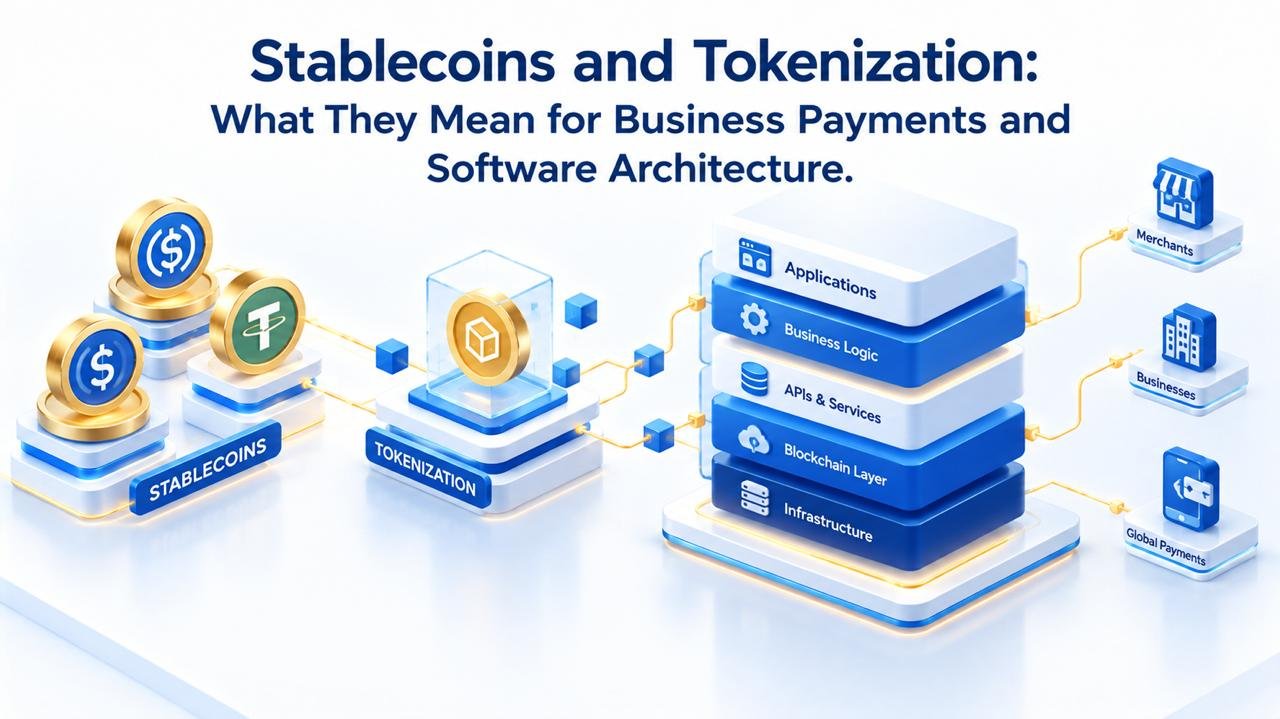
TL;DR: Stablecoins move value on digital ledgers at a steady price, and tokenization turns real assets into programmable tokens; together they offer faster settlement but demand new integration and compliance design.
Cross-border payments still take days and pass through several intermediaries. Each hop adds fees, and each cut-off time delays settlement. Stablecoins and tokenization aim to remove those frictions by moving value on shared digital ledgers.
Businesses now ask a practical question: should our payment stack support them? In this article, we explain what these technologies are and where they fit. We also show what they change in your software architecture.
What Stablecoins Are
A stablecoin is a digital token designed to hold a steady value, usually one unit of a national currency. Issuers back the token with reserves such as cash and short-term government securities. A holder can send the token to anyone on the network within minutes at any hour.
Stablecoins do not all carry the same risk. Reserve quality, redemption rights, and regulatory status differ between issuers, so treat issuer due diligence as a core requirement.
What Tokenization Means
Tokenization represents a real-world asset, such as a bond or an invoice, as a token on a ledger. The token carries rules in code: who can hold it, when it settles, and how it pays out.
The two technologies work well together. A tokenized bond can settle against a stablecoin payment in a single transaction, which removes the delay between delivery and payment.
Where These Technologies Help Business Payments
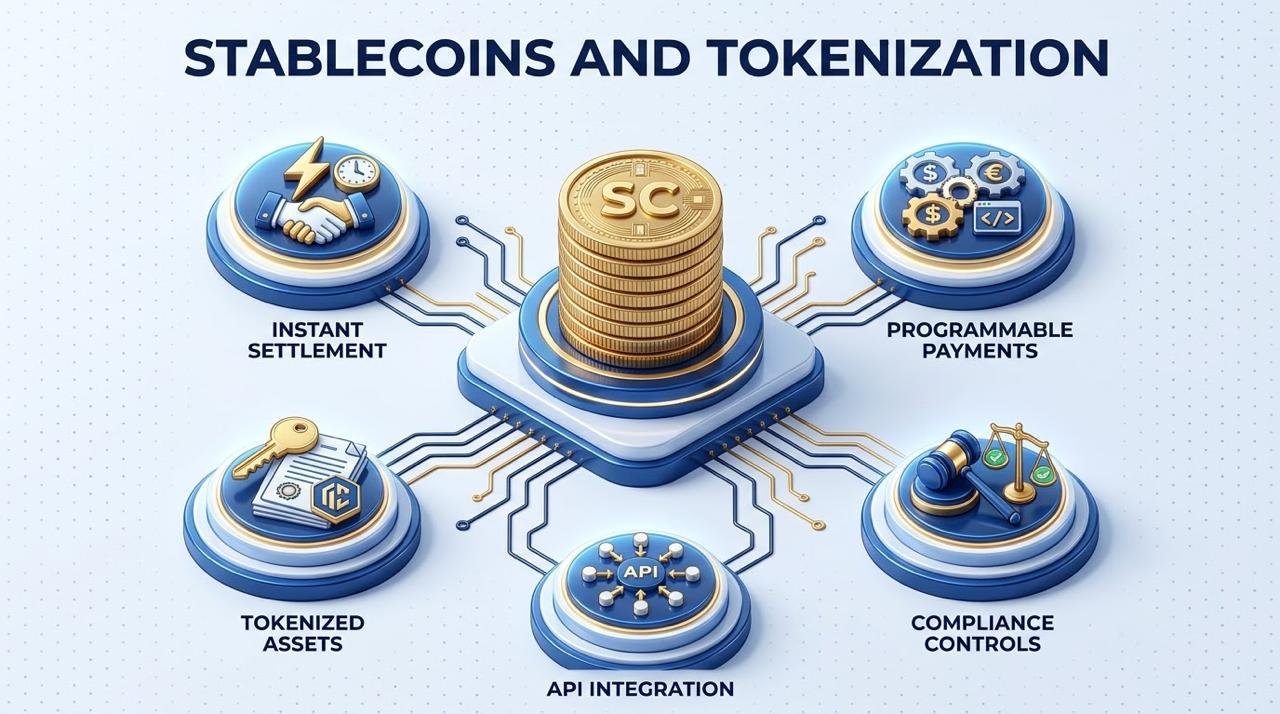
- Cross-border payments: settlement takes minutes rather than days, and fees often fall because fewer intermediaries take a cut.
- Treasury operations: companies move funds between entities and regions outside banking hours.
- Supplier and contractor payouts: businesses pay recipients in markets with weak banking access.
- Programmable payments: code releases funds when agreed conditions hold, such as a confirmed delivery.
- Tokenized assets: firms trade and settle assets faster and keep clearer ownership records.
Adoption remains uneven. Regulation, liquidity, and customer readiness differ by market, so pilot in a corridor where the benefit is clear.
What Changes in Your Software Architecture
A stablecoin payment does not follow the same path as a card or bank transfer. Your system must handle a new set of components.
- Wallet and key management: someone must hold the private keys. Options range from third-party custody to your own infrastructure, and each carries different risk.
- Blockchain connectivity: your software reads and writes to one or more networks through node providers or APIs, and it must handle congestion and confirmation delays.
- Reconciliation: on-chain records must match your internal ledger and your bank accounts, including the on-ramp and off-ramp steps where customers convert between local currency and tokens.
- Event-driven design: confirmations arrive asynchronously, so your services should react to events instead of waiting on a response.
- Smart contract integration: programmable features need audited contracts and a clear upgrade plan.
We recommend an abstraction layer between your core payments logic and any single network or provider. That layer lets you add rails, swap providers, and adapt to regulation without rewriting your application. It fits naturally into enterprise software solutions and scales well on cloud services.
Risks and Controls
Security comes first. Lost keys mean lost funds, and attackers target wallets and bridges. Use hardware-backed key storage, multi-party approval, and strict access policies. Our cybersecurity services help teams put these controls in place.
Regulation varies widely. Stablecoin rules, licensing regimes, and reporting duties differ by country, and they are changing fast. Involve legal counsel early and build compliance checks, such as sanctions screening and transaction monitoring, into the payment flow.
Counterparty risk matters too. If an issuer fails to honour redemptions, holders can lose value. Limit the balance you hold in any one stablecoin, and convert to local currency promptly when you do not need to hold tokens.
Peg stability deserves a plan as well. Well-designed stablecoins hold their value under normal conditions, but stress events have pushed some tokens off their peg. Decide in advance how your system reacts.
A Practical Path to a Pilot
Start with one use case where cost or delay hurts today, such as paying overseas suppliers. Pick a regulated stablecoin and a custody partner, then build a limited pilot with clear success metrics: Settlement time, total cost per payment, and reconciliation effort.
Run the pilot in parallel with your existing rails. Compare results after a few months and decide whether to expand.
Thinking about adding stablecoin payments to your product? Our engineers can design the architecture and build the pilot with you. Talk to Innosaber about a pilot.
FAQ
How is a stablecoin different from Bitcoin?
A stablecoin aims to hold a steady value tied to an asset such as a national currency. The price of Bitcoin floats freely with market demand.
Is tokenization the same as blockchain?
No. Tokenization is the act of representing an asset digitally. Blockchain is one technology that can record and transfer those tokens.
Does a business need to hold crypto to use stablecoins?
Not always. Many providers convert local currency to stablecoins and back again, so your business can send and receive value without holding tokens on its balance sheet.
Are stablecoin payments legal?
Rules depend on the country and the type of activity. Consult legal counsel in each market before launch.
The Next Payment Rail Is Programmable. Is Your Architecture Ready?
Stablecoins and tokenization can make business payments faster and more transparent. They also change how your software handles keys, networks, ledgers and compliance.
The teams that benefit most start small. They pick one payment corridor, build an abstraction layer and measure settlement time and cost against their current rails.
We help businesses design payment architecture that adapts as the rules and the technology evolve. Contact Innosaber to start your pilot.
