
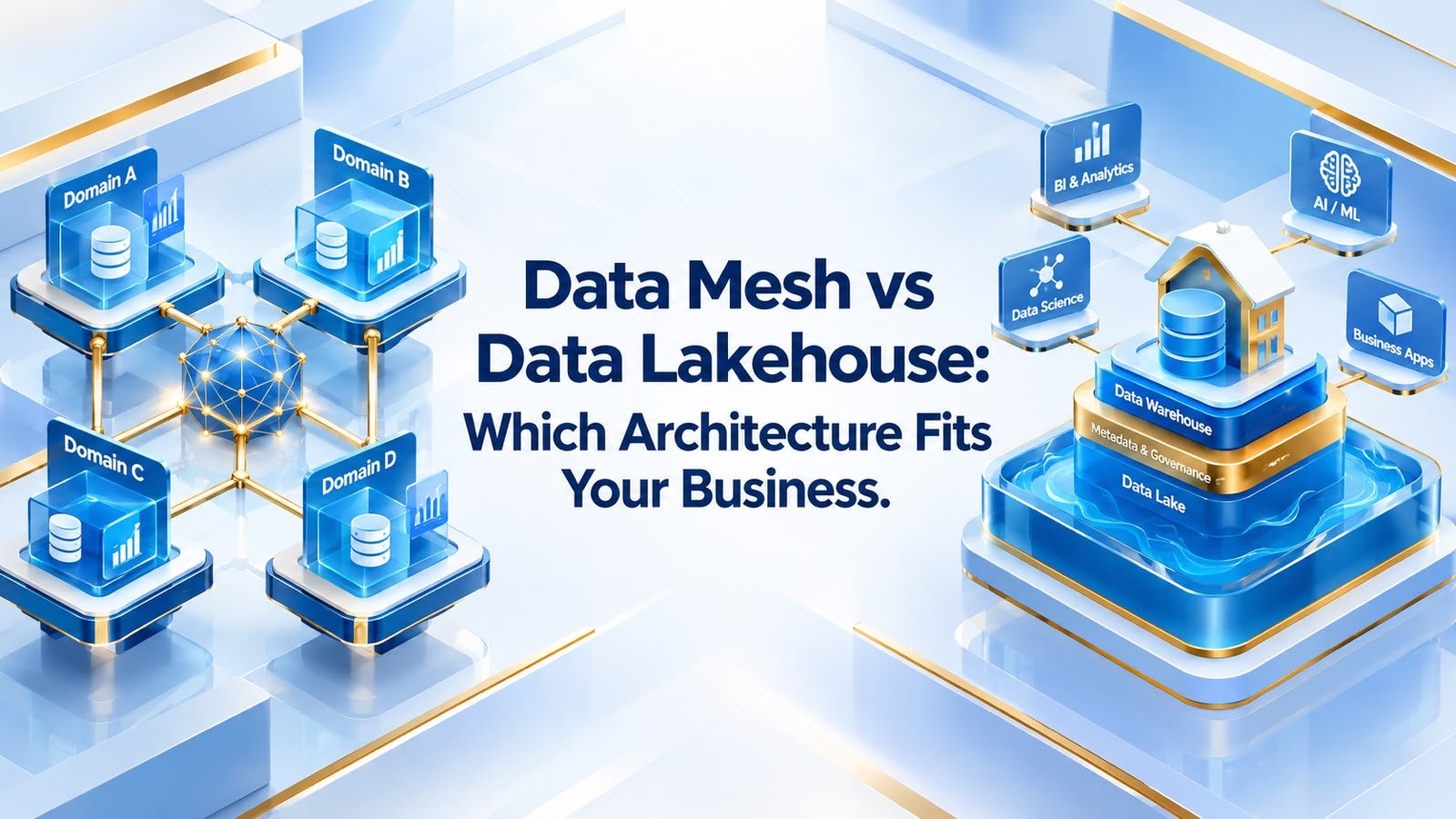
TL;DR: Most growing businesses should start with a data lakehouse. Move to a data mesh only when separate domain teams own large data sets and a central team can no longer keep up.
Your data keeps growing, and your reports keep slowing down. Sooner or later, someone on your team will suggest a new architecture, and two names will come up: data mesh and data lakehouse. Both promise cleaner data and faster answers. They solve different problems.
We build data platforms for growing businesses, and we see the same mistake often. Companies pick the fashionable option instead of the one that fits their team. This guide explains both architectures in plain terms and shows you how to choose.
What Is a Data Lakehouse?
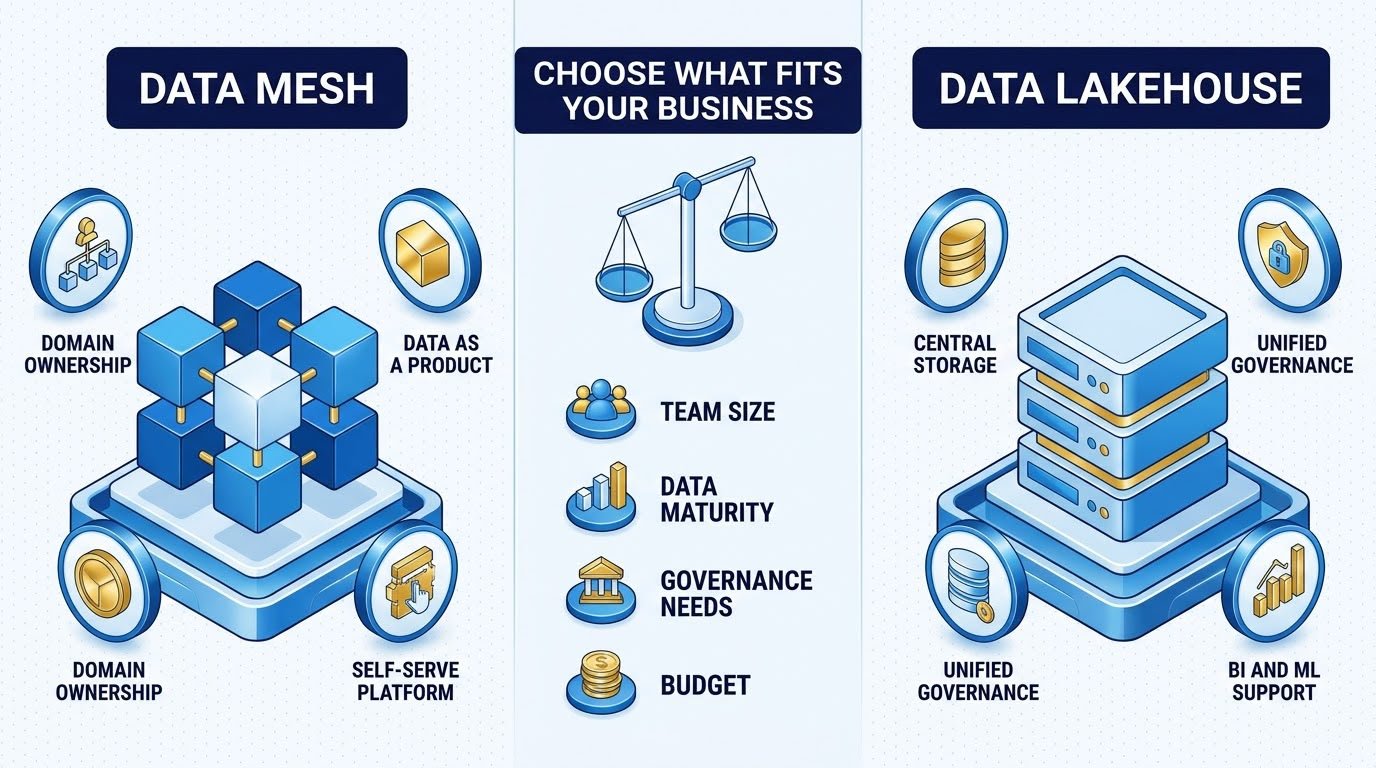
A data lakehouse stores all your data in one place on low-cost cloud storage. A management layer on top lets the same data feed dashboards and machine learning models. Before lakehouses, most companies ran a data lake for raw files and a separate warehouse for reports. They copied data between the two, and the copies drifted out of sync.
A lakehouse removes that split. Your analysts run SQL queries, and your data scientists train models against one governed copy. Open table formats such as Delta Lake and Apache Iceberg make this possible.
What Is a Data Mesh?
A data mesh is not a product or a tool. It is an operating model. Each business domain, such as sales or logistics, owns its data and publishes it as a product that other teams can use. A central platform team provides shared tooling, and a small governance group sets common rules.
The idea targets an organizational problem. In large companies, one central data team often becomes a queue. Every request waits for that team, and the people who understand the data best have no say over how the company handles it. A mesh moves ownership to those people.
Where a Lakehouse Fits Best
A lakehouse suits most growing businesses. You should lean toward it when:
- One central team can handle your data requests.
- You want reports and AI projects to run from the same data.
- You need strong governance without building a large program around it.
- Your budget favors one platform over many.
A retailer with one analytics team is a typical fit. It pulls sales and inventory data into one lakehouse and serves every dashboard and forecasting model from there.
Where a Data Mesh Fits Best
A mesh pays off at a larger scale. It works when:
- Several business units already run their own engineers and data stores.
- A central team has a backlog of months, and business units work around it.
- Each domain understands its own data better than any central team can.
- Leadership will fund a platform team and commit to shared standards.
A mesh also demands discipline. Without firm standards, each domain builds its own silo, and you end up with a bigger mess than you started with. Most mid-sized companies cannot afford that risk, and they do not have the staff to run it.
Four Questions That Decide It
- How many teams produce data? If the answer is one or two, choose the lakehouse.
- How long do data requests wait? If the queue is short, a central team still works.
- How mature is your governance? A mesh needs clear ownership rules from day one.
- What do you plan to build on the data? Reporting and AI projects run well on a lakehouse.
If you answered with a lakehouse three or four times, you have your direction. If the answers split, start with the lakehouse anyway. It costs less to change course from there.
Our Recommendation: Start With a Lakehouse and Borrow From the Mesh
We recommend the lakehouse for most businesses we work with. It gives you one governed platform, and it supports your AI initiatives from the first day. You can still borrow mesh ideas as you grow. Name an owner for each major data set and publish clear documentation for it. Then add quality standards that each owner must meet.
If your company later grows into several autonomous domains, you can move toward a full mesh without rebuilding. The lakehouse becomes the shared platform that the mesh needs anyway.
Not sure which path fits your team? Talk to our engineers about your data and your team size, and we will map the right architecture with you. You can also see how our custom software solutions connect to your data platform.
FAQ
Difference between a data mesh and a data lakehouse?
A lakehouse is a technology architecture that stores and serves data from one platform. A mesh is an organizational model that gives each business domain ownership of its own data. One answers where your data lives, and the other answers who owns it.
Can you combine a data mesh and a data lakehouse?
Yes. Many companies run a lakehouse as the shared platform and apply mesh principles on top. Domain teams own their data products, and the lakehouse stores and serves them.
Is a data mesh more expensive than a lakehouse?
Usually, yes. A mesh needs a platform team and trained staff in every domain, so the cost is more organizational than technical. A lakehouse concentrates cost in one platform and one team.
How long does it take to implement a data lakehouse?
Timelines vary, but a focused first phase often takes two to three months for a mid-sized business. That phase covers your core data sources and your first dashboards. You then add more sources over time.
Fit the Architecture to the Team, Not the Trend
A lakehouse gives most businesses a fast, governed route to analytics and AI. A mesh solves a scaling problem that only large, multi-team organizations face. Match the architecture to your team size and your data needs, and you avoid an expensive rebuild later.
We help businesses design and build data platforms that fit how they work. If you want a clear recommendation for your situation, contact our team today.
