
TL;DR: Green software engineering cuts cloud costs and carbon at the same time by tuning code, right-sizing infrastructure, and running flexible workloads when the grid is cleaner.
Cloud bills keep climbing, and so does the energy behind them. Data centers draw a growing share of global electricity, and every inefficient query and idle server adds to that load. We see the same pattern in nearly every environment we review. The waste hides in plain sight, and most of it costs little to fix.
Green software engineering gives teams a way to fix it. The discipline treats energy use as a design constraint, much like latency or security. In this article, we explain what it covers and where the biggest savings sit. We also show how you can start without rebuilding your stack.
What Green Software Engineering Actually Means
Green software engineering is the practice of building software that uses less energy and produces less carbon for the same output. The Green Software Foundation calls this goal carbon efficiency: you deliver the same business value with fewer emissions.
Performance and sustainability point in the same direction. A faster query uses less CPU time. A smaller payload uses less network energy. We rarely see a real trade-off between a quick system and a green one, so the work pays off twice.
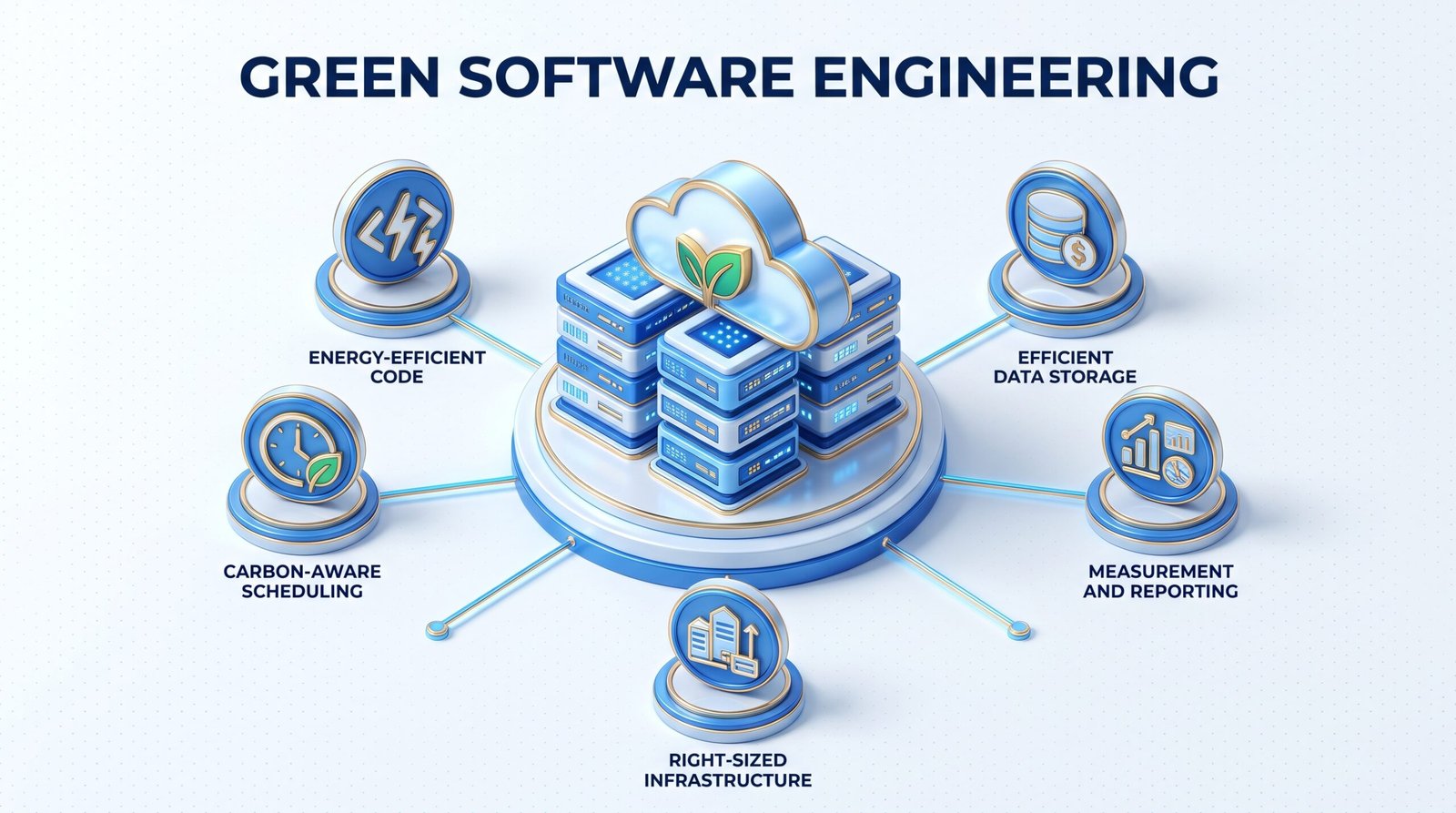
Five practices drive most of the results: efficient code, right-sized infrastructure, carbon-aware scheduling, lean data storage, and measurement. The sections below take each one in turn.
Start With Energy-Efficient Code
Efficient code is the cheapest place to begin. Slow algorithms and chatty APIs burn compute around the clock, and nobody notices because the system still works. We profile the busiest code paths first, since a small number of them account for most of the load.
A single unindexed database query that runs a million times a day can use more energy than an entire service that handles a few hundred requests. Fixing it takes an hour. Caching and batching cut repeated work, and lean data formats shrink every response that crosses the network.
We build these checks into code review so efficiency becomes a habit. Our custom software solutions team adds performance budgets to the pipeline, which flags a regression before it reaches production.
Right-Size Your Cloud Infrastructure
Most organizations overprovision. Teams reserve capacity for peak traffic and then leave it running at low utilization all month. Every idle instance still draws power, and it still appears on your invoice.
Right-sizing fixes this. We review utilization data and move steady workloads to smaller instance types. We turn on autoscaling for variable workloads. Containers and serverless platforms help too, because they pack more work onto each physical machine.
Our cloud services practice pairs this work with a cost review. Lower consumption shrinks the footprint and the bill at the same time, so finance and sustainability teams end up on the same side.
Run Workloads When and Where the Grid Is Cleaner
Electricity does not carry the same carbon cost at every hour. Grids lean on more renewable power when the sun shines or the wind blows. They lean on fossil peaker plants when demand spikes. Carbon-aware scheduling takes advantage of that gap.
Many batch jobs, such as nightly reports and model training, do not need a fixed start time. We schedule them for low-carbon windows or move them to regions with cleaner power. Latency-sensitive traffic stays close to your users.
Cloud providers publish regional carbon data, and open tools such as the Green Software Foundation’s Carbon Aware SDK read it for you. The change usually takes a scheduler tweak, not an architecture rewrite.
Treat Data and Storage as a Footprint
Data has a carbon cost from the moment you store it. Old logs and duplicate datasets keep spinning on disk long after anyone needs them. We set retention rules and move cold data to archive tiers, then delete what the business no longer uses.
AI workloads deserve extra attention. Training and inference consume large amounts of compute, so we choose smaller models wherever they meet the need. Our artificial intelligence services team tests whether a compact model delivers the accuracy a use case requires before anyone commits to a larger one.
Measure It or It Will Not Happen
You cannot reduce what you do not track. Start with the energy and carbon dashboards your cloud provider already exposes. Pair them with application metrics such as CPU time per request. Then set a baseline and pick one target per quarter.
The Software Carbon Intensity specification from the Green Software Foundation offers a standard way to score an application, so you can compare results over time. Report the score next to cost and uptime. Teams act on numbers they see every week.
Regulation adds pressure as well. Sustainability reporting rules in several markets now ask large companies to disclose their emissions, and cloud and software use feed directly into that figure. Early measurement makes the first report far less painful.
A Practical Roadmap You Can Start This Quarter
You do not need a transformation program. You need a short list of moves in the right order.
- Baseline. Pull a month of usage and carbon data for your ten most expensive workloads.
- Right-size. Shrink or schedule anything that runs below half utilization.
- Optimize. Profile the busiest services and fix the worst queries first.
- Shift and report. Move flexible jobs to cleaner windows and publish the results next to your cost metrics.
Small, steady changes compound, and each one lowers both cost and emissions. If you want a partner to run this assessment, talk to our team and we will map the savings in your environment, starting with your largest workloads.
FAQ
What is green software engineering?
Green software engineering is the practice of designing and running software to use less energy and produce fewer carbon emissions while delivering the same business result.
Does green software cost more to build?
Usually it does not. Efficient code and right-sized infrastructure lower cloud spend, so most changes pay for themselves. Some measurement tooling needs a small upfront investment.
How do we measure the carbon footprint of an application?
Start with your cloud provider’s carbon dashboard for infrastructure-level data. Add application metrics such as CPU time and data transferred, then apply a standard method like the Software Carbon Intensity specification to turn them into a score.
Is carbon-aware scheduling safe for production workloads?
Yes for flexible work such as batch jobs and training runs. We keep latency-sensitive services close to users and apply carbon-aware rules only where timing has slack.
Efficient Systems Win Twice
Green software engineering does not ask you to choose between performance and responsibility. Efficient code and right-sized infrastructure cut your cloud bill and your emissions in the same stroke. The savings start small and grow as the habits spread across teams.
We help organizations audit their cloud workloads and set up measurement that sticks.
Contact Innosaber to start a sustainability review of your cloud environment.
