

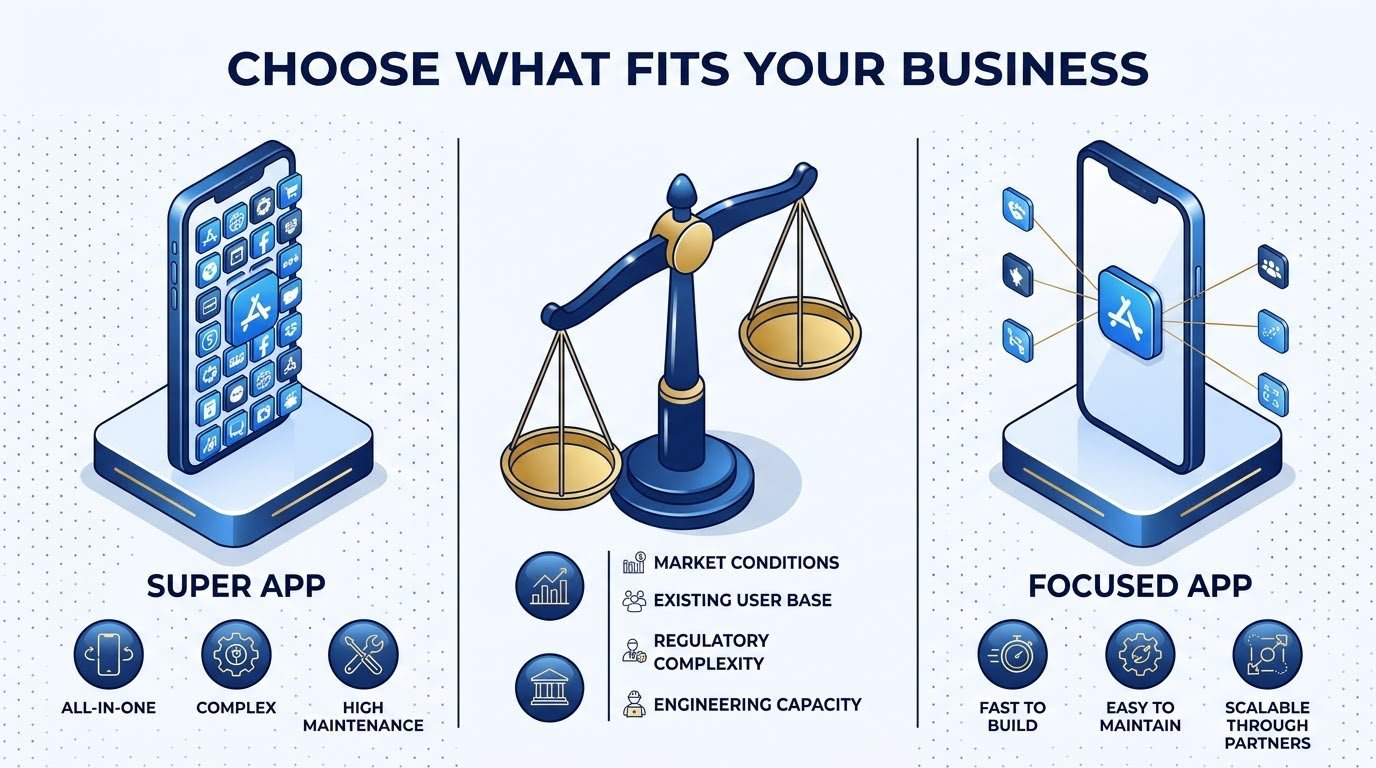
TL;DR: Super apps bundle many unrelated services into one platform, but building one only pays off under specific market conditions. Most businesses get more value from a focused app that does one thing well and integrates with others.
Grab, WeChat, and Gojek proved a bold idea. One app can handle payments, messaging, food delivery, and ride-hailing all at once. Business leaders now ask a natural question. Should we build a super app too?
For most businesses, the honest answer is no. Super apps work in specific markets with specific conditions behind them. Building one without those conditions in place usually creates a bloated product. It ends up doing many things poorly instead of one thing well.
What Makes an App a “Super App”
A super app is a single app that houses several genuinely unrelated services. One login and one wallet tie those services together into one identity. WeChat combines messaging, payments, and thousands of mini programs. Grab combines rides, food delivery, and payments under one account.
This differs from a regular app that simply has many features. A super app’s services are often independent products in their own right. They just happen to share one entry point and one account.
Why Super Apps Took Off in Some Markets and Not Others
Super apps thrived in markets like China and Southeast Asia for concrete reasons. Traditional banking infrastructure was fragmented or hard to access for many users. A single app filled several gaps at once, from payments to messaging to transport. High smartphone-first adoption also meant users had no legacy desktop habits to break.
Western markets tell a different story. Users already have dedicated apps for messaging, payments, and delivery. Switching all of that to one platform offers little upside and real inconvenience. That is a major reason most Western super app attempts have struggled to gain traction.
The Real Cost of Building One Platform for Everything
A super app means running several unrelated product lines inside one codebase. Each service often needs its own team, its own compliance requirements, and its own release cycle. Payments alone bring financial regulation. Food delivery brings its own safety and logistics rules.
This complexity slows everything down. Features ship slower because more systems depend on each other. App size and performance become harder to manage as more services get bundled in. Focus suffers too, since attention gets split across products instead of concentrated on one.
When a Super App Strategy Actually Makes Sense
A super app strategy fits a narrow set of situations well. A business with genuinely complementary services and a large existing user base is one example. Logistics, payments, and a loyalty program that already share the same customer base can combine naturally. A market with the same infrastructure gaps seen in Southeast Asia is another.
Outside of those conditions, the model rarely earns its cost. Most companies are better served asking whether consolidation actually helps their specific users, not whether the model worked somewhere else.
A More Realistic Alternative for Most Businesses
A focused app that does one core job extremely well usually beats a scattered one. Businesses can extend that core app through partnerships and integrations instead of building every service in-house. This keeps the product sharp and keeps engineering effort concentrated where it matters most.
Our mobile app development team helps businesses figure out exactly where that line sits. We look at what to build, what to integrate, and what to leave out entirely.
FAQ
What makes a super app different from a feature-rich app?
A super app usually houses genuinely separate services, like payments and messaging, under one identity layer. A regular app just has many features within one core product.
Do super apps work outside Asia?
A few Western platforms have tried. Most struggle because users already have specialized apps for each function and see little reason to switch.
Is a super app more expensive to build than a regular app?
Yes, significantly. It usually means maintaining multiple unrelated product lines inside one platform, each with its own regulatory and technical demands.
Should a startup consider a super app model?
Rarely. Most startups get more value from proving one core product works well before expanding into unrelated services.
Focus First, Consolidate Later
Super apps make headlines because a few of them succeeded spectacularly. What gets less attention is how specific the conditions were that made that success possible.
Most businesses gain more from building a sharp, focused mobile experience than from chasing a model built for a different market and a different competitive landscape.
If you are weighing whether to consolidate services into one platform or keep them focused and integrated, reach out to our team to talk through what fits your business and your users.
