
TL;DR: On-device AI runs models directly on a phone instead of a remote server, and businesses are adopting it for faster response times, lower cost at scale, offline reliability, and stronger privacy guarantees for sensitive data.
Most AI features in mobile apps still work the same way. The phone sends data to a server, a model processes it, and the answer comes back. On-device AI skips that round trip. The model runs directly on the phone’s own chip.
This shift is not just a performance tweak. It changes what a mobile app can promise its users about speed, privacy, and reliability. It is already showing up in features many people use daily, often without realizing where the processing actually happens.
What Actually Counts as On-Device AI
On-device AI means a model runs on the phone’s own chip, usually a neural processing unit built for exactly this task. The models tend to be smaller and compressed to fit the hardware. Common examples include on-device translation, face unlock, keyboard next-word prediction, and photo categorization.
Many voice assistants now handle simple wake word detection locally too. The heavier reasoning still gets sent to a server, but the first, fastest step happens right on the device.
Why Latency Pushes Features Off the Cloud
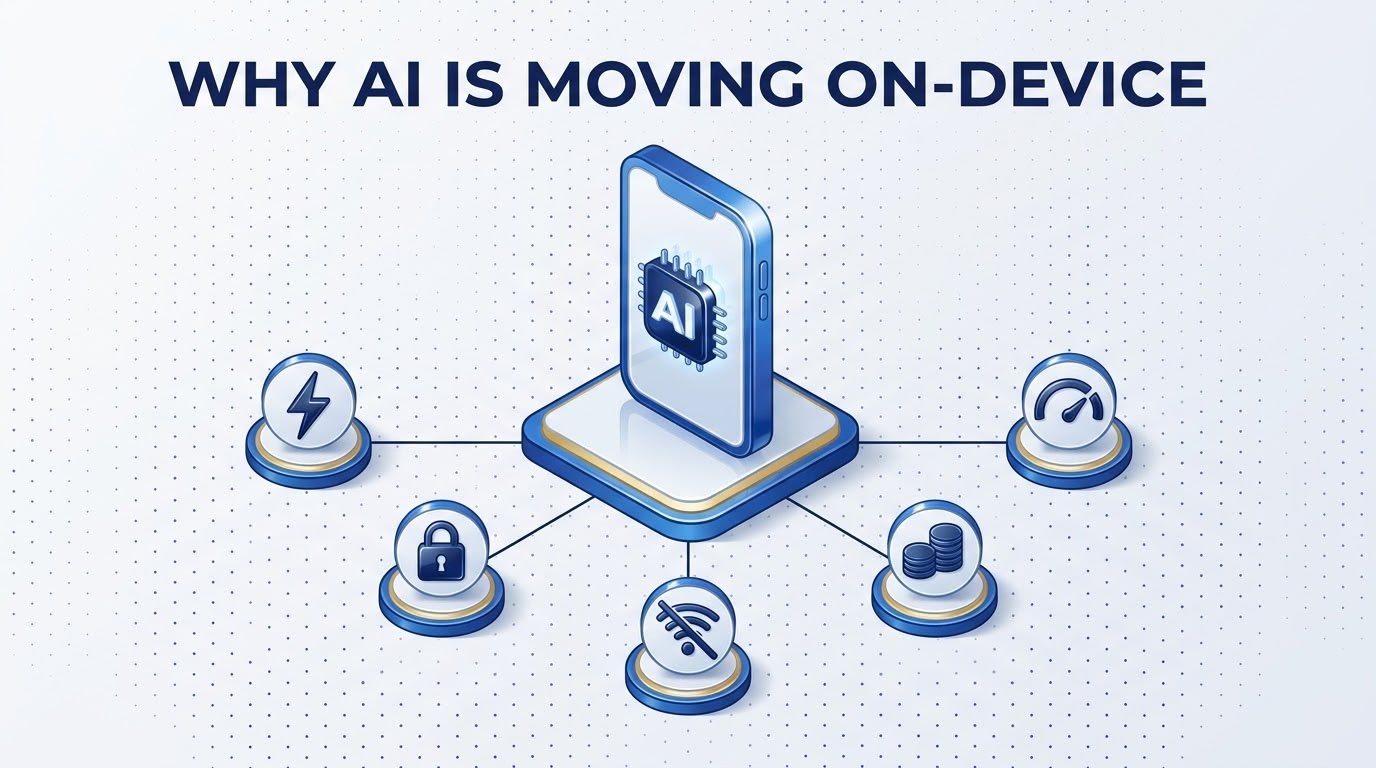
A round trip to a server adds delay, even a fast one. That delay matters for features that need to feel instant, like camera filters, live voice commands, or augmented reality overlays. Network conditions add another layer of risk, since a weak signal can stall a cloud request entirely.
There is also a cost dimension. Every request sent to a server costs compute time and money at scale. Processing simple, high-volume tasks on the device instead removes that cost from the equation entirely.
The Privacy Argument Gets Real Traction
Sensitive data processed on-device never has to leave the phone. Biometric data, personal photos, and other private inputs stay local instead of traveling to a server and back. This reduces compliance exposure for businesses handling sensitive information.
It also matters directly to users. Privacy-conscious customers increasingly notice and care whether their data leaves their device. On-device processing gives a business a genuine answer, not just a policy statement, when that question comes up.
What Still Needs the Cloud
On-device AI has real limits. Complex reasoning, large models, and anything requiring up-to-date information still needs server-side processing. Phone hardware simply cannot run the biggest, most capable models at reasonable speed or battery cost.
Most production systems end up hybrid. A small local model handles simple, common cases instantly. Anything more complex gets handed off to the cloud, where a larger model can take the time it needs.
What This Means for Businesses Building Mobile Features
Building on-device AI requires different skills than typical cloud-based development. Model compression, on-device inference frameworks, and testing across a wide range of chip capabilities all become part of the job. It is also a genuine build versus buy decision, since not every feature benefits enough to justify the extra engineering work.
Our mobile development team helps businesses decide which features actually belong on the device and which ones should stay on a server, based on real performance and privacy tradeoffs rather than trend-following.
FAQ
Does on-device AI work without an internet connection?
Yes, for features processed entirely on the phone. That is one of its biggest advantages for offline reliability.
Is on-device AI less accurate than cloud AI?
Sometimes, since the models are usually smaller and less capable at complex tasks. That gap is closing quickly for narrow, well-defined features.
Does on-device AI cost less to run?
Yes, at scale, since the business avoids paying server compute costs for every request. There is still an upfront cost to build and optimize the on-device model.
Which mobile features are already using on-device AI?
Keyboard prediction, face unlock, some camera features, and increasingly parts of voice assistants and translation tools.
Bringing Intelligence Closer to the User
On-device AI is not replacing the cloud. It is taking over the parts of the experience where speed, privacy, and reliability matter more than raw model power.
Businesses building mobile features today need to decide, feature by feature, which parts belong on the device and which parts still need a server behind them.
If you are exploring which of your product’s features could move on-device, talk to our mobile development team about what’s realistic for your app and your users.
