TL;DR: Enterprises need a governance framework that assigns clear ownership for AI agent decisions before deployment, not after an incident happens.
AI agents now approve invoices, screen job applicants, negotiate vendor terms, and answer customer queries without a human checking every step. We see enterprises deploy these systems faster than they build the structures to govern them. When an agent makes a costly error, most organizations discover they never decided who actually owns the outcome.
This gap creates real exposure. A misclassified transaction, a biased screening decision, or a hallucinated contract term can trigger regulatory scrutiny, customer harm, and reputational damage within hours. We wrote this article to help enterprise leaders build accountability into their AI programs before an incident forces the conversation.
Why AI Agent Accountability Differs From Traditional Software Risk
Traditional enterprise software follows rules a developer wrote and a QA team tested. When it fails, teams trace the bug to a specific line of code. Autonomous agents built on large language models behave differently. They generate outputs probabilistically, adapt to context, and sometimes take actions no one explicitly programmed.
This shift matters because standard incident response assumes a deterministic system. Enterprises running AI-powered systems need response plans that account for non-deterministic behavior, including scenarios in which the same input produces different outputs across runs.
Boards and risk committees increasingly ask a direct question: if the agent acts, who answers for the action? Legal teams, compliance officers, and engineering leads often each assume someone else owns the answer.
The Four Layers of Responsibility Every Enterprise Should Define
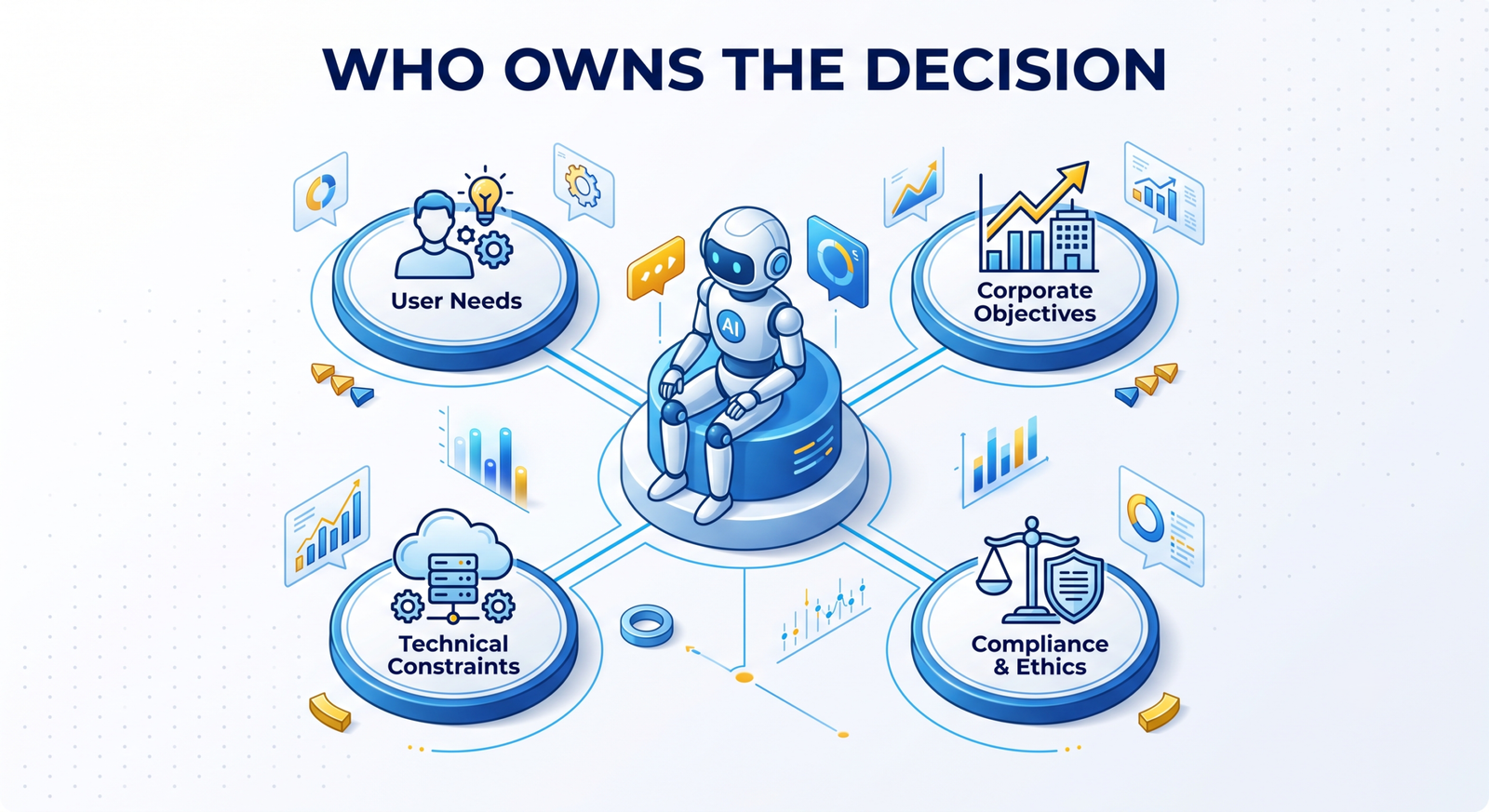
We find that clear governance separates responsibility into four layers, each with a distinct owner. The first layer covers the model provider, who is accountable for the underlying system’s documented capabilities and limitations.
The second layer covers the integrator, typically an internal team or a partner delivering custom software. This layer is accountable for how the agent connects to business systems and what permissions it receives.
The third layer covers the business owner, the executive whose department deploys the agent and who is accountable for the decision to use it in a given workflow. The fourth layer covers the end user or operator, who is accountable for following escalation procedures when an agent flags uncertainty.
Enterprises that skip this exercise tend to discover the gaps only after an incident, when three departments each point to a different layer.
Building an AI Governance Framework That Actually Holds Up
A workable framework starts with an inventory. Enterprises need a living register of every AI agent in production, what decisions it makes, and what data it touches. Many organizations underestimate this step and later find agents running in departments no central team tracks.
From there, we recommend a tiered review process. Low-stakes agents, such as those drafting internal summaries, need lighter oversight than agents approving payments or making hiring recommendations. Matching the level of human review to the level of business risk keeps the framework practical rather than bureaucratic.
Audit trails matter as much as the review process itself. Every agent decision above a defined risk threshold should log its inputs, reasoning trace where available, and the human who approved or overrode it. This record becomes essential during a cybersecurity incident review or a regulatory inquiry.
Enterprises building this kind of governance rarely succeed with a generic template. Working with a partner experienced in enterprise software solutions lets teams map governance controls directly onto existing systems instead of bolting on a separate compliance layer.
What Regulators Already Expect From Enterprise AI
Regulatory frameworks across major markets already assign obligations for high-risk automated decisions, covering areas like credit, employment, and healthcare. Enterprises operating internationally face overlapping requirements, and ignorance of a rule rarely serves as a defense once an agent causes harm.
We see the strongest enterprise programs treat governance as a competitive advantage rather than a compliance tax. Customers and partners increasingly ask vendors to demonstrate accountability structures before signing a contract, and enterprises with documented governance close those deals faster.
None of this replaces legal counsel for a specific regulatory question. It does mean, though, that waiting for a regulator to ask first is the costliest way to build a governance program. Our team helps enterprises design and implement AI-powered systems with accountability built in from the first deployment. Talk to us about a governance review before your next agent goes live.
FAQ
Who is legally liable for an AI agent’s mistakes?
Responsibility typically depends on contract terms with the model provider, the integrator’s implementation choices, and the business owner’s deployment decision. Enterprises should document this allocation in writing before deployment rather than relying on assumptions.
Does a human need to approve every AI agent decision?
No. Enterprises generally apply tiered review, requiring human approval only for higher-risk decisions while allowing lower-stakes agent actions to proceed with periodic audit rather than real-time sign-off.
What should an AI incident response plan include?
It should include a clear escalation path, a defined owner for the affected workflow, an audit trail of the agent’s inputs and outputs, and a rollback procedure to disable the agent while the issue is investigated.
How often should AI governance be reviewed?
Most enterprises review their framework quarterly, with an additional review triggered whenever they deploy an agent into a new business function or a regulator issues new guidance.
Governance Is Not Optional Anymore
Enterprises that treat AI governance as an afterthought inherit risk they cannot see until it surfaces as an incident. The organizations that get ahead of this problem build ownership into every layer of their AI stack. That ownership runs from the model provider through to the operator who reviews a flagged decision.
We help enterprises design governance frameworks that fit their existing systems rather than adding friction on top of them. If your organization runs AI agents without a clear answer to “who is responsible,” that gap is worth closing now.
Contact our team to start your AI governance review.