TL;DR: Most app store rejections come down to incomplete metadata, broken core functionality, missing privacy disclosures, or guideline violations that a thorough pre-submission review would have caught before Apple or Google ever saw the app.
A rejected app costs more than a delayed launch date. It costs marketing momentum, developer hours, and sometimes an entire release window tied to a product announcement or seasonal campaign.
Apple and Google both publish detailed guidelines. Developers still submit apps that stall in review for avoidable reasons. This article walks through the most common causes of app store rejection and how a disciplined pre-submission process prevents them.
Why App Store Rejections Happen So Often
Apple’s App Store and Google Play both run every submission through a mix of automated checks and human review. Reviewers work through thousands of apps and apply the guidelines consistently. Small oversights that seem minor to a developer often trigger an immediate rejection.
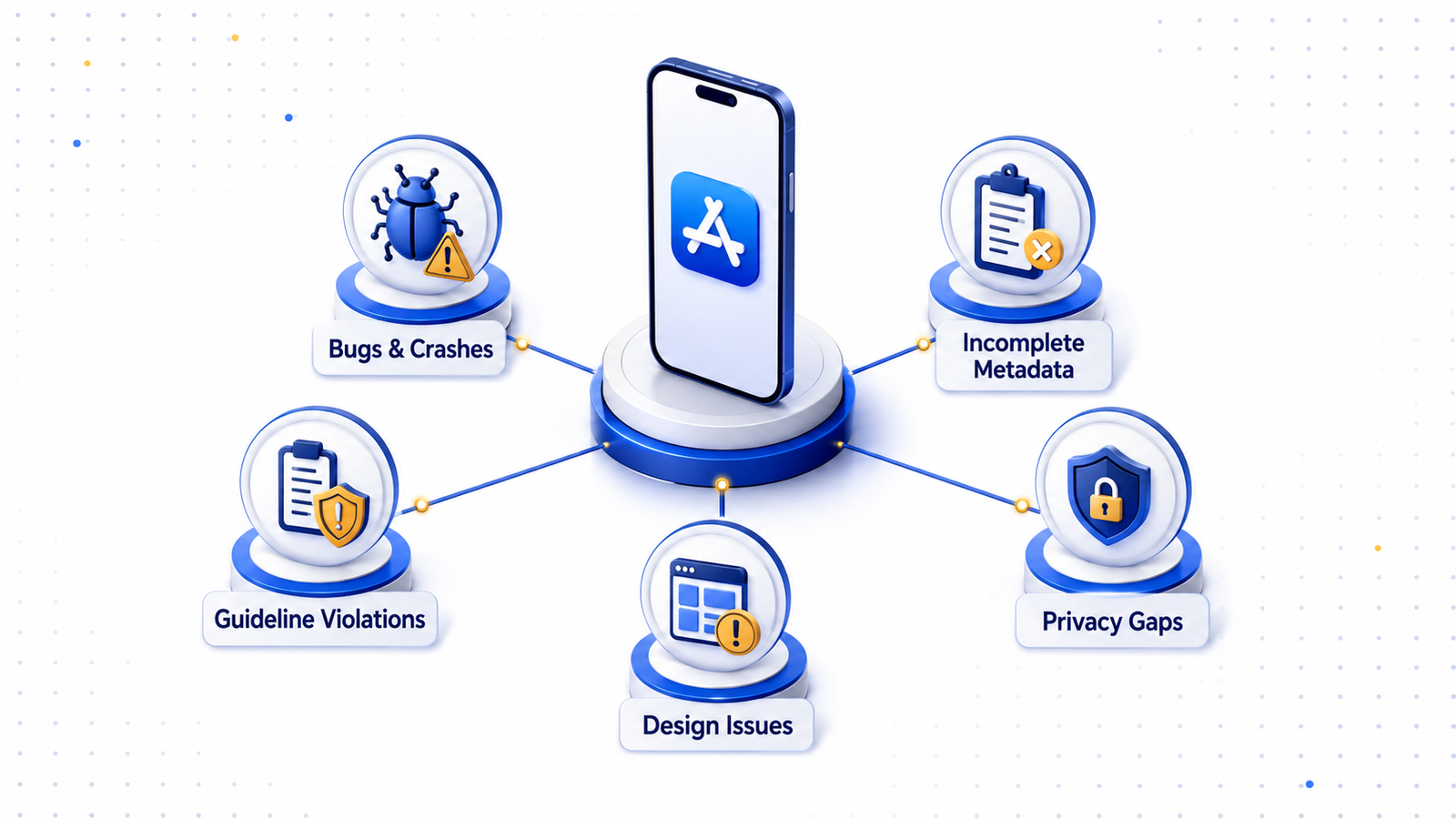
Most rejections trace back to one of a handful of recurring categories: incomplete information, broken functionality, guideline violations, or privacy gaps. Understanding these categories in advance turns review into a formality instead of a gamble.
The Most Common Rejection Reasons (Apple and Google)
Bugs and crashes. Reviewers test core user flows directly. A crash, a freeze, or a broken link during a basic walkthrough triggers an immediate rejection, regardless of how polished the rest of the experience looks.
Incomplete app information. Missing screenshots, placeholder text, and broken demo accounts all count as incomplete submissions. Unclear descriptions of what the app actually does cause the same problem.
Misleading metadata. App titles, keywords, and screenshots must accurately represent what the app does. Reviewers reject listings that promise features the app does not actually deliver.
Guideline violations. Both platforms restrict certain content categories, monetisation models, and design patterns. Apps that duplicate existing functionality with minimal differentiation, or that use deceptive UI patterns, commonly draw a flag here.
Design and usability issues. Apple in particular rejects apps with inconsistent navigation or unclear UI elements. A clean, tested UX and UI design process avoids this entirely.
Metadata and Guideline Issues That Trip Up Developers
Developers often underestimate how closely reviewers check the smaller submission details. An app name that closely resembles an existing trademarked brand raises an immediate flag. Keyword stuffing in the app title and screenshots that show unfinished builds cause the same problem, and a careful pass before submission catches all three.
Subscription and in-app purchase apps face particularly scrutiny. Both stores require clear, upfront pricing disclosures and a straightforward cancellation path. An app that hides either behind confusing menus routinely goes back for revision.
Technical and Privacy Pitfalls
Privacy compliance causes a growing share of rejections as both platforms tighten their requirements. An app must declare exactly what data it collects, explain why it collects that data, and provide a working privacy policy link before submission.
A security-conscious development process also prevents the technical rejections that stem from insecure data handling. Storing sensitive information without encryption is a common example, as is requesting permissions the app does not actually need.
Requesting location, camera, or contact access without a clear, visible reason inside the app experience draws attention from reviewers just as often, even when the underlying functionality is legitimate.
How to Prepare Your App for a Smooth Review
A structured pre-submission checklist prevents almost every common rejection reason. Test every core user flow on a real device before submitting. Confirm every screenshot and description matches the current build exactly, and verify that demo accounts work for reviewers without extra setup steps.
Review both platforms’ latest guideline updates before each submission. Apple and Google revise their policies regularly, and an app that passed review last year can fail on the same grounds today if a rule has changed.
Build in time for at least one full internal QA pass that focuses specifically on the guidelines rather than general functionality testing. This step alone catches most avoidable rejections before a reviewer ever sees the app.
How Innosaber Helps You Launch Without Delays
Innosaber’s mobile app development team builds submission readiness into every project from the start, not as an afterthought before launch. That means clean, guideline-compliant UX and UI design, thorough QA testing, and clear privacy disclosures from day one.
We also run a dedicated pre-submission review against Apple’s and Google’s latest guidelines before any app goes live. This review catches the details that cause avoidable delays. Talk to our team before your next submission to reduce your review risk.
FAQ
How long does an app store review typically take?
Apple’s review process usually takes 24 to 48 hours. Google Play reviews often complete within a few hours to a few days, though both timelines extend when an app needs additional manual review.
Can I appeal an app store rejection?
Yes. Both Apple and Google provide an appeals process, and a developer can request a second review or clarify how the app meets a disputed guideline. A resubmission with the actual issue fixed usually moves faster.
Does a rejected app go back to the end of the review queue?
Yes, in most cases. The platform treats a resubmitted app as a new submission and places it back in the standard review queue, which is why avoiding rejection on the first attempt matters for launch timing.
Are privacy policy requirements the same for Apple and Google?
No. Each platform sets its own specific privacy disclosure requirements. An app targeting both stores needs to meet each set of rules individually rather than assuming one policy satisfies both.
Do app updates have different rejection reasons?
Largely no. Updates go through the same review criteria as new submissions. A previously approved app can still fail an update review if it introduces a bug, a new permission request, or a guideline violation.
Launch on time by getting the review right the first time.
App store rejection is almost always preventable. A disciplined review process catches the common causes, bugs, incomplete metadata, guideline violations, and privacy gaps, well before submission.
Innosaber’s mobile app development team builds that discipline into every project. We pair clean design and thorough QA with a pre-submission guideline check that catches issues before Apple or Google ever does.
A smooth review process protects your launch date, your marketing spend, and the momentum you have built ahead of release. Getting it right the first time always costs less than fixing it after a rejection notice.