TL;DR: Fintech companies need custom software built for regulatory compliance, security, and scale from day one, not adapted from generic templates later.
Fintech companies operate under constraints most industries never face. Every feature touches money, personal data, or both, and every release invites scrutiny from regulators, banking partners, and security auditors. Off-the-shelf software rarely survives that scrutiny intact.
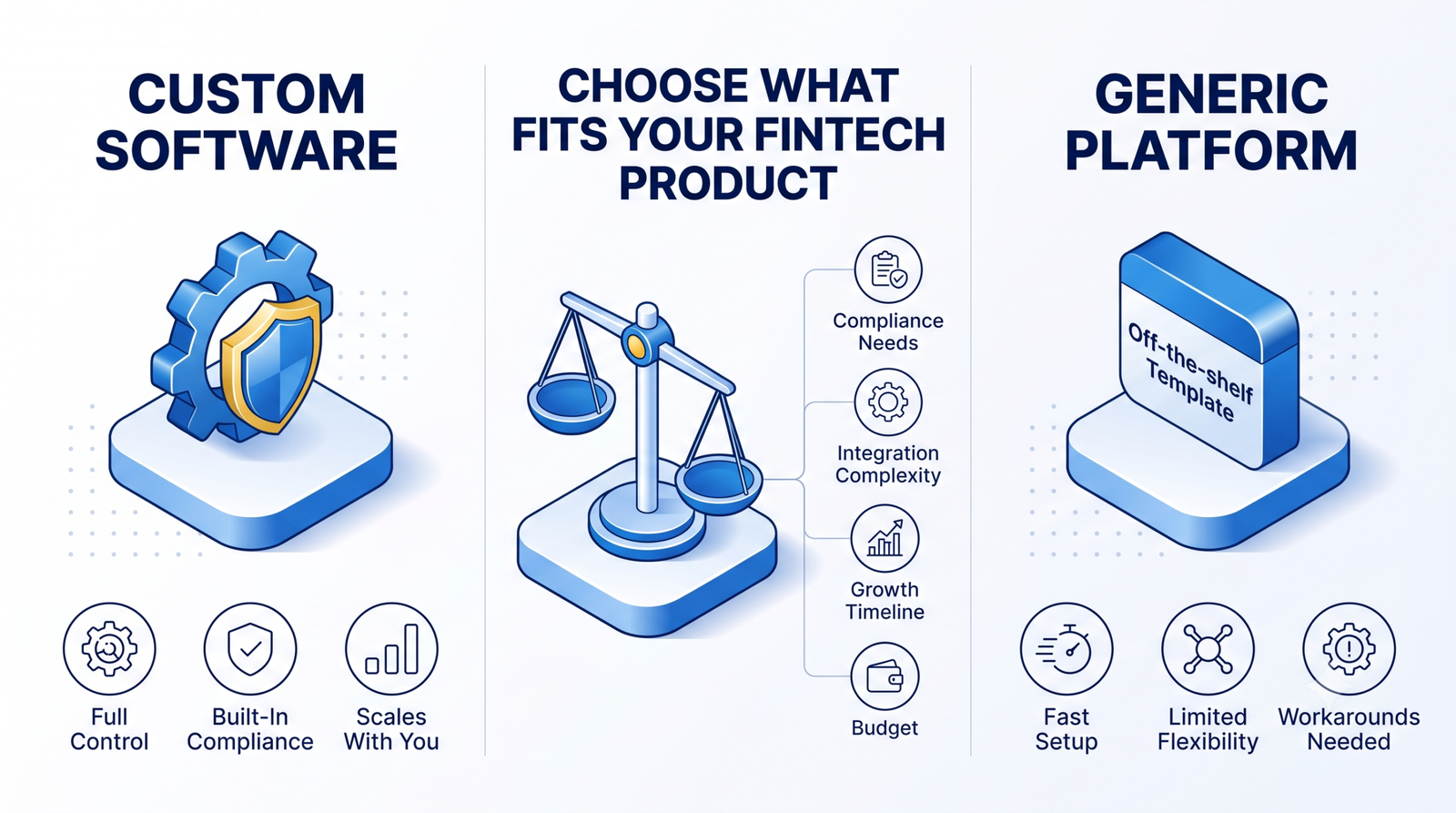
We work with fintech teams that tried generic platforms first. They hit a wall once they needed a compliance workflow, a specific ledger structure, or an integration their vendor never anticipated. Custom software development solves that problem by building the product around the constraints from the start.
Why Fintech Cannot Rely on Generic Software Platforms
Generic SaaS platforms optimize for the widest possible customer base. This means they rarely support the specific ledger logic, reconciliation rules, or reporting formats a fintech product needs. Teams end up building workarounds on top of a platform that was never designed for financial transactions.
Custom software development gives fintech teams direct control over data models, transaction flows, and audit logging from the first line of code. That control becomes essential the moment a bank partner or regulator asks for a specific report the platform vendor never built.
The Compliance Layer Fintech Software Cannot Skip
Fintech products typically need to satisfy KYC and AML obligations, data residency rules, and transaction monitoring requirements simultaneously. Building these requirements into the architecture from the start costs far less than retrofitting them after a regulator flags a gap.
We design compliance checkpoints as part of the transaction flow itself, not as a separate reporting layer bolted on afterward. This approach keeps audit trails consistent and makes it far easier to produce evidence during a regulatory examination.
Strong cybersecurity practices sit underneath every compliance control. Encryption at rest and in transit, role-based access control, and continuous vulnerability scanning protect both customer funds and the institution’s banking relationships.
Architecture Decisions That Determine Whether Fintech Software Scales
Fintech transaction volume rarely grows in a straight line. A product might process a few hundred transactions a day at launch and tens of thousands within a year of a successful partnership. Architecture decisions made at the start determine whether that growth is smooth or painful.
We favor modular services over monolithic builds for fintech products because this lets teams scale the transaction engine independently of the reporting layer or the customer-facing app. It also isolates failures, so a spike in one service does not take down the entire platform.
Choosing the right database strategy matters as much. Ledger data needs strong consistency guarantees, while analytics workloads benefit from a separate store optimized for read performance. Mixing these needs into a single database often creates bottlenecks once volume increases.
What to Look for in a Custom Software Development Partner
Fintech founders should look for a development partner with direct experience shipping financial products, not just general web or mobile apps. A partner who has already navigated a compliance audit understands where the hidden costs sit.
Integration experience matters too. Fintech products rarely operate alone. They connect to banking cores, payment processors, credit bureaus, and identity verification services. A partner comfortable with enterprise software integrations handles those integrations without treating each one as a novel problem.
Our team builds fintech products end to end, from architecture through compliance-ready launch. Talk to us about your fintech build before you commit to a platform that cannot scale with your compliance needs.
FAQ
How long does custom fintech development take?
A functional MVP typically takes three to six months, depending on the number of integrations and the compliance scope, while a full production-ready platform with regulatory sign-off often takes six to twelve months.
Is custom software more expensive than fintech SaaS?
Custom software usually costs more upfront, but it removes the recurring workaround costs and compliance retrofits that generic platforms create as a fintech product scales.
Which compliance standards should fintech software support?
Most fintech products need KYC and AML controls, PCI DSS alignment for payment data, and data residency compliance for every market they serve, built into the architecture rather than added later.
Can fintech software be migrated to a custom platform?
Yes, though migration is smoother when the original platform’s data model is well documented. A phased migration that runs the old and new systems in parallel reduces risk during the transition.
Build the Fintech Product Regulators and Customers’ Trust
Fintech software carries a higher bar than most digital products, and generic platforms rarely clear it without expensive workarounds. Custom development lets founders build compliance, security, and scale into the foundation instead of patching them in after a regulator or a growth spurt forces the issue.
We build fintech products designed to pass audits and handle scale from day one.