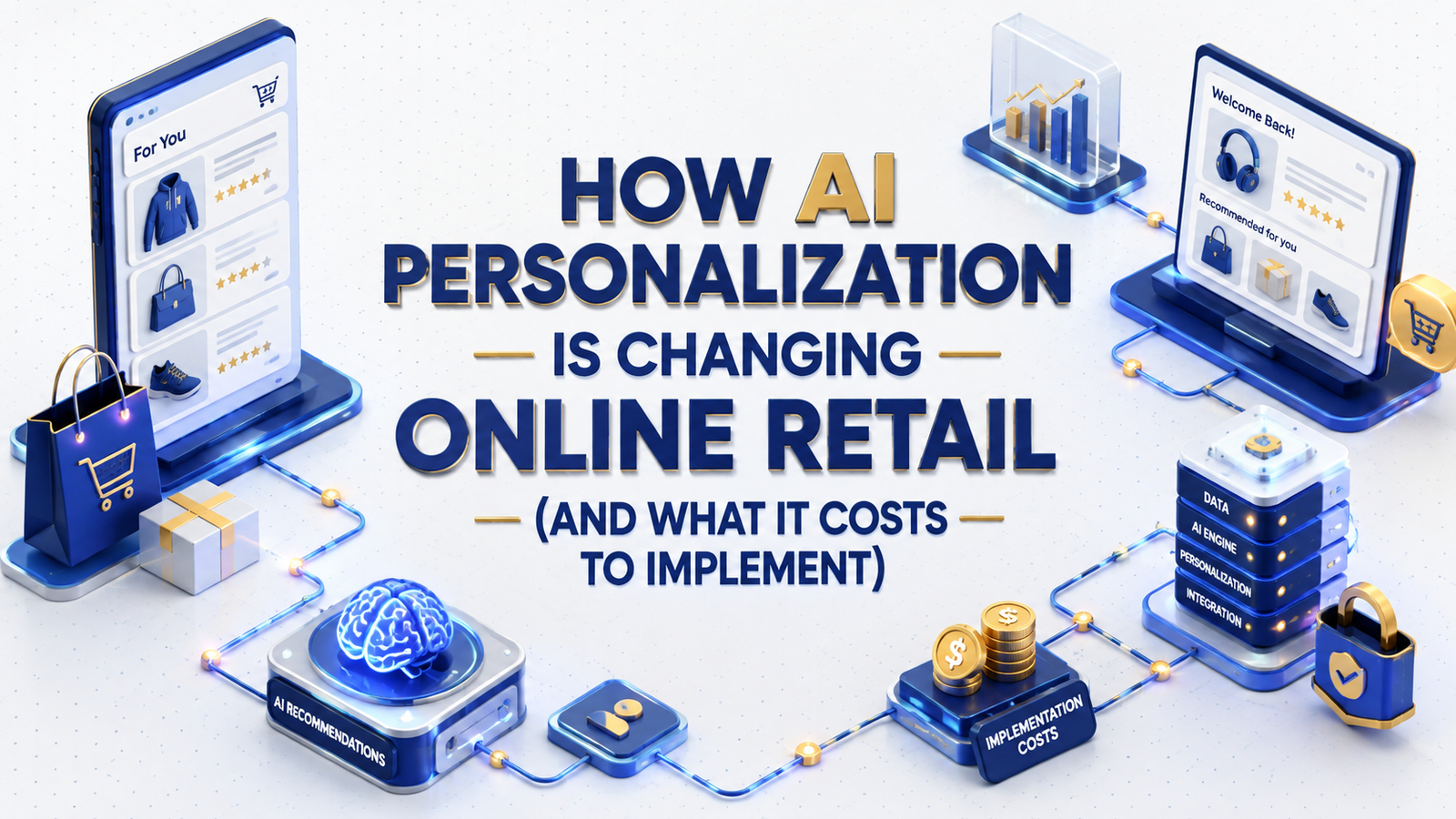
TL;DR: AI personalization uses purchase history, browsing behavior, and real-time signals to tailor product recommendations, pricing, and content to each shopper, and most online stores can start with a targeted pilot before committing to a full rebuild.
A shopper who buys running shoes twice a year now expects a store to remember that, suggest matching socks, and skip the baby product ads. Amazon and other large retailers set that bar years ago, and customers now carry the same expectation into every online store they visit. For a mid-sized retailer, meeting that expectation used to mean a data science team and a six-figure budget. That is no longer true. This guide covers what AI personalization actually does, what it costs at different levels of ambition, and how to start without betting the whole budget on one big rebuild.
What AI Personalization Actually Does
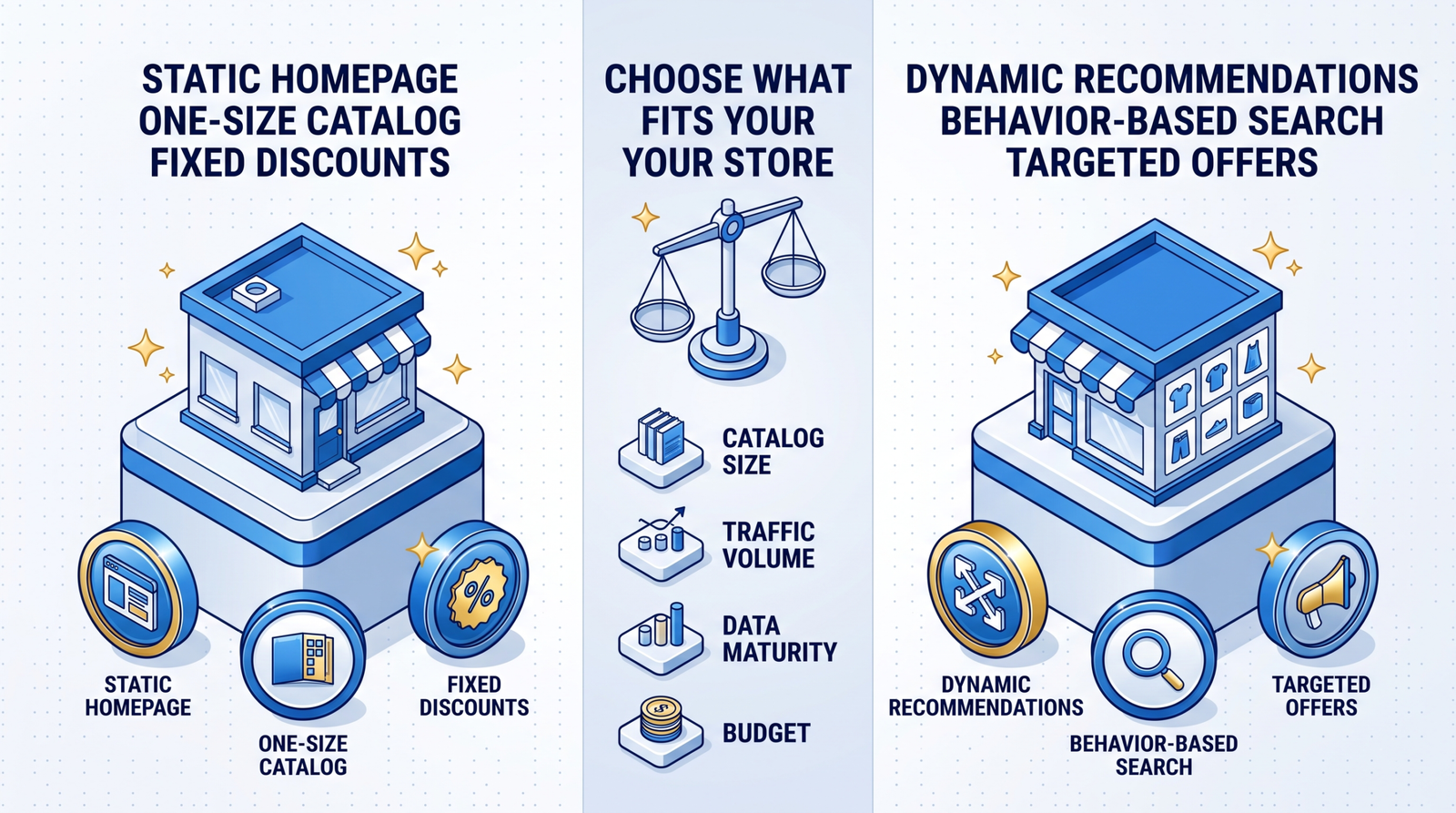
AI personalization systems watch what a shopper does on a site, what they have bought before, and sometimes what similar shoppers bought, then use that pattern to adjust what the shopper sees next. That shows up in a few concrete ways.
- Product recommendations that update based on browsing session, not just past orders
- Search results reordered around a shopper’s demonstrated preferences
- Homepage and category pages that rearrange themselves per visitor
- Email and retargeting campaigns built around individual behavior instead of broad segments
- Dynamic pricing or promotions targeted at shoppers likely to abandon a cart
Why It Actually Moves Revenue
Generic storefronts show the same homepage to a first-time visitor and a returning customer who has spent thousands. That wastes the most valuable real estate on the site on people who already know what they want. Personalization closes that gap by putting the most relevant product in front of each shopper at the moment they are deciding whether to buy.
The effect compounds across a large catalog. A store with a few dozen products can rely on a human merchandiser to guess what sells well together. A store with thousands of SKUs cannot, and that is exactly where a recommendation engine earns its cost back fastest.
What Personalization Costs at Different Levels
The price range is wide because the term covers everything from a plugin to a fully AI-powered recommendation engine trained on years of transaction data.
- Off-the-shelf tools: platform apps or third-party plugins that add basic recommendation widgets, typically a monthly subscription with limited customization
- Mid-tier integration: connecting an existing personalization API to your product catalog and customer data, usually a scoped project rather than a subscription
- Custom-built systems: a recommendation engine trained on your own data, integrated across search, email, and merchandising, sized like any other custom software solutions project
How to Start Without a Full Rebuild
Most retailers do not need to personalize every touchpoint on day one. A focused pilot, usually a recommendation widget on product pages or an abandoned-cart flow driven by behavior instead of a fixed discount, proves the concept on a small budget before a larger investment gets approved.
The technical requirement underneath any of this is the same: clean, connected data. If your catalog, order history, and browsing behavior live in three disconnected systems, personalization has nothing reliable to work from. That is often where a data engineering foundation needs to come first, followed by the AI layer built on top of it.
If your store is still showing every visitor the same homepage, talk to our team, and we will map out what a personalization pilot would look like for your catalog and traffic.
FAQ
Do I need a large dataset before personalization is worth trying?
Not necessarily. Even a few months of order and browsing history is enough to power basic recommendation logic. The dataset improves the results over time; it does not gate the starting point.
Will personalization work with my e-commerce platform?
Most major platforms support personalization through apps, APIs, or custom integration, so a full platform migration is rarely required just to add this capability.
How is this different from just running retargeting ads?
Retargeting ads bring shoppers back to your site. Personalization changes what they see once they arrive, which is a different and complementary layer of the same strategy.
What is a reasonable first step if the budget is limited?
A single recommendation widget on your highest-traffic product pages, tied to real purchase data, is usually enough to measure impact before expanding further.
Personalization Is Now a Baseline, Not a Differentiator
The stores that treat personalization as an experiment are already behind the ones that treat it as infrastructure. The gap shows up quietly, in cart abandonment rates and repeat purchase numbers, long before it shows up in a quarterly review.
Innosaber builds personalization pilots that start small and connect cleanly to the systems a retailer already runs, so the investment scales with the results it produces. Reach out to talk through what a first pilot would look like for your store.