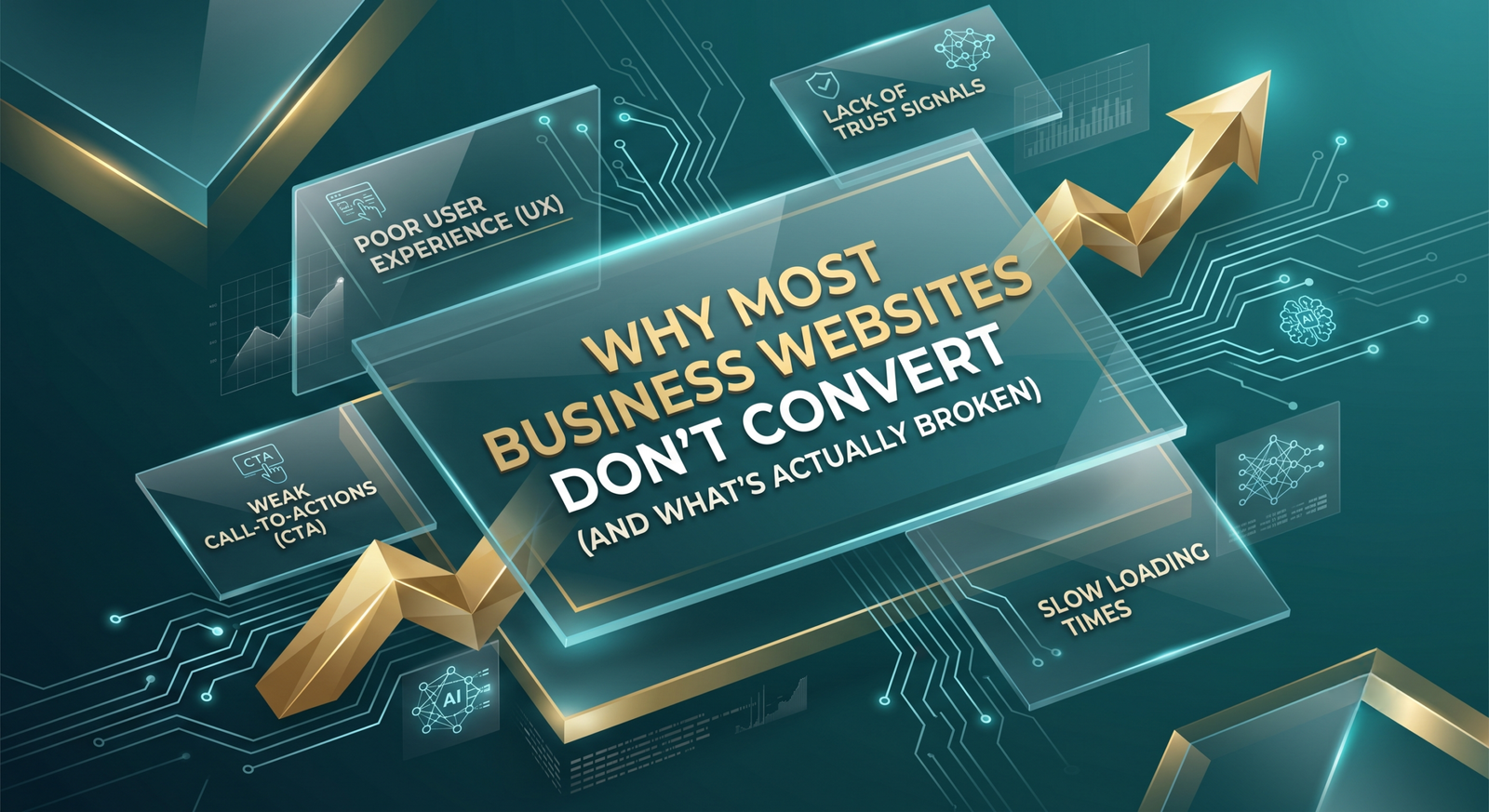
A lot of businesses put real money into their website and still aren’t seeing results. Traffic comes in. People look around. Then they leave without doing anything.
The instinct is usually to blame the design, or the SEO, or the marketing agency. Sometimes one of those is the problem. More often, the issue is structural. The site was built to look good rather than to work. Those are two different briefs, and they produce two very different outcomes.
Here is what we actually see when we audit low-converting websites, and what needs to change.
The site talks about the business, not the visitor
This is the most common problem and the easiest to miss when you’re close to your own business. The website is written from the company’s perspective rather than the visitor’s.
Pages that open with the founding story, the awards, the company mission. Copy that describes what the business does in internal terms rather than in terms of what the customer is trying to solve. A homepage that answers “who are we” before it answers “can we help you.”
Visitors arrive with a problem or a question. If the first thing they find is content about the business instead of content that speaks to their situation, most of them will leave before they find out whether you can actually help.
The fix is to reframe the copy around the visitor. What are they trying to do? What is getting in the way? What does a good outcome look like for them? Answer those questions early and clearly, and the rest of the page has something to build on.
There is no obvious next step
A website without a clear call to action is a brochure. It can inform, but it cannot convert.
The problem is usually not that the call to action is missing. It is that there are too many of them, or they are buried below the fold, or they are vague. “Learn more” is not a call to action. “Get in touch” barely qualifies.
Each page should have one primary action you want the visitor to take. That action should be visible, specific, and low enough friction to actually complete. On a services page, that might be booking a discovery call. On a product page, it might be starting a trial. The format changes depending on where the visitor is in their decision process. The principle stays the same.
The site is slow, and you’re losing people before they read anything
Page speed is not just a technical metric. It directly affects how many visitors stay long enough to see what you do.
A site that takes more than a few seconds to load loses a significant share of visitors before a single word is read. On mobile, where most web traffic now comes from, the tolerance is even lower. If your site is slow, you are losing people before the conversion problem even begins.
The usual causes are uncompressed images, bloated themes with unused code, too many third-party scripts loading on every page, and hosting that is not matched to the traffic the site actually receives. Most of these are fixable without a full rebuild. A PageSpeed Insights audit is a straightforward starting point and costs nothing.
When we build and optimise websites at Innosaber, performance is part of the brief from day one. We handle image optimisation, asset minification, caching, and CDN configuration as standard, not as extras added at the end.
Trust signals are missing or too generic to matter
First-time visitors do not know your business. Before they take any meaningful action, they need something that tells them the business is credible, that others have had a good experience, and that the risk of engaging is low.
Client logos, case studies, specific testimonials, certifications, named team members, and clear contact details all do this work. The absence of these signals, or their presence in a form that feels generic or unverifiable, quietly kills conversions.
A testimonial that says “Great service, highly recommend” with no name and no context does almost nothing. A short case study that describes a real problem and a measurable outcome does quite a lot. The closer that kind of evidence is placed to your call to action, the more work it does.
The mobile experience was adapted from desktop rather than designed
for it
Responsive design is the baseline. A site that technically adjusts to a smaller screen but was conceived for desktop is not a good mobile experience. It is a desktop site squeezed into a phone, and visitors can feel the difference.
Mobile visitors browse differently. They have less patience, smaller screens, and no mouse. Navigation that works well with a cursor can be frustrating with a thumb. Forms that are easy on a keyboard are annoying on a phone. If a meaningful share of your traffic is coming from mobile and your conversion rate on mobile is noticeably lower than on desktop, that gap is the answer.
Our website builds at Innosaber are mobile-first by default. We design for how people actually use their phones, then scale up to desktop, rather than the other way around.
The page doesn’t match what brought the visitor there
When someone clicks an ad or a search result and lands on a page that doesn’t match what they were looking for, they leave. This is called message mismatch, and it is one of the fastest ways to waste a marketing budget.
An ad that promises a specific solution should land on a page that leads with that solution. A search result for a specific service should go to a page about that service, not the homepage. The experience from first click to landing page needs to be consistent.
A large share of paid traffic gets sent to homepages or catch-all service pages that don’t reflect the specific thing that generated the click. Fixing that mismatch often produces faster improvements than any redesign would.
What to actually do about it
Most of these problems are fixable without starting over. The issues are structural, but they can be addressed through targeted changes to copy, page layout, load speed, and how trust is presented.
The starting point is knowing where visitors drop off and why. Analytics will show you where people leave. Watching real users interact with the site, even informally, will show you why. Once you have that, the fixes are easier to prioritise and sequence.
At Innosaber, our website design and development work is built around this from the start. We are not building sites that look good in a portfolio screenshot. We are building sites that are structured to convert visitors into enquiries, and enquiries into clients. That means the copy, the structure, the speed, and the trust signals all get the same attention as the visual design.
FAQ
How do I know if my site has a conversion problem?
If you are getting traffic but not seeing enquiries, sign-ups, or sales in proportion to that traffic, the site is not doing its job. A rough benchmark for business websites is one to five percent of visitors converting into leads. Below that, and there is something specific getting in the way.
Is a full redesign the answer?
Not always. A redesign is usually the most expensive and slowest way to improve conversion. In many cases, targeted changes to copy, calls to action, page speed, and trust signals will get you
further, faster. Start with an audit of what is actually broken before committing to a rebuild. Sometimes a rebuild is the right call. Often it is not.
What makes a call to action work?
Specificity, visibility, and the right level of commitment for where the visitor is. A first-time visitor is not ready to sign anything, but they might be ready to book a short call or download something
useful. Make the action clear, make it easy to find, and match the ask to what the visitor is likely willing to do at that stage.
We have testimonials, but they don’t seem to help. Why?
Generic testimonials with no name, no company, and no specific outcome are easy to ignore. Specific ones that describe a real situation and a real result are harder to dismiss. Where you
place them matters too. A testimonial sitting on a separate “reviews” page does less work than one placed right next to your main call to action.
How much does page speed actually matter for conversions?
More than most businesses expect. Even a one-second improvement in load time can move conversion rates noticeably, especially on mobile. If your site scores poorly on Core Web Vitals, fixing that is one of the highest-return improvements available before you touch anything else.
Websites that are built to work
Most conversion problems are not design problems. They are clarity problems, structure problems, and trust problems. They can be diagnosed and fixed without starting from scratch.
At Innosaber, we design and develop websites with one goal: turning the traffic you are already getting into results you can measure. Whether you need a new build on WordPress, WooCommerce, Shopify, or a custom stack, or you need an existing site audited and improved, we start with the problem you are actually trying to solve.
Book a consultation, and we will start by looking at what is actually broken.