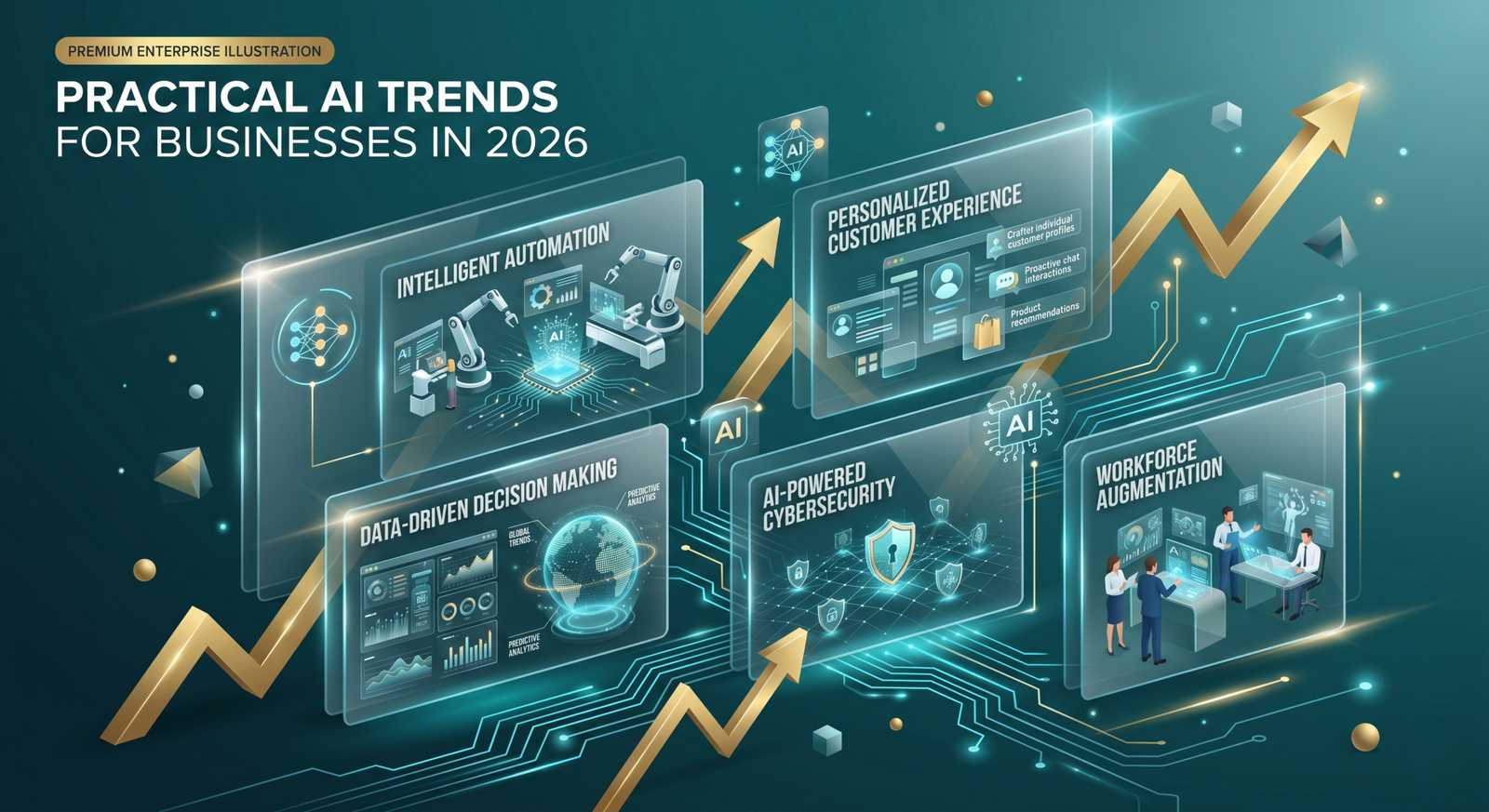
There is no shortage of AI coverage right now. Most of it sits at one of two extremes. Either breathless hype about how everything is about to change, or dismissive skepticism from people who tried one chatbot and were not impressed.
The reality for most businesses is somewhere more practical. AI is producing real results in specific applications. It is also being oversold in ways that lead organisations to invest in things they do not need yet. The skill right now is knowing which is which.
This is a look at the AI trends that are actually worth paying attention to in 2026, and more importantly, what they mean for businesses trying to make sensible decisions about where to focus.
Agentic AI: From Tools to Systems That Act
For the last few years, most business AI applications have been reactive. You ask a question, and the AI answers. You provide a document, and the AI summarises it.
What has changed in 2026 is the move toward agentic AI. Systems that can take sequences of actions toward a
goal, not just respond to a single prompt. An agentic system can research a topic, pull data from multiple sources, generate a draft, check it against a set of criteria, and flag it for human review. Without a human
managing each step.
This is a meaningful shift for business processes. Tasks that require a person to coordinate several steps,
researching options, comparing data, and preparing outputs can increasingly be handled by an AI agent, with a
human reviewing the result rather than doing the work.
If you have internal workflows that are currently bottlenecked by coordination work, gathering data from multiple systems, producing regular reports, triaging incoming requests, agentic AI is worth looking at seriously. The technology is not perfect, but it is mature enough to be useful in production in the right
environments.
AI and Data Engineering Are Converging
This is less flashy than some of the other trends, but it is one of the most important for businesses trying to get
real value from AI.
For most of the last decade, data engineering and AI were treated as adjacent disciplines. Data teams built
pipelines and warehouses. AI teams built models and queried them. They worked together but were structured
differently.
What is happening now is a convergence. The infrastructure that powers AI, the data pipelines, the vector
databases, and the retrieval systems, is increasingly part of the same build as the AI application itself. You
cannot separate “getting the data ready” from “building the AI” anymore, because the quality of the data
architecture directly determines the quality of what the AI can do.
For businesses, this means AI projects need to be scoped and resourced as full-stack data projects from the start. Organisations that try to add AI on top of existing data infrastructure without improving that infrastructure first tend to get inconsistent results. Not because the AI is bad, but because the data feeding it is not reliable.
At Innosaber, we build AI and data engineering as a single engagement rather than sequencing them. It is a
more honest way to scope the work, and it produces systems that are actually reliable.
Smaller, Specialised Models Over General-Purpose Giants
The conversation around AI for the last couple of years has been dominated by the largest general-purpose
models. Systems trained on enormous datasets to answer almost any question.
The trend in 2026 is moving toward smaller, specialised models fine-tuned on specific domains. A model
trained specifically on legal contracts performs better at contract analysis than a general model. A model trained
on a company’s internal documentation performs better at answering internal queries than a model that knows
about everything but nothing deeply.
For businesses, this is useful in a few ways. Smaller specialised models are cheaper to run. They tend to be
more accurate in their domain. They can be run on private infrastructure, which matters for organisations with
sensitive data that cannot go through third-party APIs.
Rather than asking “how do we use the big AI models,” the better question for most businesses is “what is the
specific task we want to automate or improve, and what kind of model is actually right for that task?”
AI-Assisted Development Is Changing How Software Gets Built
This one affects businesses that build software, whether that is a tech company or an enterprise with an internal
development team.
AI-assisted development tools have moved from novelty to standard practice in most professional development
environments. The impact is real but nuanced. Developers using AI assistance are faster at certain tasks.
Boilerplate code, test generation, documentation, repetitive refactoring. They are not faster at architectural
decisions or debugging complex logic. Those still require experienced human judgment.
For businesses commissioning custom software development, the efficiency gains from AI tooling should
translate to faster delivery on standard tasks. The expectation that AI tools mean dramatically lower costs across
the board is less accurate. The engineering work that still requires senior developers has not changed much.
What has changed is the productivity floor. Junior developers can now produce output closer to mid-level
standards on routine tasks. That affects how development teams are structured and how projects are staffed.
Multimodal AI: Text, Images, and Data in the Same System
Most business AI applications so far have been text-based. Summarise this document. Answer this question.
Generate this content.
Multimodal AI, systems that work across text, images, audio, and structured data simultaneously, is becoming
more accessible and more useful for real business applications.
For businesses, the interesting applications show up in areas like quality inspection systems that analyse images
and compare against specification data, document processing that handles mixed text and image content like
invoices, contracts, and technical drawings, and customer service systems that can process screenshots, photos, and text in the same interaction.
This is not widely deployed yet, but it is moving fast. Businesses in manufacturing, logistics, healthcare, and
any industry that handles mixed-format documents or visual inspection tasks are the early beneficiaries.
The Governance Gap: AI Without Oversight Is a Risk
One trend that does not get enough coverage in business AI discussions is governance.
As AI is used in more decisions, such as loan approvals, hiring screening, medical triage, and customer credit
limits, the question of who is accountable for AI-generated decisions becomes important. Not just ethically, but
legally and commercially.
Organisations that are deploying AI in decision-making processes without clear oversight frameworks are
building a risk they may not have fully priced. Regulatory attention on AI governance is increasing, and the
expectation that AI decisions are explainable and auditable is becoming a compliance requirement in some
industries.
For businesses building or buying AI systems: document what the AI is deciding, what data it is using, how
errors are identified, and how a human overrides the system when it gets something wrong. This is not
complicated to do if it is designed from the start. It is very difficult to retrofit.
Our cybersecurity and compliance work often intersects with this, particularly for enterprise clients in regulated
industries where AI governance is a live requirement, not a future concern.
What Businesses Should Actually Do With This
The temptation when reading about AI trends is to feel like you need to respond to all of them immediately.
You do not.
The more useful exercise is to pick one business problem that is costing you time or money, has clear inputs and
outputs, and is a candidate for AI assistance. Scope a focused project around that problem. Build it properly.
Measure whether it worked. Then use that experience to decide what is next.
This approach produces AI systems that are actually used and that deliver measurable value. Broad AI strategies
that try to modernise everything at once tend to produce a lot of activity and not much outcome.
If you are not sure where to start, the Innosaber process begins with a discovery phase designed to help you
identify the right problem before any build work starts.
FAQ
Do we need a dedicated AI team to get started?
No. Many successful AI integrations are built in partnership
with an external development team while the internal team manages the business requirements and output
review. A dedicated internal AI team makes sense once you have multiple AI systems in production and need
ongoing model management. For initial projects, a capable external partner is often more practical.
Is now the right time to invest in AI, or should we wait?
For most businesses, waiting is the more expensive
option. The cost of AI tooling has fallen significantly, the applications that deliver ROI are better understood,
and organisations that are experimenting now are building practical knowledge that will compound over time.
The risk of moving too slowly is falling behind competitors who are building that experience.
How do we avoid picking the wrong AI use case?
Start with the problem, not the technology. The best AI use
cases have specific, measurable outcomes, repetitive inputs, and a clear process that the AI is improving. If you
cannot describe what success looks like before the project starts, the use case needs more definition.
What is the difference between AI and automation?
Traditional automation follows explicit rules. If this, then
that. AI handles situations where the rules are too complex to write explicitly, or where the system needs to learn
from data rather than be programmed with predetermined logic. In practice, the right answer for many business
processes is a combination of both.
How long before we see ROI on an AI project?
Depends on the scope and the use case. A focused AI
integration targeting a specific workflow can show measurable results within months of going live. Broader
transformation projects take longer. The clearer the use case and the better the data, the faster the return.
Practical AI for Businesses That Want Results
The AI trends that matter for your business are the ones that connect to a specific problem you are trying to solve. Not the ones generating the most coverage. At Innosaber, we work with startups and enterprise organisations to identify where AI makes sense, build the data foundations it needs to work properly, and deliver systems that run in production. No pilots who go nowhere. No integrations that look good in a demo and fail in practice. If you are ready to have a practical conversation about where AI fits in your business, book a consultation, and let’s start with the problem.