

TL;DR: AR shopping lets customers preview products in their own space and voice commerce lets them order by speaking, and both work best when your product data, APIs, and checkout already run clean and fast.
Online shoppers cannot touch what they buy. They cannot hold a lamp up to their living room wall or try on a pair of glasses. That gap causes hesitation, abandoned carts, and returns.
AR shopping and voice commerce attack that friction from different angles. AR shows shoppers how a product looks in their world. Voice lets them search and reorder without typing. This article explains how each works, where each fits, and how to pilot them without a large budget.
What Is AR Shopping?
AR stands for augmented reality. It places digital objects into a live camera view. A shopper points their phone at a room, and a 3D model of a sofa appears on the floor at true scale.
Retailers use AR in two main ways. Placement tools show furniture and decor in a real room. Try-on tools show eyewear and cosmetics on a shopper’s face.
AR runs in two environments. Native app experiences deliver the smoothest results, and they suit retailers with a loyal app audience. Web-based AR opens directly in the mobile browser, so shoppers skip the download. Web AR reaches more people, and app AR offers more control.
Both approaches need the same raw material: accurate 3D models of your products. That requirement is the biggest hidden cost of any AR project.
What Is Voice Commerce?
Voice commerce lets shoppers search, reorder, and check orders by speaking. They might talk to a smart speaker, a phone assistant, or a voice feature inside your own app.
Voice works best for simple, low-risk actions. Reordering a household item takes one sentence. Browsing a dozen sofas does not suit a voice interface because shoppers need to see their options. Voice excels when the shopper already knows what they want.
Voice search also changes how people phrase queries. Spoken queries run longer and sound more natural than typed ones. Your search must handle those phrases well. Our AI services team builds search and conversational features that understand natural language.
Why These Two Technologies Share One Foundation
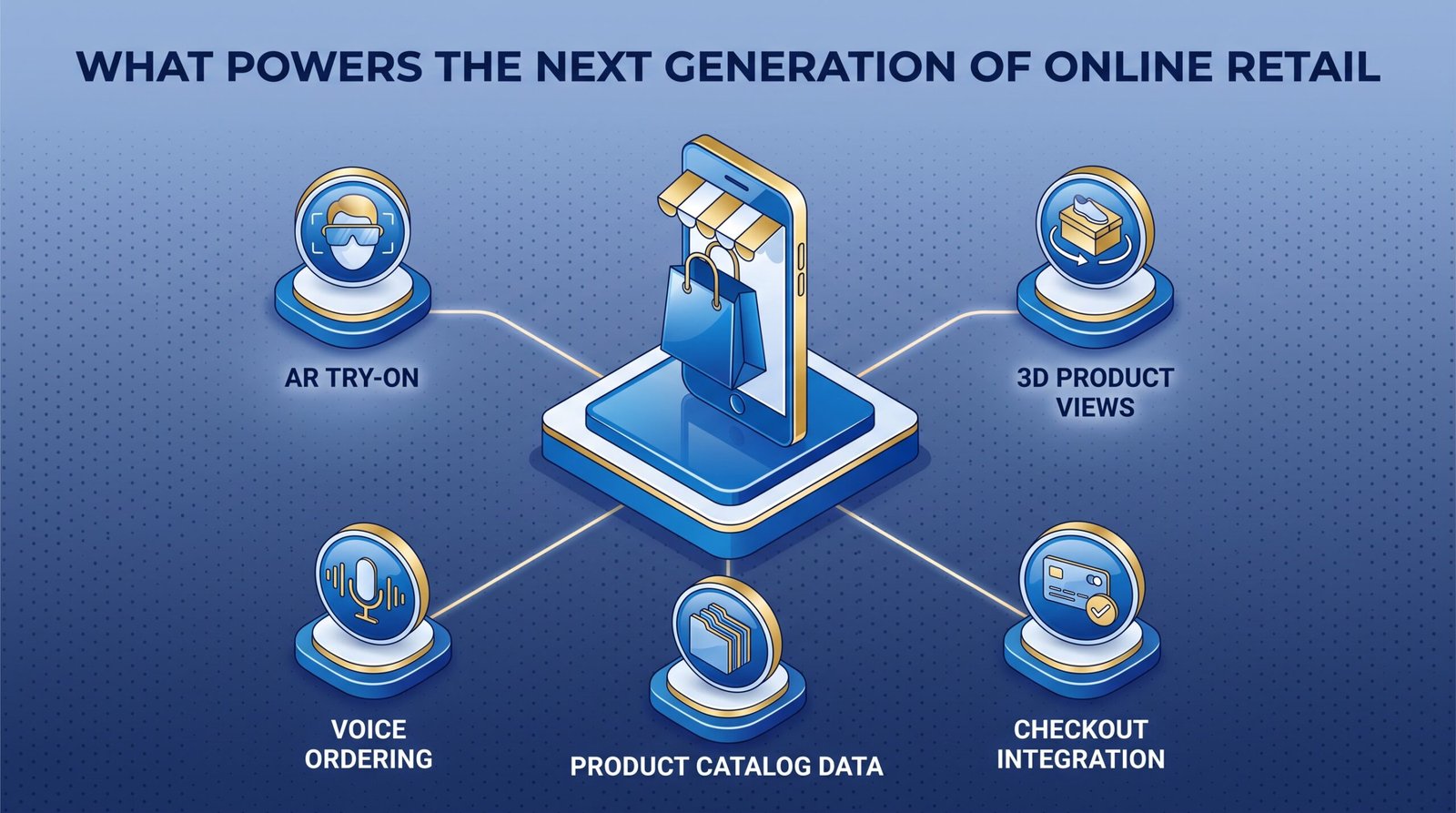
AR and voice look different on the surface. Underneath, they need the same things. Both depend on accurate product data and fast APIs. Both also need a checkout that works smoothly on a phone.
If your product catalog has missing attributes, AR will place the wrong size and voice search will return the wrong results. If your APIs respond slowly, both experiences feel broken. Shoppers forgive a slow static page more readily than a slow interactive feature.
That shared foundation is good news. You can invest in it once and then add AR, voice, or both as your strategy evolves. A strong base in ecommerce website development makes every later feature cheaper to build.
What You Need Before You Build
3D assets. AR needs a 3D model for every product you want to show. Photogrammetry or CAD conversion can produce them, and the cost scales with catalog size. Start with your best sellers.
Structured product data. Voice and AR both read your catalog. Dimensions, materials, colors, and variants must live in consistent fields.
Performance. AR models must load quickly on mid-range phones. Compress your assets and test on real devices. Our mobile app development team tunes this for native experiences, and our website design and development team does the same for the browser.
Privacy and consent. AR uses the camera, and voice uses the microphone. Ask for permission clearly, explain why you need it, and state how you handle the data.
A clear interface. Shoppers need to find the AR button and understand what happens next. Good UX and UI design makes the difference between a feature people try once and one they keep using. Our primer on what UX and UI design involves covers the basics.
Where Each Technology Works Best Today
AR delivers the most value where fit, scale, or appearance drives the purchase decision. Furniture, eyewear, cosmetics, and home improvement all fit that description. A shopper who sees a couch in their living room feels more confident about size and color.
Voice delivers the most value where speed and repetition matter. Grocery reorders and order status checks suit it well. A shopper with full hands can still complete a purchase.
Neither technology suits every catalog. A store that sells commodity items with little visual variety gains little from AR. A store with a large, complex range gains little from voice-only ordering. Match the technology to the buying decision.
Mistakes to Avoid
Teams repeat the same errors with these projects.
The first mistake is building AR for the sake of novelty. If the feature does not answer a real customer question, shoppers ignore it. Start with the question, such as whether the item will fit in the room, and design the feature around it.
The second mistake is poor 3D quality. A model that looks cartoonish or has the wrong scale damages trust. Bad AR performs worse than no AR.
The third mistake is treating voice as a separate channel. Voice orders must connect to the same inventory, pricing, and fulfillment systems as your website. Otherwise you create stock errors and confused customers.
The last mistake is skipping measurement. Track conversion, return rates, and usage for each feature. Decide what success looks like before launch.
How to Start With a Pilot
Run a small pilot before you commit to a full rollout.
Pick one product category where AR or voice has an obvious benefit. Build 3D models or voice flows for a limited set of items. Launch to part of your audience and compare the results against a control group.
Review the data after a few weeks. Look at engagement, conversion, and returns. If the numbers justify it, expand. If they do not, you learned cheaply.
We build the supporting pieces: product data pipelines, APIs, storefront integration, and mobile experiences. If you want to scope a pilot, reach out to our team.
FAQ
The difference between AR shopping and voice commerce?
AR shopping shows products visually in a shopper’s own space. Voice commerce lets shoppers search and order by speaking. They solve different friction points.
Do shoppers need an app to use AR shopping?
No. Web-based AR runs in the mobile browser. Native apps offer smoother performance, but the browser option reaches more shoppers.
Is AR shopping expensive to build?
The main cost comes from creating accurate 3D models. Starting with your best sellers keeps the first investment manageable.
Can small businesses use these technologies?
Yes, through a focused pilot. Start with one category and expand based on measured results.
Give Shoppers Fewer Reasons to Leave
AR shopping and voice commerce remove two of the biggest frictions in online retail: uncertainty and
effort. AR answers the question of whether a product will work for the shopper. Voice answers the
question of whether they can skip the typing.
Success comes from solid fundamentals and a focused pilot, not from chasing every new feature. Clean data, fast APIs, and clear design come first.
Contact Innosaber to plan a pilot that fits your catalog and your customers.
