
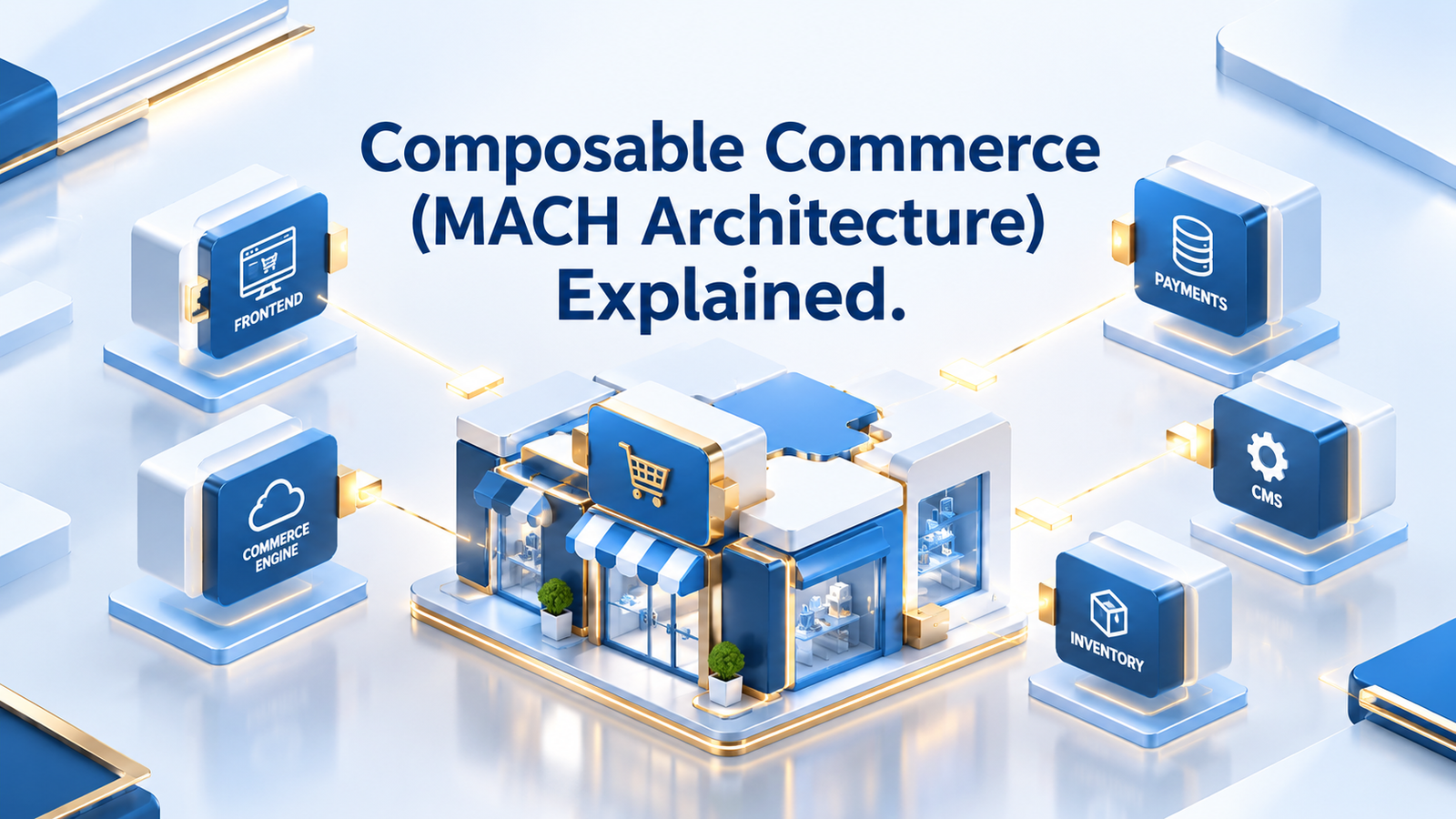
TL;DR: Composable commerce assembles your store from independent services that talk through APIs, and MACH architecture gives you four principles to do it safely: microservices, API-first, cloud-native SaaS, and headless.
Most online stores run on one platform that does everything. Catalog, cart, checkout, promotions, and content all share a single codebase. That setup works until you need to change one piece. Then every change touches everything, and a simple update turns into a long release cycle.
Composable commerce solves that problem. We assemble the store from independent services and connect them through APIs. MACH architecture gives that approach its rules. This guide explains what MACH means, when composable commerce pays off, and what it demands from your team.
What Is Composable Commerce?
Composable commerce treats your store as a set of building blocks. Each block does one job and talks to the other blocks through an API. Search is one block and checkout is another. Promotions and payments each get their own, and so does content management.
When a block stops fitting your needs, you replace it. The rest of the store keeps running.
A monolithic platform works differently. It bundles every function into one system. You get a fast setup and a single vendor to call. You also get tight coupling, so a change to checkout can break your product pages.
You can see the appeal of the composable model. It trades some simplicity for a lot of flexibility. Your team picks the best tool for each job instead of accepting whatever the platform includes.
What Does MACH Stand For?
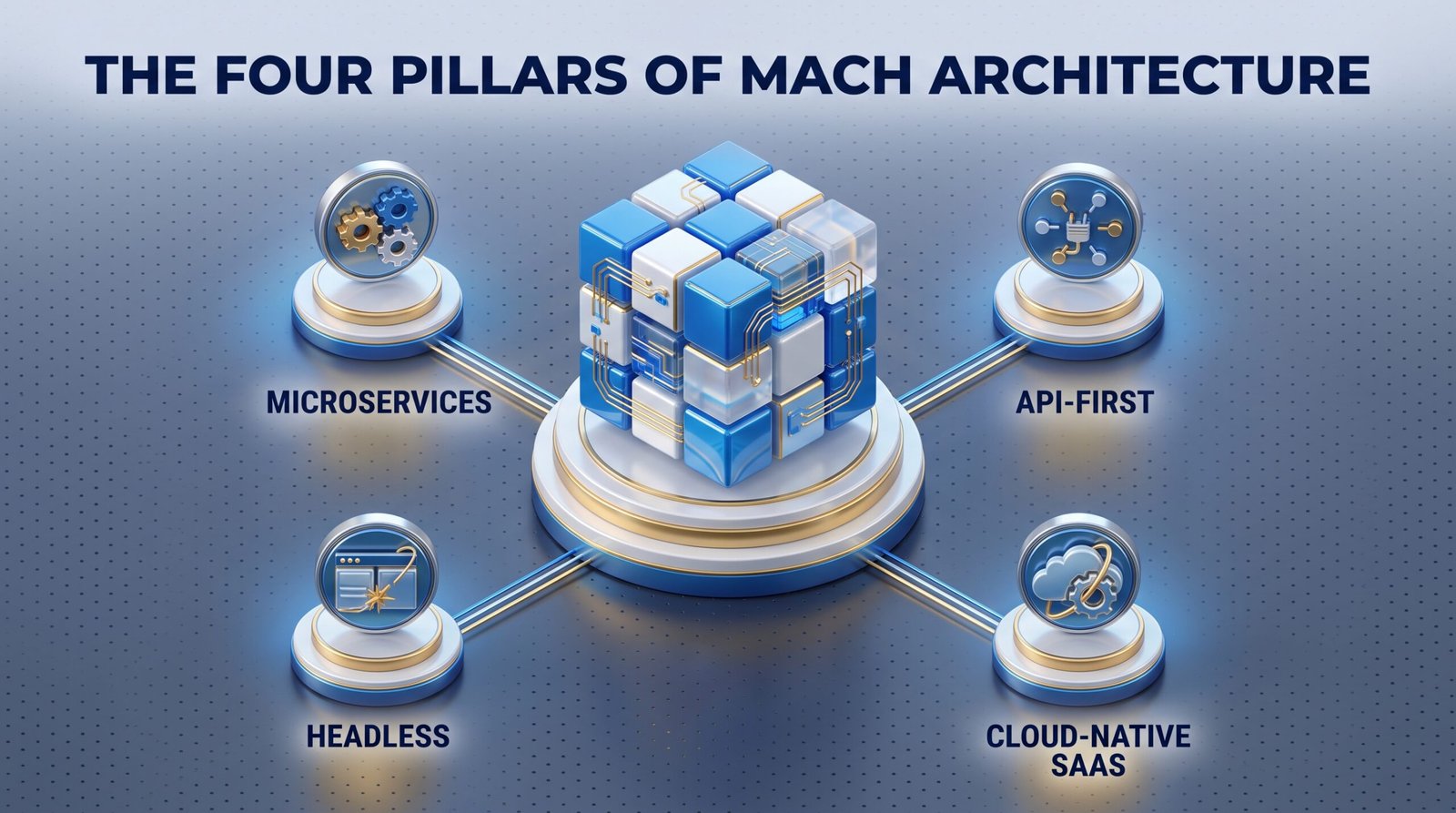
MACH is an acronym for four principles. Together they describe how a composable store should work.
Microservices. Each business function runs as its own small service. The cart service does not depend on the search service. You can update, scale, or replace one without touching the others. Our custom software solutions team builds services this way when a store needs functions that off-the-shelf tools do not cover.
API-first. Every service exposes its features through an API before anything else. Your storefront, mobile app, and in-store kiosk all call the same APIs. That consistency lets you launch a new channel without rebuilding your commerce logic.
Cloud-native SaaS. The services run in the cloud as managed software. Your vendors handle updates and scaling, so your team stops patching servers. A traffic spike during a sale becomes the vendor’s problem to absorb. If you need help choosing a hosting approach, our cloud services team can advise.
Headless. The front end separates from the back end. Your commerce engine stores products and processes orders, while a separate front end controls what shoppers see. Designers can change the storefront freely because the back end does not care how it looks. Our website design and development team builds these front ends.
Composable Commerce vs Headless Commerce
People often use these two terms as if they mean the same thing. They do not. Headless commerce splits the front end from the back end. That is one change. Composable commerce goes further and splits the back end itself into independent services.
Think of headless as the first step. You can run a headless store on a single commerce platform and still depend on that platform for everything behind the scenes. A composable store breaks that dependence. Each function becomes a component you can swap.
That difference matters when you evaluate vendors. A vendor that sells a headless storefront does not necessarily offer composable commerce. Ask whether you can replace search, promotions, or checkout independently.
When Composable Commerce Pays Off
Composable commerce does not suit every store. It pays off in specific situations.
First, consider how many channels you sell through. A business with several storefronts, regions, or brands benefits from shared services behind different front ends. You build the product catalog once and reuse it everywhere.
Second, look at how fast you need to change. If your marketing team wants to test new experiences weekly, a monolith slows them down. A composable store lets you ship front-end changes without waiting on back-end releases.
Third, check how unusual your requirements are. Complex pricing rules, custom checkout flows, and deep ERP integration all strain standard platforms. Composable architecture gives you room to build those pieces properly. Our enterprise software solutions often involve connecting commerce services to ERP and inventory systems.
Last, think about growth. A store that hits the limits of its platform every year pays a hidden tax. Composable commerce removes that ceiling.
The Trade-Offs to Plan For
Composable commerce gives you freedom, and it also hands you responsibility. You should weigh these costs honestly before you commit.
You will manage more vendors. Each service has its own contract, roadmap, and support channel. Someone on your team must own those relationships.
Integration work grows. Services must exchange data reliably, and failures between them are harder to trace than failures inside one system. You need good monitoring from day one.
Your security surface widens too. Every API is a possible entry point. Strong authentication and regular reviews matter, and our cyber security services team can help you build them in.
Finally, you need engineering capacity. Someone must design how the pieces fit together. Smaller stores without that capacity often do better on a well-run single platform. Our guide to what ecommerce website development involves can help you judge where you stand.
How to Move Toward Composable Without Rebuilding Everything
You do not need a big-bang migration. Most teams succeed by replacing one capability at a time.
Start by mapping your current store. List each business function and note where it causes pain. A rigid content system or a slow checkout usually tops the list.
Next, pick one function to replace first. Choose something with clear business value and limited dependencies. Content management and search are common starting points.
Then put an API layer between your current platform and the new service. This layer lets the old and new pieces coexist while you migrate. Measure the result before you move on to the next function.
Repeat the cycle. Over time, the original platform shrinks until you can retire it or leave it handling a small task.
We help businesses plan this path every week. If you want a second opinion on where to start, talk to our team.
FAQ
What does MACH stand for in commerce?
MACH stands for microservices, API-first, cloud-native SaaS, and headless. The four principles describe how to build a store from independent, replaceable services.
Is composable commerce the same as headless commerce?
No. Headless separates the front end from the back end. Composable commerce also splits the back end into independent services that you can swap one by one.
Is composable commerce only for large enterprises?
No, but it suits businesses with complex needs best. Smaller stores with standard requirements often do well on a single platform until their needs outgrow it.
How long does a move to composable commerce take?
It depends on scope. A phased approach that replaces one capability at a time delivers value sooner and avoids a risky full migration.
Swap Parts, Not the Whole Store
Composable commerce rewards businesses that know what they want to change. MACH architecture gives you the principles to make those changes safely: independent services, open APIs, managed cloud software, and a flexible front end.
The right path depends on your channels, your team, and your goals. We start with a clear map of your current store and a small first step. That approach keeps risk low and results visible.
Ready to explore what composable commerce could do for your business? Contact Innosaber and we will help you plan your first move.
