
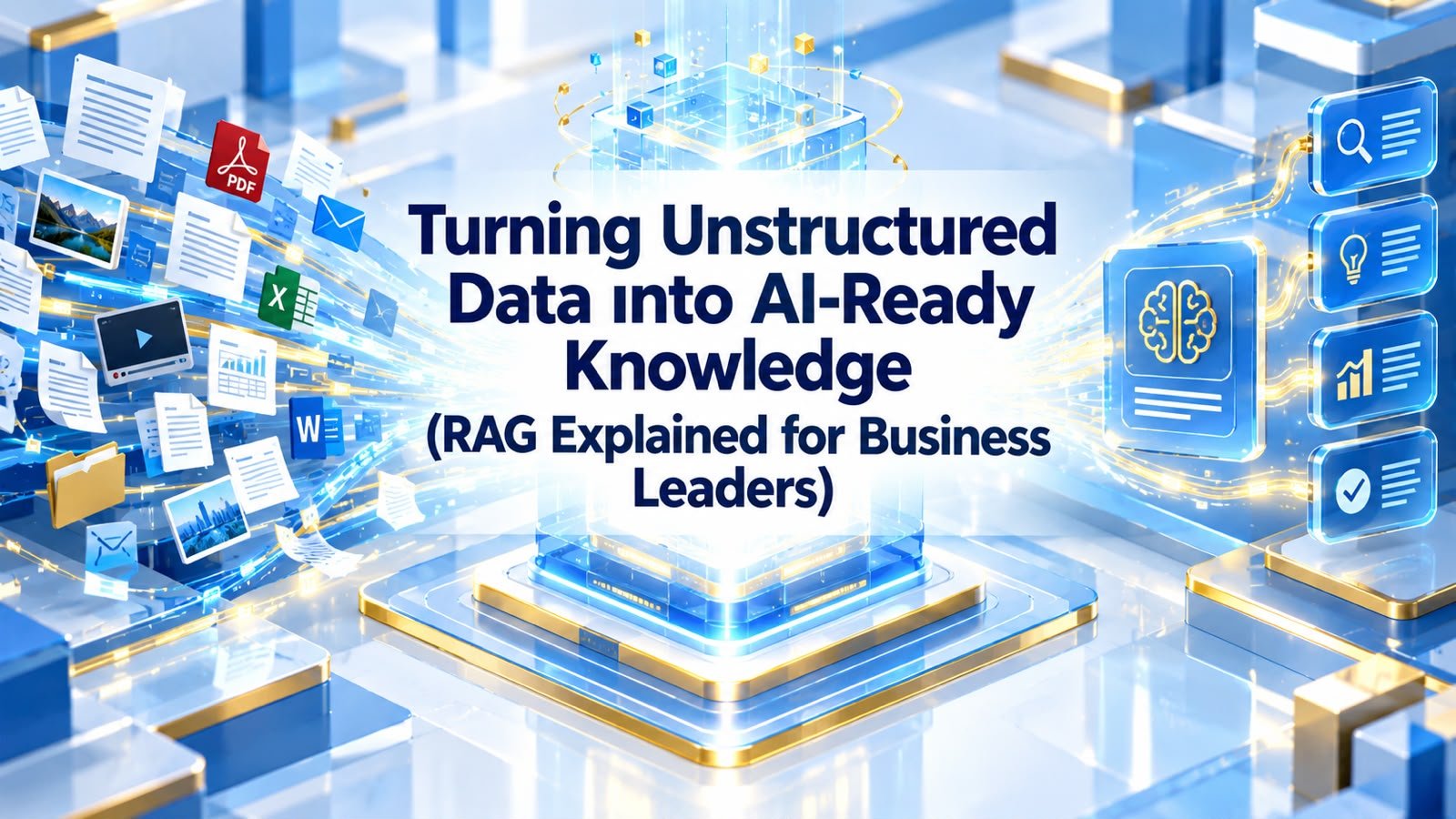
TL;DR: Retrieval-augmented generation (RAG) lets an AI model look up facts in your own documents before it answers, which cuts made-up answers and keeps responses current without retraining the model.
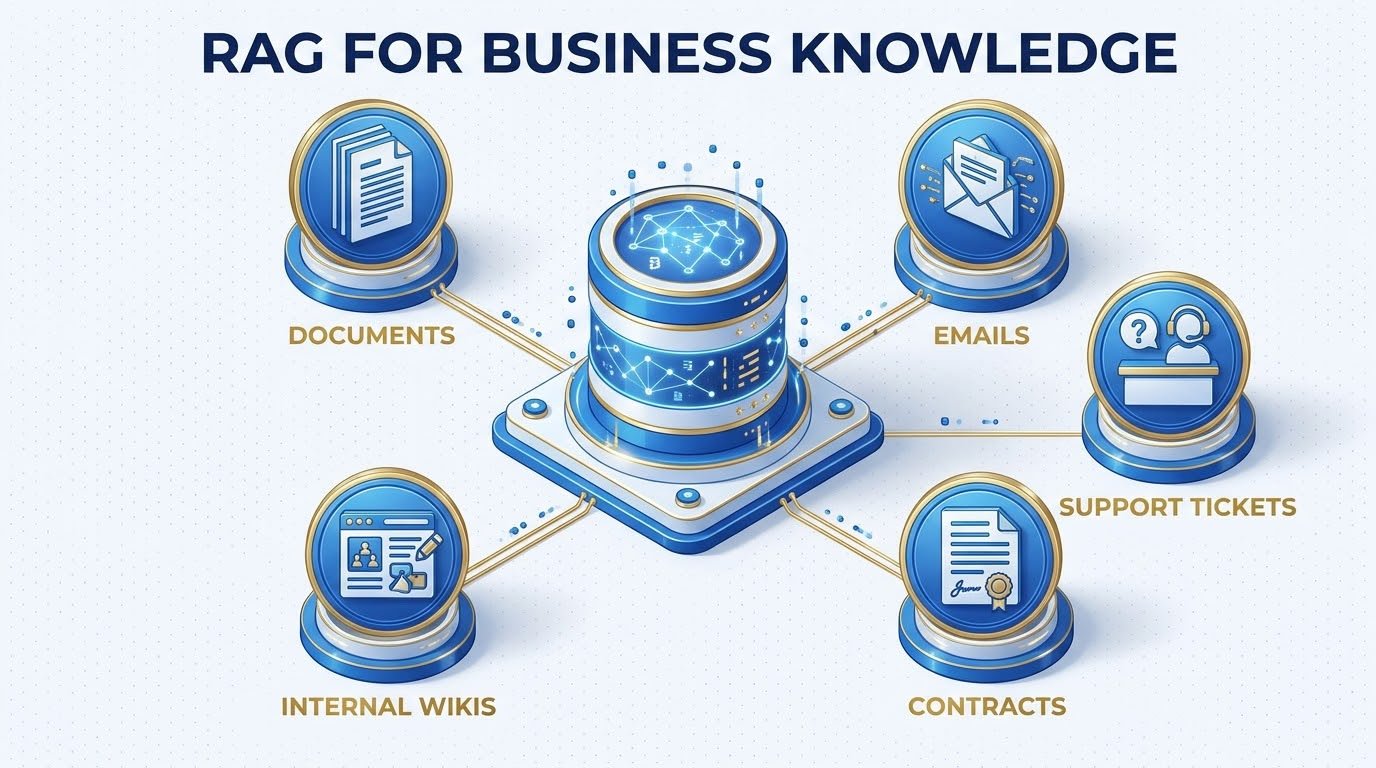
Most of what your company knows sits in unstructured files. Contracts, emails, support tickets, and PDF manuals hold years of answers. No database indexes them, and nobody can search them well.
AI models can read and summarize text, but they know nothing about your business. Ask a general chatbot about your refund policy, and it will guess. Retrieval-augmented generation, or RAG, solves this problem. This guide explains RAG in plain language and shows how to turn your documents into knowledge that AI can use.
What Is RAG?
RAG is a method that connects an AI model to your own information. Instead of answering from memory alone, the model first searches your documents for relevant passages. It then writes its answer from those passages.
Think of an open-book exam. A closed-book student relies on what they memorized. An open-book student checks the source and then answers. RAG gives your AI the open book.
This matters for two reasons. The model stops inventing facts because it has real text to work from. And your answers stay current, because you update the documents instead of retraining the model.
How RAG Works
- Collect. Gather documents from your file stores, email, ticketing tools, and wikis.
- Prepare. Clean the text and split it into small chunks of a few paragraphs each.
- Index. Convert each chunk into a numerical representation called an embedding, and store it in a vector database.
- Retrieve. When someone asks a question, the system finds the chunks that match its meaning.
- Generate. The AI model reads those chunks and writes an answer, ideally with links to the sources.
Steps one to three run ahead of time. Steps four and five run each time a user asks a question.
Why Unstructured Data Is the Hard Part
The AI model is the easy piece. Your data is the hard piece. Files come in mixed formats. Scanned PDFs need text extraction. Old documents contradict new ones. Tables lose their meaning when you cut them into chunks.
Poor data gives poor answers. A RAG system that searches outdated policies will quote outdated policies with confidence. Teams that succeed spend most of their effort on data quality. They remove duplicates and tag each document with a date and an owner. They also refresh the index on a schedule.
Where Businesses Use RAG
- Customer support. Agents and chatbots answer from current product manuals and past tickets.
- Internal knowledge search. Staff ask about HR policies or engineering guidelines and get sourced answers.
- Contract and compliance review. Legal and risk teams find relevant clauses in seconds.
- Sales enablement. Reps pull accurate product details into proposals.
Our AI services team builds these systems for growing businesses. For background on how language models fit into business software, read our guide to harnessing the power of GPT in custom software solutions.
Security and Governance Come First
A RAG system is only as safe as your access rules. If it indexes every file, it can expose a confidential salary sheet to any employee who asks the right question. The system must respect the same permissions as your source systems. Every answer should cite its sources so that people can verify it. Log queries so that you can audit how people use the system. Our cybersecurity services cover these controls.
How to Start With RAG
- Choose one narrow use case with a clear owner, such as support answers for one product line.
- Audit the documents behind it and fix the obvious quality problems.
- Build a pilot with a small group of real users and a set of test questions with known answers.
- Measure accuracy and fix the failures. Widen the scope only after that.
Keep the first project small. RAG rewards teams that test with real questions and improve steadily. A pilot that runs for a few weeks will teach you more than a long planning phase. Ready to turn your documents into working knowledge? Contact our team, and we will scope a pilot with you. We build RAG systems as part of our custom software solutions.
FAQ
What is the difference between RAG and fine-tuning?
Fine-tuning changes the model itself by training it on extra data. RAG leaves the model alone and gives it relevant documents at question time. RAG costs less to update and lets you cite sources, so most businesses start there.
Does RAG stop AI from making things up?
It reduces the problem but does not remove it. A model with good source text makes fewer errors. You still need citations and testing, plus a fallback that says “I don’t know” when the documents lack an answer.
Is my data safe in a RAG system?
It can be, if you design for it. Keep data in your own cloud environment and enforce user permissions at retrieval time. Encrypt the index and the connections between systems.
What kinds of data work with RAG?
Text-heavy sources work best, including PDFs, Word files, emails, wikis, and support tickets. Structured data in databases can join in too, but it usually needs a separate query step.
Your Knowledge Is Already There. Make It Searchable.
RAG turns scattered files into answers that your team and customers can trust. The model matters less than the quality of your data and the strength of your access rules. Get those right and the results follow.
We help businesses design RAG systems that stay accurate and secure. If you want to see what your documents can do, contact Innosaber today.
