
TL;DR: Vibe coding and no-code app builders let anyone generate a working app fast, which is genuinely useful for prototypes and simple internal tools, but most businesses still need real engineering once the product has to scale, integrate deeply, or handle sensitive data.
Type a description of an app and watch a working prototype appear in minutes. That is the promise behind vibe coding and modern no-code app builders. For many use cases, they genuinely deliver on it.
The harder question comes later. What happens when that prototype needs to handle real users, real data, and real business requirements? That is usually where the gap between a fast start and a finished product shows up.
What Vibe Coding and No-Code Builders Actually Do
Vibe coding lets an AI model generate working code from a natural language description, refined through further prompts. No-code builders take a different route. They use drag-and-drop interfaces with pre-built logic blocks, templates, and connectors instead of code at all.
Both approaches lower the barrier to building something functional. They let a non-technical founder or a small team ship a working version of an idea without hiring a full engineering team first.
Where They Genuinely Shine
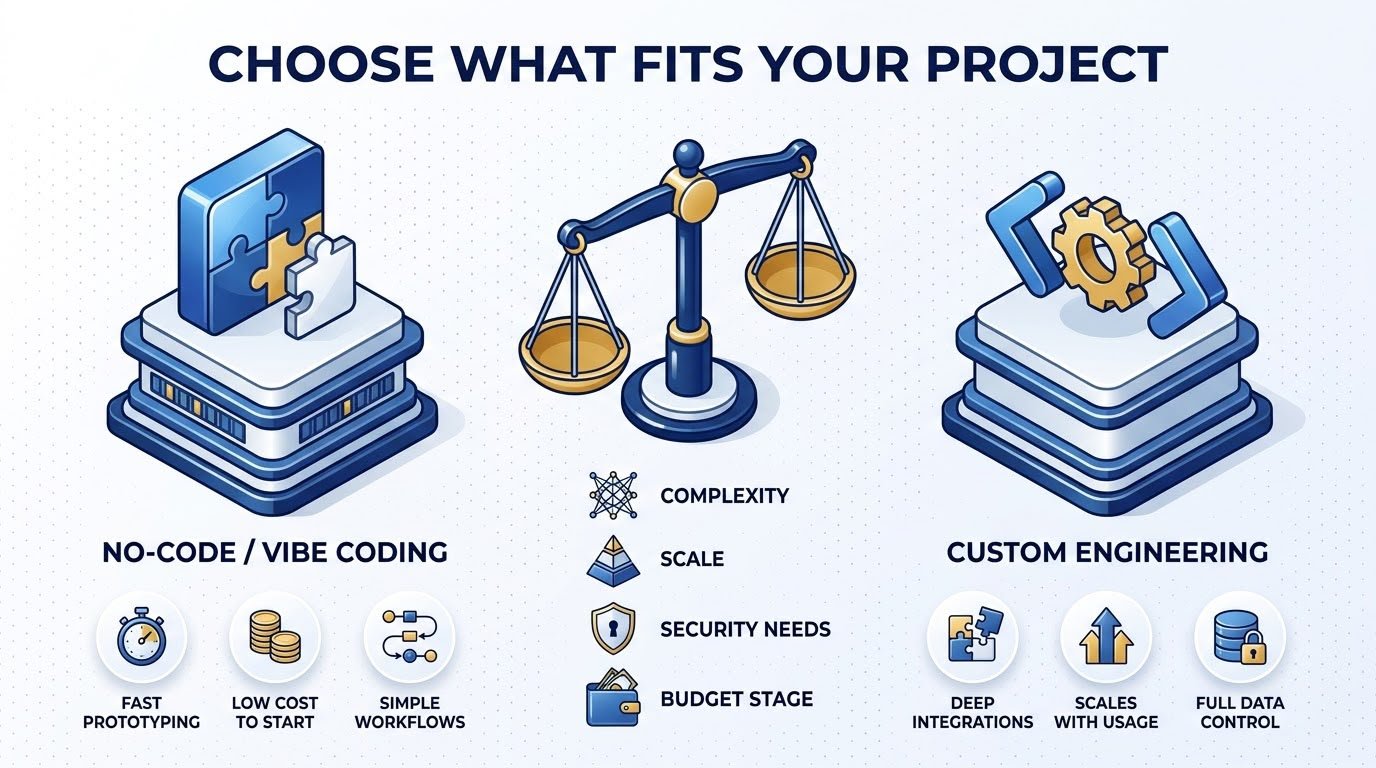
Rapid prototyping is the clearest win. A founder can validate an idea in days instead of months. Internal tools for a small team are another strong fit, especially simple workflow automation that does not need to scale beyond a handful of users.
They also work well for building an MVP to show investors or gather early user feedback. That feedback often shapes the product more usefully than months of engineering work built on assumptions.
Where They Start to Break Down
Custom business logic beyond what templates support is the first wall most teams hit. Complex integrations with existing systems come next, since no-code connectors rarely cover every edge case a real business needs. Performance at scale is another limit, particularly once many users hit the app at once.
Data security and compliance requirements add further pressure. Sensitive data often needs controls a generic platform was not built to provide. Deep customization and full code ownership become harder too, since the underlying platform still sets the rules.
The Hidden Cost of Outgrowing a No-Code Foundation
Migrating off a no-code platform later is often harder than building custom from the start. The underlying architecture was never designed with a migration path in mind. Data export limitations can make the process slower and messier than expected.
Costs can also scale unpredictably as usage grows on some platforms. A tool that felt cheap during the prototype stage can become an expensive constraint once the product actually succeeds.
A Practical Way to Use Both
Use no-code or vibe coding to validate an idea quickly and cheaply. Once the product proves it needs to scale, integrate deeply, or handle sensitive data, bring in real engineering to build the version meant to last.
Our custom software team regularly helps businesses make this transition. We take a validated prototype and rebuild the parts that need real engineering, without throwing away everything that already works.
FAQ
Is vibe coding the same as no-code?
Not exactly. Vibe coding usually generates actual code through AI prompts. No-code tools use visual interfaces with pre-built blocks instead of code at all. Both aim to lower the barrier to building.
Can a no-code app handle a growing user base?
Some can scale reasonably well, but most hit limits around performance, customization, or cost once usage grows significantly.
When should businesses switch from no-code?
Once the product needs deep integrations, handles sensitive data, or requires business logic the platform’s templates cannot support.
Is no-code prototyping a waste before custom development?
No. A no-code prototype is often the fastest, cheapest way to validate that an idea is worth the investment before committing to custom engineering.
Prototype Fast, Build to Last
Vibe coding and no-code builders have earned their place in the mobile development process. They are genuinely the fastest way to test an idea before spending real engineering budget on it.
The businesses that get burned are the ones that treat a no-code prototype as a finished product instead of a first draft.
If your no-code app is starting to hit real limits, talk to our development team about what a custom rebuild would actually take.
