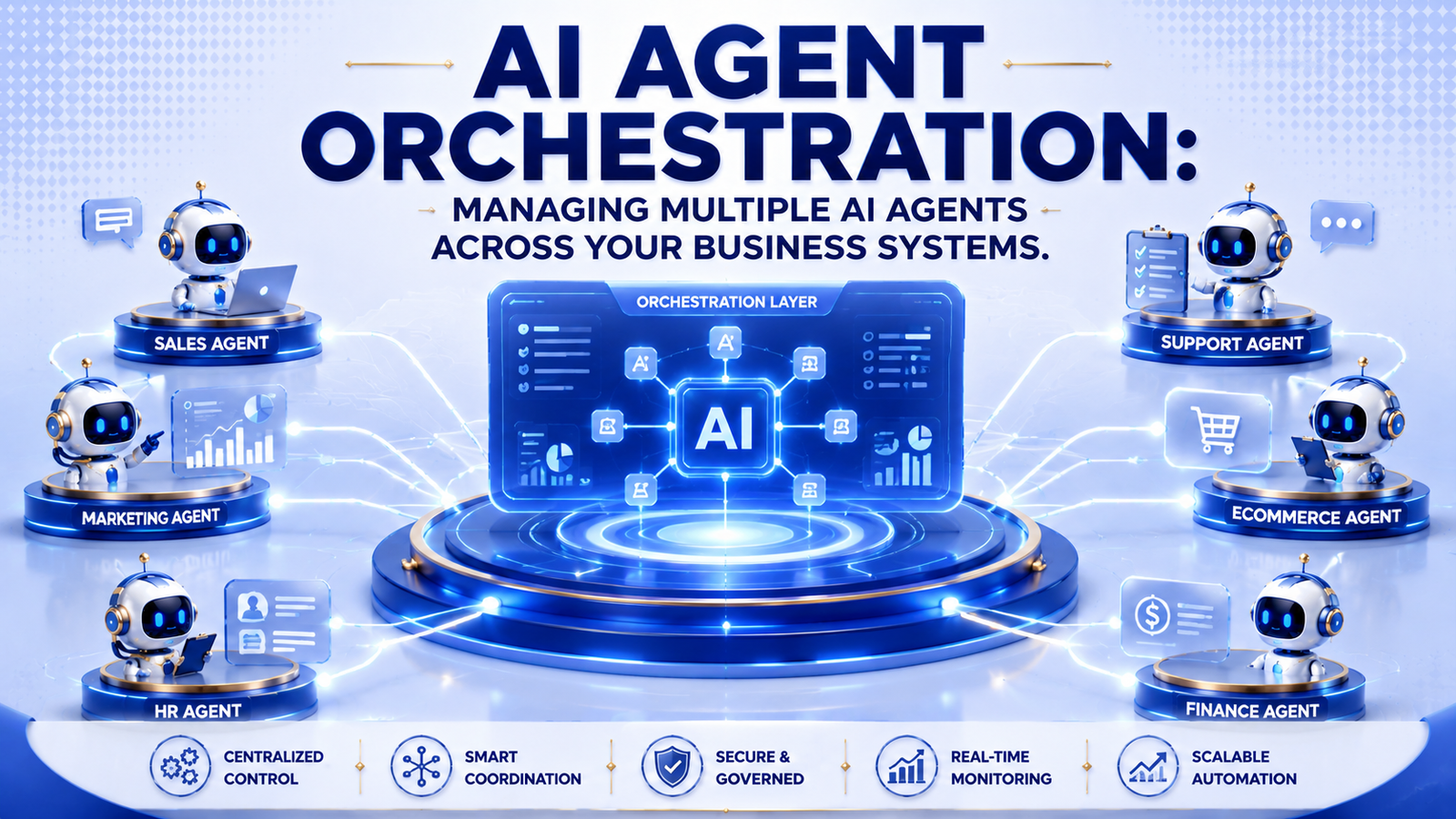
TL;DR: As businesses roll out more than one AI agent across departments, orchestration, the practice of coordinating what each agent does, when, and with what data, becomes the difference between real efficiency and operational chaos.
Most businesses start their AI agent journey with one agent handling one task, such as answering customer questions or pulling reports. That single agent is easy to manage. The trouble starts once a second agent joins, then a third, each built for a different department and often by a different team.
Without a plan for how these agents interact, businesses end up with agents duplicating work, contradicting each other, or competing for access to the same systems. Orchestration is what keeps multiple agents working toward the same outcome instead of against each other.
What Is AI Agent Orchestration?
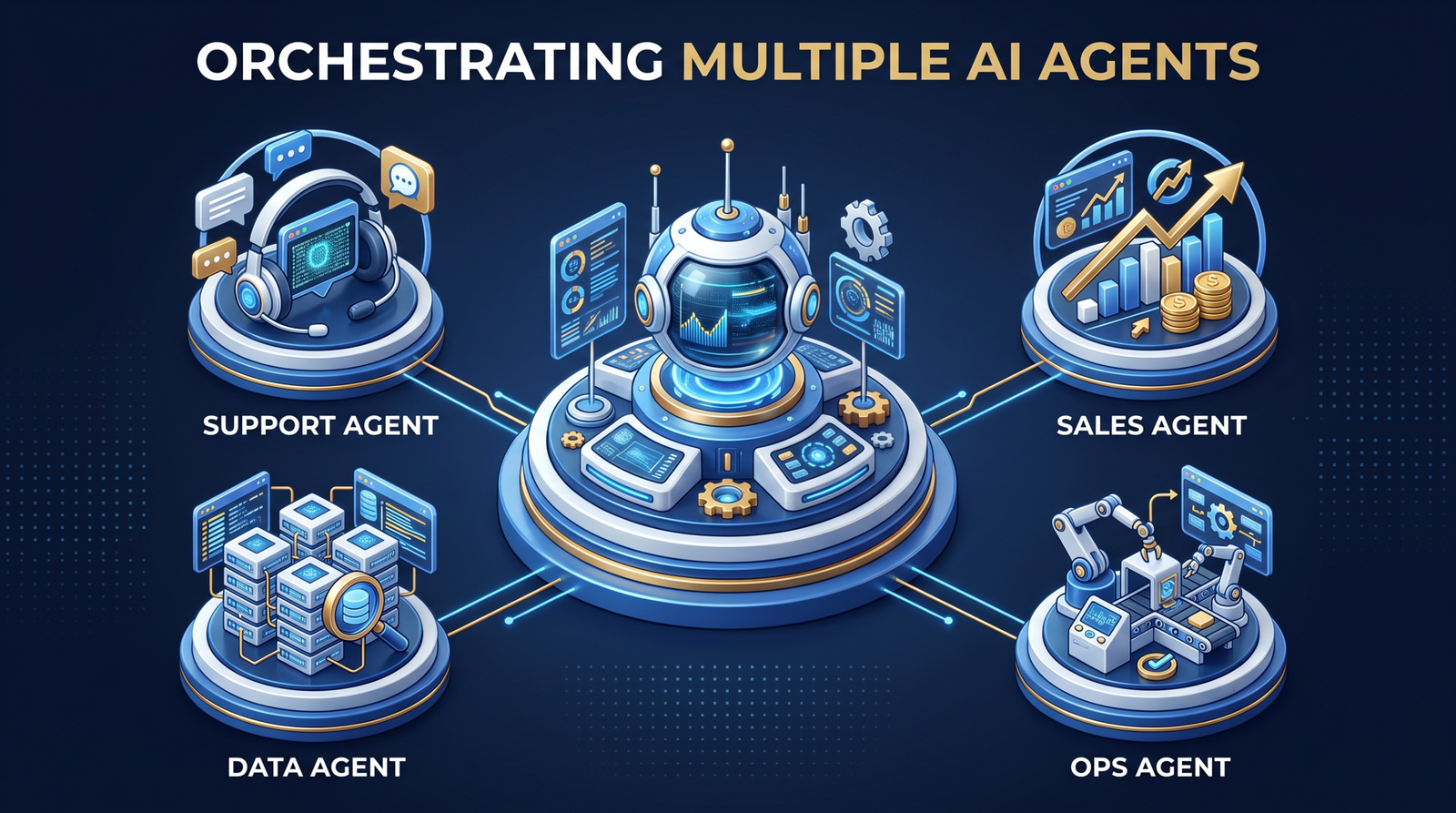
Orchestration is the layer that decides which agent handles which task, in what order, and with what data. Instead of every agent acting independently, an orchestration layer routes work between agents, resolves conflicts when two agents could handle the same request, and keeps a shared record of what has already been done.
Why One Agent Is Rarely Enough
A single general-purpose agent sounds simpler, but it usually performs worse than several focused agents working together. A support agent needs deep knowledge of your ticketing system. A sales agent needs deep knowledge of your CRM. Trying to make one agent expert in everything usually makes it mediocre at all of it.
As businesses lean further into AI-driven workflows, the number of narrow, specialized agents tends to grow faster than expected, which makes coordination a real operational question rather than a future one.
Core Components of an Orchestration Layer
- A routing mechanism that decides which agent should handle a given request based on its scope and permissions.
- Shared context or memory so agents do not repeat work or contradict a decision another agent already made.
- Conflict resolution rules for when two agents could reasonably act on the same task.
- Monitoring and logging so a human can see what each agent did and why, especially across enterprise systems handling sensitive data.
Common Failure Points When Agents Aren’t Coordinated
The most common failure is silent duplication, where two agents both act on the same customer request without knowing about each other, leading to conflicting emails or duplicate orders. Another common issue is permission sprawl, where each agent was given broad access to get it working quickly, and nobody scoped those permissions back down later.
These problems rarely show up in a demo with one agent running cleanly. They show up weeks later, once real usage across cloud infrastructure exposes the gaps between agents that were never designed to work together.
Building an Orchestration Strategy for Your Business
Start by mapping which agents exist today, even informally built ones, and what each one is allowed to touch. From there, a lightweight orchestration layer, even a simple routing rule set, does more good than adding a fourth agent to an uncoordinated pile. If you are past the point of tracking this on a spreadsheet, talk to our team, and we can help design an orchestration approach that fits your systems.
FAQ
What is AI agent orchestration?
It is the practice of coordinating multiple AI agents so they work together instead of duplicating effort, contradicting each other, or competing for access to the same systems.
How many AI agents does a typical business need?
There is no fixed number. Orchestration becomes necessary as soon as a second agent is added, even if both agents seem to handle unrelated tasks.
What is the difference between orchestration and automation?
Automation handles a single task end to end. Orchestration coordinates multiple automated agents or workflows so they do not conflict with each other.
Where should a business start with agent orchestration?
Start by mapping every agent currently in use and what systems each one can access, then add routing and permission rules before adding more agents.
Coordination Is the Next Competitive Advantage
Adding more AI agents without a coordination plan creates more work, not less. Orchestration is what turns a pile of individually useful agents into a system that actually saves time.
The businesses ahead on this are not the ones with the most agents. They are the ones who scoped permissions and routing before their agent count got out of hand. Contact Innosaber to build an orchestration strategy for your AI agents.