TL;DR: AI shopping agents already browse, compare, and buy on behalf of customers, so your store needs structured data, dependable APIs, and an agent-readable checkout to stay visible and transactable in 2026.
A growing share of online shopping traffic no longer starts with a person clicking through a browser. It starts with an AI agent acting on a shopper’s behalf, comparing prices, checking stock, and completing checkout in seconds. Store owners who invested heavily in website design and development built for human eyes are noticing something strange: some of their best products stay invisible to these agents, even when the products are in stock and competitively priced.
We call this shift agentic commerce, and it changes what “store readiness” actually means. A fast, attractive storefront is no longer the finish line. Your store also needs to speak a language that AI agents understand: structured, verifiable, and machine-readable. This article breaks down what agentic commerce involves and what to fix first.
What Is Agentic Commerce?
Agentic commerce describes shopping tasks that an AI agent completes on a person’s behalf, rather than a human clicking through pages manually. A shopper might ask an assistant to find a specific product, compare three retailers, and place the order automatically once it finds the best match. The agent reads product pages, checks pricing and availability, and in some cases pays and checks out without a human touching the site.
This is different from a chatbot answering questions. The agent takes real action: it adds items to a cart, applies a discount code, and submits payment. Retailers who treat this as a future problem are already losing sales to competitors who use AI services to make their sites legible to these systems today.
How AI Shopping Agents Discover and Evaluate Your Store
Agents rely on the same signals search engines have used for years, pushed further. They read structured product data (schema.org markup, product feeds), check whether prices and stock levels are accurate in real time, and look for a checkout flow that does not require a human to solve a CAPTCHA or read a pop-up. If your ecommerce website development foundation renders prices only through client-side JavaScript that a crawler cannot parse, an agent may skip your store and buy from a competitor instead.
Accuracy matters more than ever. An agent that receives incorrect stock data once is unlikely to trust that source again, and it has no loyalty to keep trying.
A Readiness Checklist for Agent-Friendly Stores
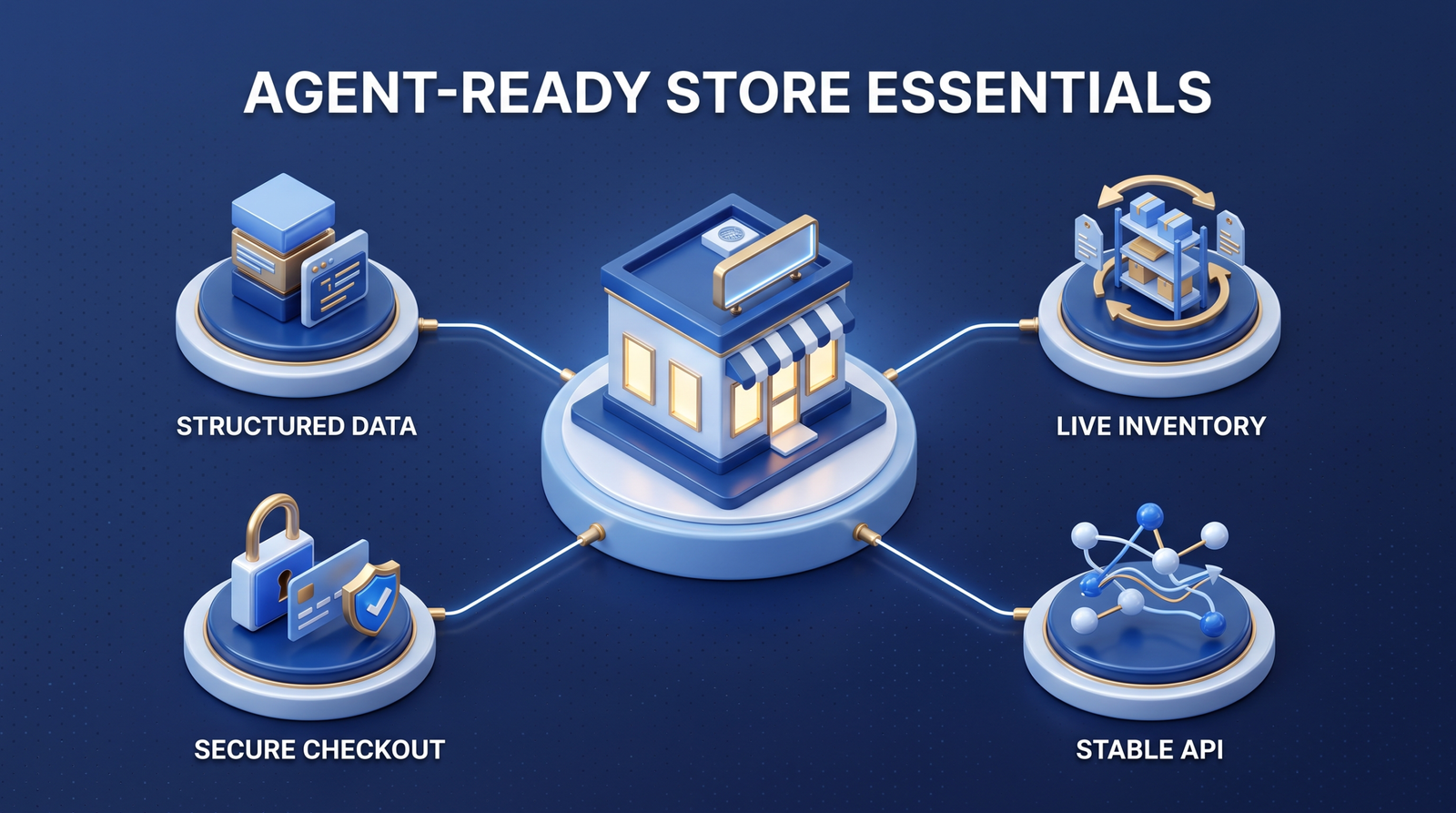
A few fixes cover most of the gap between a human-only storefront and one that agents can transact with confidently:
- Structured product data. Implement complete schema.org markup for price, availability, SKU, and reviews on every product page.
- Machine-readable feeds. Keep a clean, current product feed that mirrors what your website actually shows, so agents never receive conflicting information.
- Stable, documented APIs. Expose inventory and pricing through an API an agent can query directly instead of scraping rendered HTML.
- Predictable checkout. Reduce steps that assume a human is present, such as image CAPTCHAs, and keep policy text (returns, shipping, warranty) in plain, parseable copy.
- Consistent identifiers. Use the same SKU and product ID across your site, feed, and marketplace listings so an agent can confirm it found the right item.
Common Pitfalls That Keep Agents From Completing Purchases
The most common blockers are quiet ones. Pricing that only appears after a script runs, inventory numbers that lag behind the warehouse system, and login walls placed before an agent can even view a product page all push agents toward a competitor. None of these problems show up in a normal human walkthrough of the site, which is exactly why they go unnoticed until traffic and conversion data start looking off.
Security controls built for bot traffic are another factor. Aggressive bot-blocking rules protect a store from scrapers and fraud, but they can also block legitimate shopping agents acting on a real customer’s behalf. Getting this balance right usually requires custom software solutions tuned specifically to your platform rather than a generic plugin.
Getting Your Store Ready
Agentic commerce is not a redesign project. It is an audit of how machine-readable your existing store already is, followed by targeted fixes to data structure, feed accuracy, and checkout flow. Stores that handle this now will keep showing up in agent-driven searches while slower-moving competitors quietly disappear from results they cannot see. If you want a clear picture of where your store stands, talk to our team, and we will walk you through an agent-readiness review.
FAQ
What is an AI shopping agent?
An AI shopping agent is a software assistant that searches, compares, and purchases products on a person’s behalf, often across multiple retailers, without a human clicking through each page manually.
Do I need to rebuild my website for agentic commerce?
Usually not. Most stores need targeted fixes to structured data, product feeds, and checkout flow rather than a full rebuild.
How is agentic commerce different from regular SEO?
SEO optimizes for human search behavior and ranking signals. Agentic commerce readiness optimizes for machine-readable accuracy, since an agent acts on the data directly instead of a person interpreting a page.
What is the first step to make my store agent-ready?
Start with a data accuracy audit: confirm your schema markup, product feed, and live inventory all match exactly what a customer sees on the page.
The Storefront of 2026 Serves Two Audiences
Your store now has two audiences: the people browsing it and the agents shopping on their behalf. Both need accurate, consistent, easy-to-parse information to trust what they find and complete a purchase.
The retailers who treat agent readiness as a data and infrastructure problem, not a marketing one, are the ones who will keep appearing in results they cannot directly see or control.
Contact Innosaber to get an agent-readiness review for your store.