TL;DR: AI search visibility means structuring your content so tools like ChatGPT and Gemini can find it, understand it, and cite your business when someone asks a relevant question.
A growing share of buyers now open an AI assistant before they open a search engine. They ask ChatGPT to compare vendors, ask Gemini to explain a technology, or ask Perplexity for a shortlist of providers. If your business never shows up in those answers, you are losing the exact moment a prospect is forming an opinion about who to call. We call this problem AI search invisibility, and it has a fix. This guide walks through how AI engines pick their answers, why ranking well on Google no longer guarantees a mention in an AI response, and what we do at Innosaber to help our clients close that gap.
How AI Search Engines Actually Find Answers
Traditional search engines rank pages and let the user click through. AI engines skip that step. They read a set of sources, extract the parts that answer the question, and generate a single response in their own words, sometimes with a citation and sometimes without one.
That process depends on the engine finding content that states an answer plainly. If your site buries the useful fact three paragraphs into a story-style introduction, the model may never reach it. If a competitor states the same fact in the first sentence of a well-structured page, the model reads that instead.
Why Traditional SEO Doesn’t Guarantee AI Visibility
Keyword-focused SEO still matters, but it optimizes for a different goal: getting a human to click a blue link. AI engines don’t click. They summarize. A page can rank on page one of Google and still be skipped by an AI assistant if it doesn’t answer the question directly enough for the model to extract a clean sentence from it.
This is the gap that Answer Engine Optimization, or AEO, is built to close. AEO treats every page as a potential source of a quoted or paraphrased answer, not just a destination for a click.
The Building Blocks of Answer Engine Optimization
AEO borrows from SEO but adds a few habits that matter specifically to language models reading your content.
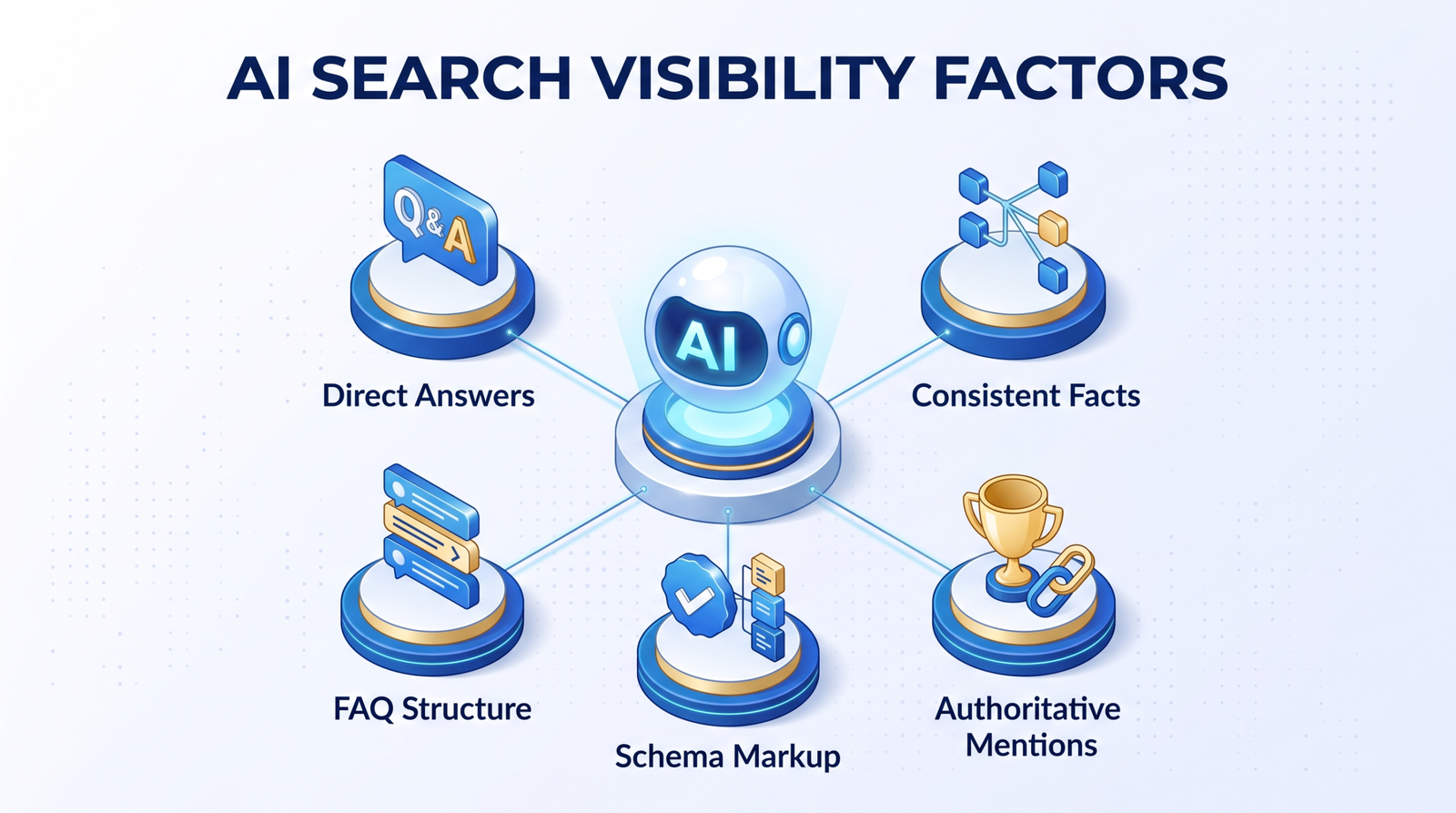
- Direct answers up front: state the conclusion in the first sentence of a section, then explain it.
- Clear question-and-answer formatting: FAQ sections written the way a person would actually ask.
- Structured data: schema markup that tells a crawler exactly what an article, product, or service page contains.
- Consistent facts across your site: contradicting numbers or claims on different pages erode a model’s confidence in citing you at all.
- Authoritative external mentions: press coverage, directories, and partner sites that reference your business by name.
Structuring Content So AI Models Can Cite You
Every page on your site is a candidate source. The pages that get cited share a pattern: a short, quotable answer near the top, followed by supporting detail, followed by a specific next step. When we rebuild a client’s information architecture through our website design and development work, we design pages around that pattern rather than around a narrative arc built for a human skimming a blog.
Product and service pages benefit from the same discipline. A page that opens with a plain description of what the service does and who it’s for gives an AI model something concrete to quote. A page that opens with a mission statement gives it nothing.
Measuring Whether AI Engines Already Know Your Business
Before investing in AEO, check where you already stand. Ask ChatGPT, Gemini, and Perplexity direct questions a prospect would ask, such as who provides a certain service in your city or how your category of product compares. Note whether your business appears, whether the facts cited about you are accurate, and which competitors show up instead.
If your business is missing or misrepresented, the fix usually starts with restructuring your content and reinforcing it with the right technical foundation. Our team builds this into every AI-powered solutions engagement, alongside the custom software development work that often needs to happen underneath it. If you want a clear picture of where you stand today, talk to our team, and we’ll run an AI visibility check on your current site.
FAQ
What is Answer Engine Optimization (AEO)?
AEO is the practice of structuring content so AI systems like ChatGPT and Gemini can extract a clear, accurate answer from it, rather than optimizing purely for human clicks and search engine rankings.
Does ranking well on Google mean I’ll show up in AI answers?
Not automatically. AI engines read and summarize content rather than ranking links, so a page can perform well in traditional search and still be skipped if it doesn’t state its answer clearly.
How long does it take to see results from AEO?
Most businesses notice a shift within a few months of restructuring key pages and reinforcing facts across the site, since AI engines rely on regular crawls rather than a single index update.
Do I need to abandon my existing SEO strategy?
No. AEO builds on solid SEO fundamentals like clean structure and credible backlinks. It adds a layer focused on making answers extractable rather than replacing what already works.
Showing Up Where the Conversation Already Happens
The shift toward AI-generated answers isn’t a future trend anymore. It’s already changing how people research vendors, compare services, and decide who to trust before they ever visit a website. Businesses that structure their content for this shift show up in those conversations. Businesses that don’t stay invisible, no matter how strong their traditional SEO looks.
Innosaber helps businesses audit their current AI visibility, rebuild key pages around clear and citable answers, and put the technical foundation in place to keep that visibility as AI engines evolve. Get in touch to start with an AI search visibility assessment.