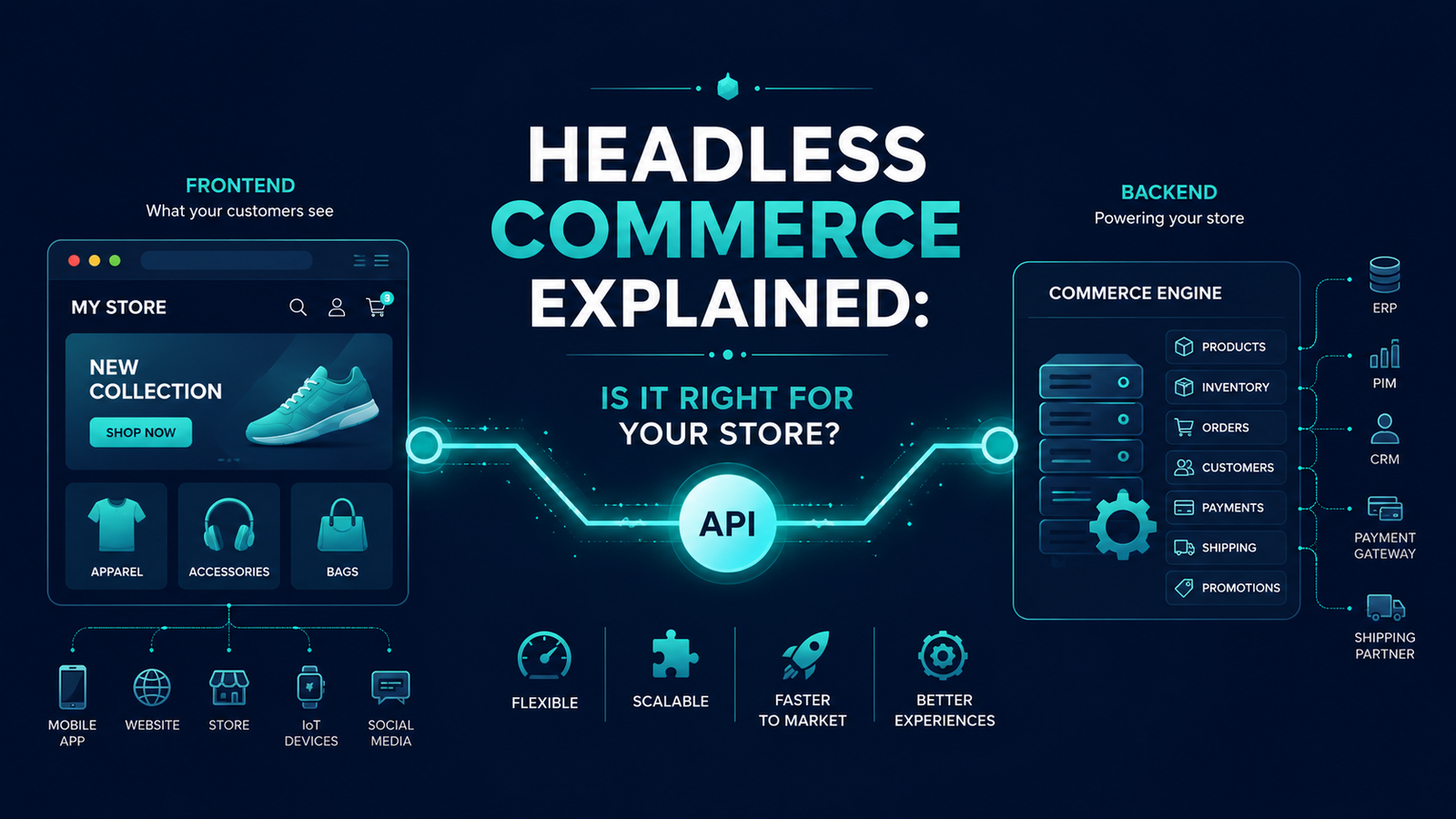
TL;DR: Headless commerce separates your storefront design from your backend engine, giving your business the freedom to build fast, custom shopping experiences without being locked into one platform’s front-end rules.
Every online store runs on two connected systems. One is the storefront customers see. The other manages products, inventory, and payments behind it. Traditional e-commerce platforms bundle both together. Headless commerce splits them apart.
That separation gives growing brands more control over speed, design, and customer experience, but it also introduces real trade-offs. This article breaks down what headless commerce actually means and helps you decide whether it fits your store.
What Is Headless Commerce?
In a headless setup, the backend manages products, orders, inventory, and payments. It operates independently from the frontend, the actual storefront customers browse and buy from. A flexible API connects the two.
This structure lets a business build its storefront using any technology it chooses. It still relies on a proven commerce engine underneath. A custom-built storefront can pull product data from the backend and render it however the brand wants. It works across a website, a mobile app, or even an in-store kiosk.
Headless vs Traditional Commerce Platforms
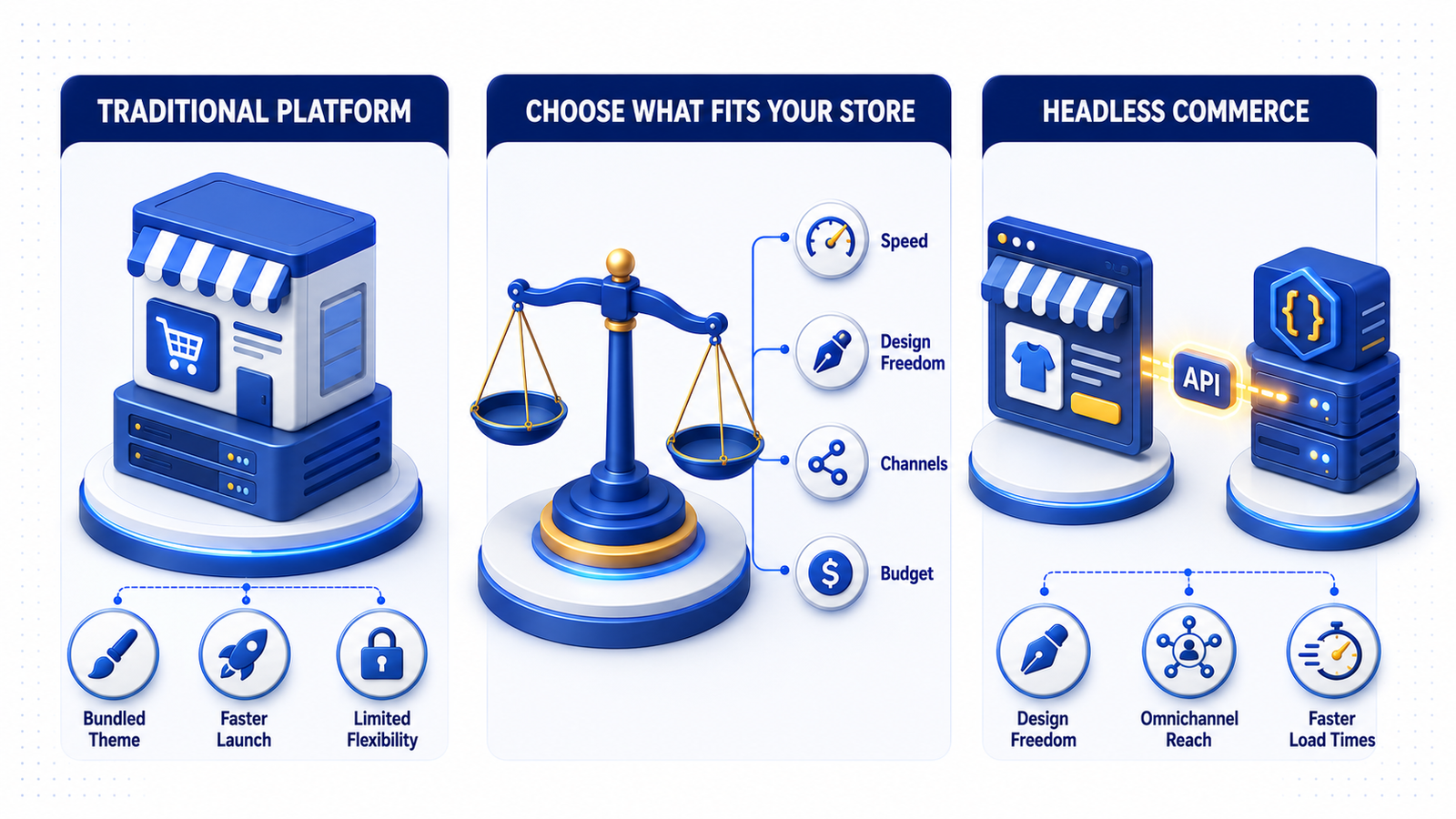
Traditional platforms like a standard Shopify or WooCommerce install bundle the storefront theme and backend logic into one system. This setup gets a store online quickly. It also limits how far the design and functionality can stretch beyond the platform’s built-in templates.
Headless commerce keeps the same reliable backend but replaces the templated storefront with a custom-built one. Our website design and development team typically builds these storefronts using modern frameworks. They load faster and adapt more easily to unique brand requirements.
The choice comes down to a simple trade-off. Traditional platforms favour speed to launch. Headless architecture favours long-term flexibility and performance, at the cost of a more involved build process.
Benefits of Going Headless
Faster load times. A custom frontend, built without the overhead of a full platform theme, typically loads pages faster. That speed directly improves conversion rates and search rankings.
Design freedom. Brands can build exactly the shopping experience they want instead of adapting their design to a platform’s template constraints.
Omnichannel reach. The same backend can power a website, a mobile app, and even physical retail displays. All of them draw from one shared source of product and order data.
Easier scaling. Frontend and backend teams can update, test, and deploy their parts of the system independently. That separation speeds up development as the store grows.
Cloud-native performance. Headless storefronts pair naturally with cloud infrastructure that scales automatically during traffic spikes like seasonal sales.
Signs Your Store Is Ready for Headless
Headless commerce fits certain businesses more clearly than others. A few signals point toward making the switch.
Your current platform’s theme limits your design or feature roadmap. Your traffic spans multiple channels: web, mobile, and marketplace, all of which need to share one product catalogue. Your page speed lags behind competitors despite optimisation efforts. Or your business plans significant growth
and needs an architecture that will not need a full rebuild in two years.
Challenges to Consider Before Switching
Headless commerce is not automatically the right move for every store. The build process takes longer and costs more upfront than a templated platform setup. A development team must design and build the storefront from scratch rather than customise an existing theme.
Ongoing maintenance also requires a development team on hand, rather than a store owner making simple template edits alone. Businesses on a limited budget often get more value from a traditional platform first, then migrate to headless once growth justifies the investment.
How Innosaber Builds Headless Storefronts
Innosaber’s e-commerce web development team designs and builds headless storefronts backed by scalable cloud infrastructure. This pairing gives brands the speed and flexibility modern shoppers expect, without sacrificing the reliability of a proven commerce backend.
We assess your current platform, traffic patterns, and growth plans before recommending a headless build, a hybrid approach, or platform optimisation. Read more about our approach to e-commerce website development, or reach out to our team for a direct assessment.
FAQ
Is headless commerce only for large enterprises?
No. Headless commerce suits any store that needs design flexibility or multichannel reach, regardless of size. The higher upfront build cost means smaller stores should weigh the investment against their growth timeline.
Does headless commerce work with Shopify?
Yes. Shopify Plus and similar platforms offer headless-ready APIs. A custom storefront can pull data from the Shopify backend while presenting a fully custom design to shoppers.
Why are headless builds more expensive?
Headless builds generally cost more upfront because a development team designs and codes the storefront from scratch. They often reduce long-term costs, though, by avoiding template limitations and expensive platform migrations later.
Can an existing store migrate to headless without losing data?
Yes. A properly planned migration keeps product, customer, and order data intact. It connects the new storefront to the existing backend through the platform’s API, rather than rebuilding the data layer.
How long does a headless commerce build typically take?
Timelines vary with scope, but most headless storefront builds take between two and five months. The exact figure depends on the design complexity, the number of integrations, and the size of the product catalogue.
A storefront that keeps up with how your customers actually shop
Headless commerce is not a trend for its own sake. It solves a specific problem. That problem is the gap between what a growing brand wants its storefront to do and what a templated platform allows.
Innosaber’s web development and cloud teams work together to build storefronts that load fast and scale across channels. Your brand keeps full control over the shopping experience, without losing the reliability of a proven commerce backend.
The right architecture depends entirely on your store’s traffic, catalogue, and growth plans. Getting that assessment right before you build saves significant time and cost down the line.