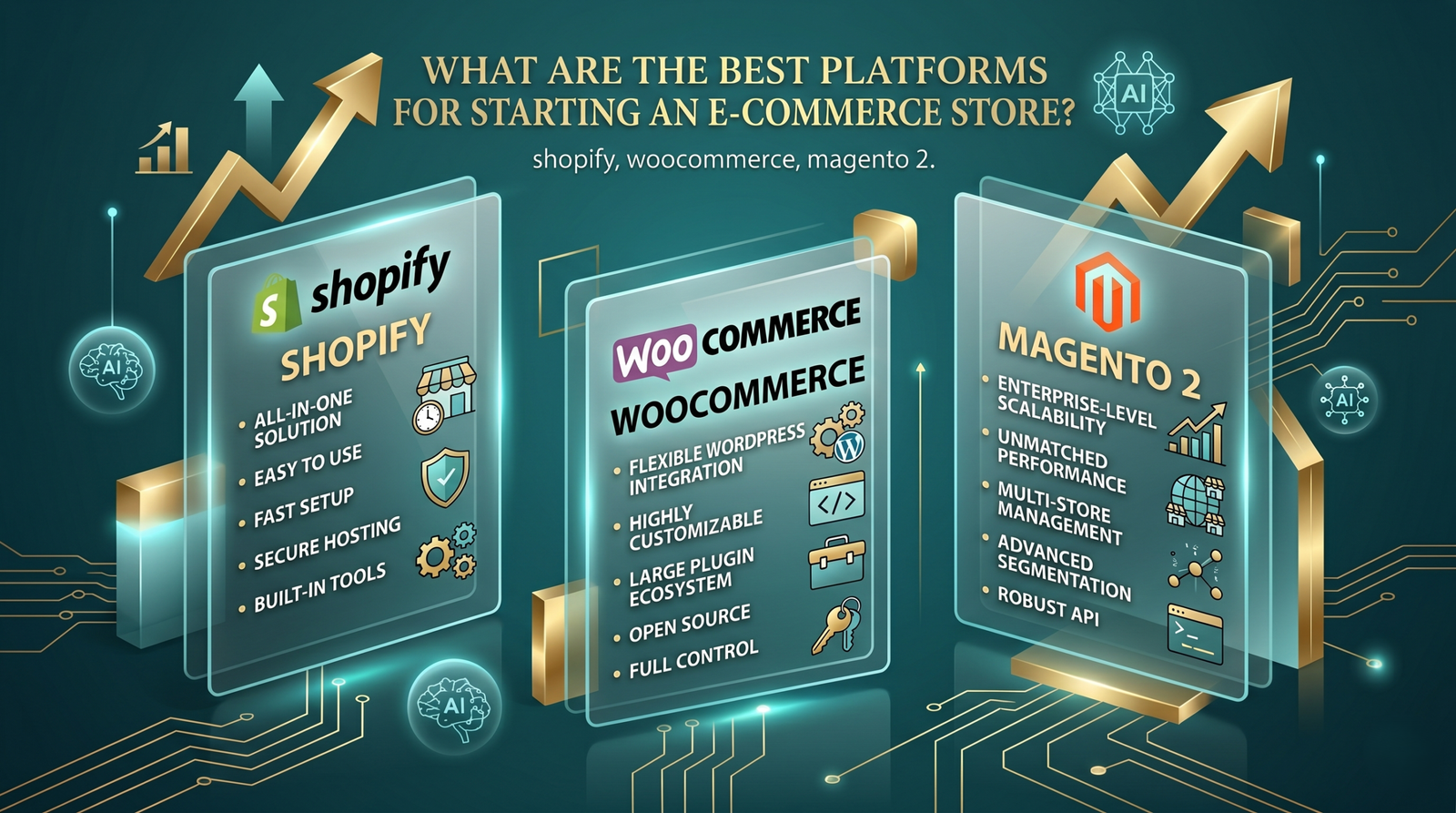
The question comes up constantly, and the honest answer is that there is no single best platform. There is the right platform for your specific situation, and the wrong one, and the difference between the two has real consequences for how much the build costs, how long it takes, and how easy or painful the store is to manage once it is live.
Shopify, WooCommerce, Magento 2, and BigCommerce are the platforms we work with most often at Innosaber. Each has genuine strengths and real limitations. What follows is a practical breakdown of each one, who it is actually right for, and the questions you should be answering before you commit to any of them.
Shopify: fast to launch, easy to manage, less flexible
Shopify is a fully hosted SaaS platform. You pay a monthly subscription, Shopify handles the hosting, security, and software updates, and you focus on the store itself. There is no server to manage and no hosting bill to worry about separately.
That simplicity is its biggest advantage. A straightforward Shopify store can be built and launched quickly; the admin interface is clean, and most merchants can manage the day-to-day without developer help for basic tasks. The app ecosystem is large, which means most standard features can be added without custom development.
The limitations become relevant as requirements get more specific. Shopify’s checkout is heavily controlled by the platform, which creates friction for businesses with unusual pricing models, complex discount logic, or specific checkout flows. Customisation beyond what themes and apps can achieve requires working within Shopify’s constraints rather than around them. Transaction fees apply unless you use Shopify Payments, which is not available in all markets. And at higher transaction volumes, the monthly cost plus app subscriptions can add up faster than expected.
Shopify is a solid choice for: businesses launching a new store without heavy technical requirements, teams that want to manage the store themselves without ongoing developer support, and direct-to-consumer brands that need a clean, well-supported platform and speed to market.
WooCommerce: maximum flexibility, real hosting and maintenance
responsibility
WooCommerce is a free open-source plugin that turns a WordPress site into an e-commerce store. The core plugin is free, but you will need hosting, a domain, an SSL certificate, and likely a set of premium plugins to cover payment gateways, shipping, and other features a serious store requires.
The main reason to choose WooCommerce over Shopify is flexibility. Because it runs on WordPress, you have full control over the codebase, the database, and every aspect of how the store behaves. There are no platform-imposed restrictions on checkout logic, pricing structures, or content. The plugin ecosystem for WordPress is enormous, with tens of thousands of extensions covering almost any requirement.
The tradeoff is ownership of the infrastructure. You are responsible for hosting performance, security patches, plugin compatibility, and making sure everything keeps working when something updates. On well-managed hosting with a competent developer keeping things in order, WooCommerce runs well. Without that, it becomes a maintenance problem.
WooCommerce is a strong choice for: businesses that already have a WordPress site and want to add e-commerce without rebuilding from scratch, content-heavy stores where the blog and product catalogue need to work closely together, and projects where the specific requirements are too custom for a SaaS platform to handle cleanly.
Magento 2: built for complexity, not for the faint of budget
Magento 2 (now Adobe Commerce in its enterprise version) is a different category of platform altogether. It is built for large, complex e-commerce operations: multiple storefronts, multi-language and multi-currency setups, large product catalogues, B2B functionality, and deep integrations with ERP and CRM systems.
The platform is powerful and highly customisable, but it requires experienced developers to build and maintain. A Magento 2 project is not something you hand to a junior developer or build with a drag-and-drop interface. The development cost is higher, the infrastructure requirements are more demanding, and the ongoing maintenance requires specialist knowledge.
What you get in return is a platform that can handle genuine enterprise complexity without bending the architecture out of shape. Custom pricing rules, complex product configurations, wholesale and retail channels on the same platform, and integrations with business systems that Shopify and WooCommerce would struggle to handle cleanly.
Magento 2 is the right choice for: established businesses with complex catalogue and pricing requirements, organisations that need B2B and B2C on the same platform, and e-commerce operations that are already at scale or are planning to grow there quickly. It is the wrong choice for a business just starting or one with straightforward requirements that does not need what Magento 2 brings.
BigCommerce: a middle ground worth considering
BigCommerce occupies a position between Shopify and Magento 2. It is a hosted SaaS platform like Shopify, which means no server management, but it gives more built-in flexibility than Shopify, particularly around checkout customisation, pricing, and B2B features.
BigCommerce does not charge transaction fees on any plan, which matters at higher sales volumes. Its native multi-currency and multi-storefront capabilities are stronger than Shopify’s out of the box. And it tends to suit businesses that have grown past what Shopify handles cleanly but are not yet at the point where a full Magento 2 implementation makes sense.
The app ecosystem is smaller than Shopify’s, and it is less widely known, which means the pool of experienced developers is smaller too. For the right type of store, it is a solid platform. It is just less likely to be the default recommendation for most projects.
How to actually choose
The platform decision should follow the requirements, not the other way around. Before choosing anything, you should have clear answers to a few basic questions.
How many products are you selling and how complex is the catalogue? A store with twenty products and simple variations has very different needs from one with five thousand SKUs, configurable bundles, and tiered pricing.
Who is managing the store after launch? If the answer is a non-technical team member, that changes what is practical. Shopify and BigCommerce are easier for non-developers to manage day-to-day. WooCommerce and Magento 2 require more hands-on maintenance.
What does the store need to connect to? Payment gateways, shipping providers, inventory systems, ERPs, CRMs. The more complex the integration picture, the more the platform architecture matters.
What is the realistic budget, not just for the build, but for ongoing hosting, maintenance, and development? SaaS platforms like Shopify and BigCommerce have predictable monthly costs. WooCommerce and Magento 2 have more variable ongoing costs depending on how much development support the store needs.
At Innosaber, we work across all four platforms and build custom e-commerce solutions where none of them is quite the right fit. The recommendation always starts with the requirements, not with a platform preference.
FAQ
Is Shopify good for a large catalogue?
Shopify can handle large catalogues technically, but the management experience and some features around complex product configurations and pricing rules can become limiting at scale. For catalogues above a few thousand SKUs with complex variants or pricing logic, WooCommerce or Magento 2 is usually the more practical choice.
Can WooCommerce handle high traffic volumes?
Yes, with the right hosting. WooCommerce on shared hosting will struggle under serious traffic. WooCommerce on a well -configured cloud setup with proper caching, a CDN, and database optimisation can handle significant load. The platform is not the bottleneck. The infrastructure is.
Is Magento 2 too expensive for a growing business?
Magento Open Source is free. The cost comes from development and infrastructure. A Magento 2 build requires experienced developers, which costs more than a Shopify setup. Whether that cost is justified depends entirely on whether the business actually needs what Magento 2 provides. For most early-stage businesses, it is overkill. For businesses with genuine complexity, the cost of trying to force that complexity into a simpler platform is usually higher.
What about building a custom e-commerce platform?
Custom builds make sense when the business model genuinely cannot be served by any existing platform. Unusual transaction types, marketplace models, or deeply integrated commerce workflows that existing platforms cannot handle cleanly. For most stores, a well-built implementation on an established platform is the better starting point. Custom platforms carry a higher build cost and a larger long-term maintenance burden.
Can Innosaber migrate an existing store to a different platform?
Yes. We handle platform migrations regularly, including product catalogue and order history transfers, URL redirect strategies to protect SEO, and integration re-mapping. Migration projects require careful planning to avoid data loss and ranking drops, but they are a standard part of what we do.
The right platform for your store, built properly
Choosing the wrong platform costs more to fix than choosing the right one costs upfront. A store that outgrows its platform needs a rebuild. One that was over-engineered for its actual requirements wastes development budget and creates ongoing maintenance overhead that was never necessary.
At Innosaber, we build e-commerce stores on Shopify, WooCommerce, Magento 2, BigCommerce, and custom stacks. Every recommendation starts with understanding the business: the products, the team, the integrations, and the growth plan. If you are planning an e-commerce build and want a straightforward view of which platform fits your situation, book a consultation, and we will walk through it with you.