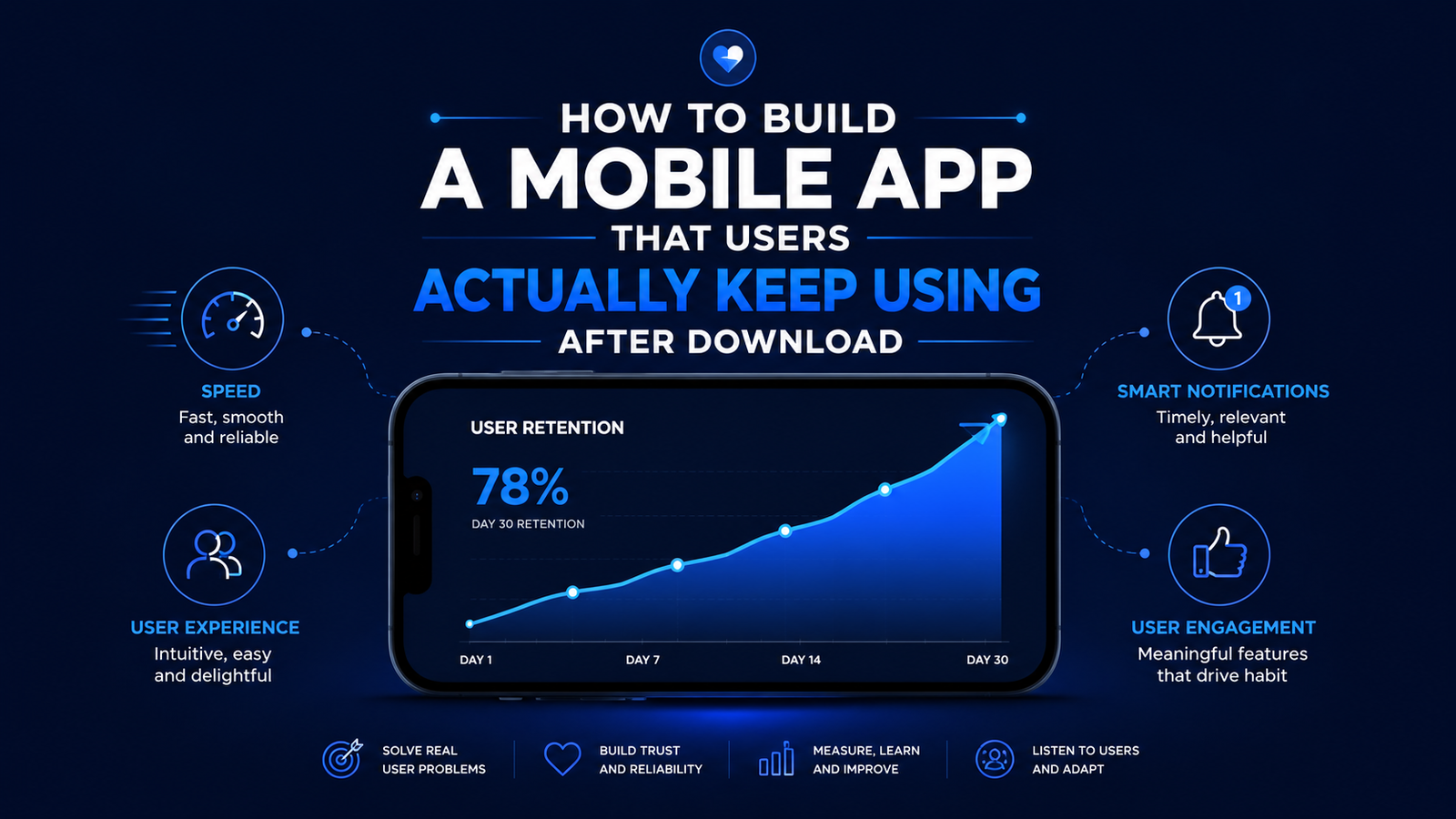
Most mobile apps lose the majority of their users within the first week of download. That is not a generalisation. Industry data consistently shows that average 30-day retention rates for mobile apps sit below 30 percent, and for many categories, the figure is far lower. Users download an app, open it once or twice, and move on.
The reasons vary, but the pattern is consistent enough that it points to something structural rather than coincidental. Building an app is one thing. Building an app people return to is a different problem entirely, and it needs to be solved at the design and architecture stage, not patched in after launch. At Innosaber, our mobile app development team thinks about retention from the first conversation with a client, not as an afterthought once the product is live.
The Problem Usually Starts Before the First Screen
A common mistake is treating the onboarding flow as something to figure out near the end of development. In practice, the onboarding experience is often the single largest driver of whether a user returns after their first session. If someone downloads your app and cannot understand its value within the first two minutes, they will not come back.
Good onboarding does not mean a tutorial with arrows pointing at buttons. It means the app communicates its purpose clearly, asks for the minimum amount of information needed to get started, and delivers some form of value before requesting permissions, sign-up, or payment. The apps that retain users well tend to earn trust incrementally rather than demand it upfront.
This is a UX/UI design problem as much as it is a product problem. The structure of the onboarding flow, the copy on each screen, the sequence of actions a new user is guided through – all of these have a measurable impact on whether someone completes setup and returns the following day.
Speed Is Not Optional
Performance problems are one of the most consistent reasons users delete apps. A slow app is not just an inconvenience. It signals to the user that the product was not built carefully, and that perception is hard to reverse.
Load times matter on first launch and on every subsequent action. Transitions should feel immediate. Lists should scroll without stuttering. Network requests should happen in the background where possible, so the user is never waiting on a spinner to do the next obvious thing.
These are engineering decisions, not design decisions. They require the right architecture from the start: efficient state management, smart caching, optimised API calls, and thorough testing across device types and network conditions. Our mobile app development team builds performance testing into the development cycle rather than treating it as a final QA step.
Notifications Need to Earn Their Place
Push notifications are one of the most powerful re-engagement tools available to a mobile product. They are also one of the fastest ways to get deleted.
Apps that send irrelevant, poorly timed, or excessive notifications train users to either turn them off or remove the app entirely. The businesses with strong retention treat notifications as a communication channel that has to earn the user’s attention every time, not a broadcast mechanism to be used freely.
Effective notification strategies are contextual. They are triggered by user behaviour, sent at times that match how the user actually uses the app, and they deliver information the user genuinely benefits from receiving. A good notification brings someone back to something they care about. A bad one reminds them the app exists and prompts them to question why they still have it.
Design for the User’s Actual Context
One of the most common gaps we see in mobile app projects is the assumption that users will interact with the app in ideal conditions. In practice, mobile users are often on slow connections, using the app one-handed, in bright sunlight, or while doing something else entirely.
Designing for real-world conditions means keeping interfaces simple enough to navigate without full attention, ensuring the app degrades gracefully on a slow connection rather than showing a blank screen, and making the most common actions reachable with a thumb without stretching across the display. These details are discussed in depth in our article on how bad UX quietly kills products.
It also means testing with real users, not just internally. Developers and designers are too familiar with the product to see where genuine confusion occurs. Getting the app in front of people who represent your actual audience before launch consistently surfaces issues that no amount of internal review would have caught.
Retention Is Built Into the Product Roadmap, Not Added Later
Retention Is Built Into the Product Roadmap, Not Added Later. The apps that hold their users over months and years are the ones that continue to deliver value beyond the initial use case. That means a product roadmap that treats post-launch development as seriously as the launch itself.
Regular updates signal to users that the product is alive and improving. New features that address real pain points give existing users a reason to re-engage. Bugs that stay unfixed for weeks tell users the opposite. The maintenance and iteration phase of a mobile product is where most of the long-term value is built or lost.
At Innosaber, we structure our mobile app development engagements to include post-launch support as a genuine component of the project, not an optional add-on. The work that happens after the app goes live is often more important than the work that preceded it.
FAQ
What is a realistic 30-day retention rate to aim for?
It depends heavily on the category. Social and communication apps tend to retain at higher rates than utility or event-based apps. A 30-day retention rate above 30 percent is considered strong across most
categories. The more useful target to track is your own retention curve over time, specifically whether it flattens out rather than continuing to decline.
How much does onboarding design affect retention?
Significantly. Research across mobile products consistently shows that users who complete onboarding and reach the core value proposition within the first session retain at considerably higher rates than those who do not. Treating onboarding as a product priority rather than a design formality is one of the highest-leverage things a mobile team can do.
Should we build analytics into the app from day one?
Yes. Understanding where users drop off, which features they return to, and which flows cause friction is essential for making good product decisions post-launch. Retrofitting analytics into an existing app is
possible but adds unnecessary complexity. Building it in from the start gives you usable data from the first week.
What causes most app uninstalls?
Performance problems, poor onboarding, irrelevant push notifications, and apps that fail to deliver on what they promised at download are the most consistent causes of uninstall. Addressing all of these during development rather than in response to negative reviews is a far more effective approach.
Does Innosaber handle post-launch support and updates?
Yes. Our mobile development engagements are structured to include ongoing support, monitoring, and iterative development after launch. We treat the post-launch phase as a core part of the product lifecycle, not a separate engagement.
Downloads are easy. Keeping users is the actual product challenge.
Getting your app into someone’s hands is a marketing problem. Getting them to open it again the next
day, and the week after that, is a product problem. The businesses that build mobile products with
lasting value are the ones that treat retention as a design constraint from day one, not a metric to
optimise after the fact.
Every decision in the development process, from how onboarding is sequenced to how the app behaves
on a slow connection, contributes to whether a user decides the app is worth keeping. At Innosaber,
that is the standard we hold our mobile work to. Not just a product that ships, but a product that earns its
place on the user’s device.
If you are planning a mobile app and want to build retention in from the ground up, contact us at innosaber.com/contact. We would be glad to work through the details with you.