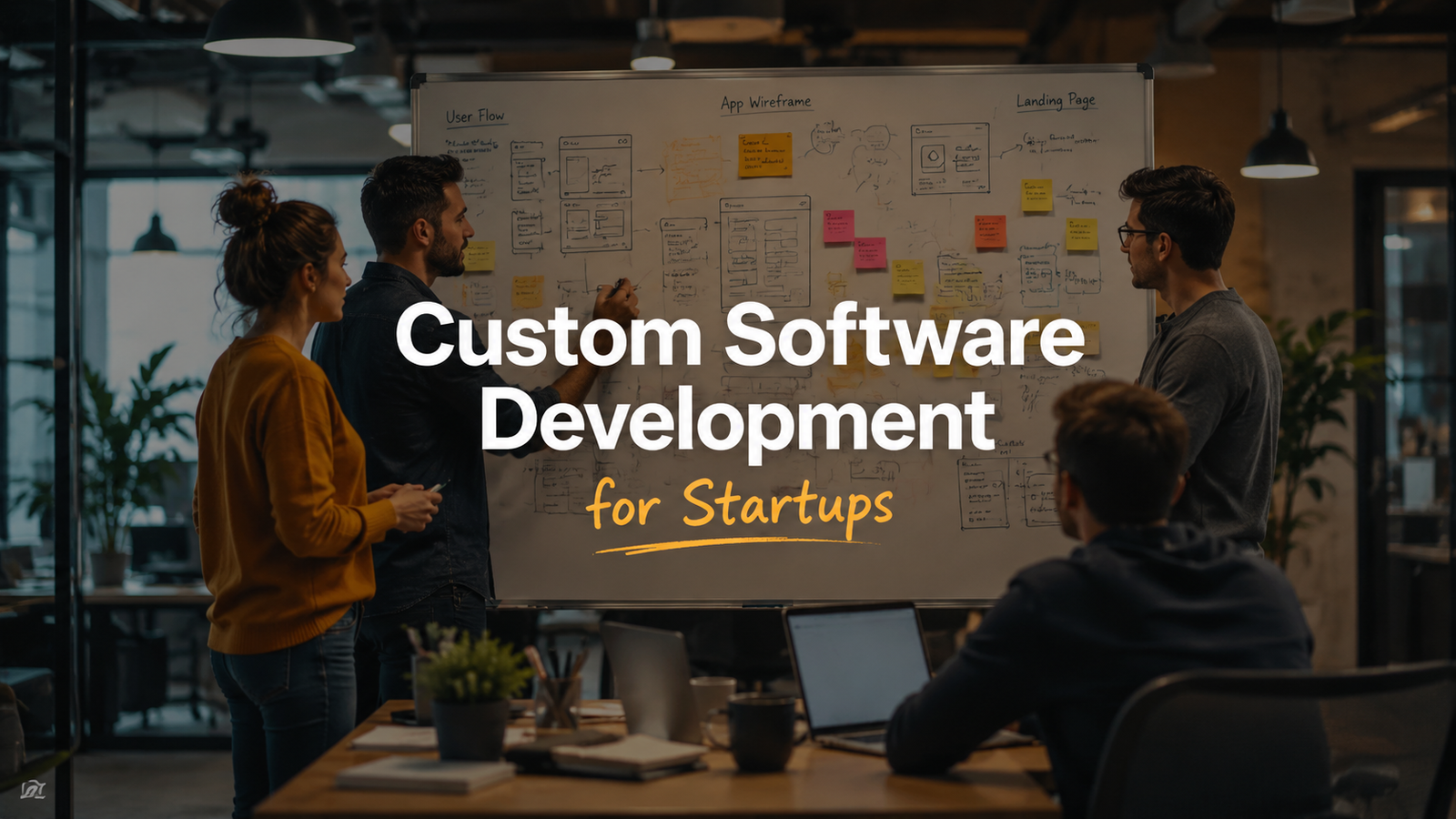
For startups, the software is not a support tool, it is the product. Custom software development for startups is about building the right thing first, learning fast, and not accumulating technical debt that makes the next version expensive.
When Your Product Is the Software
For most businesses, software is a tool that supports the operation. For startups, it is often the product itself. If you are building a SaaS platform, a marketplace, a mobile app, or any technology-driven service, the software is what you are selling, and its quality directly determines whether the business works.
That changes what custom software development means in the startup context. It is not about replacing internal tools or fixing operational inefficiencies, though those things matter too. It is about building the core offering. The stakes are different, the process looks different, and the decisions made early have a compounding effect on everything that comes after.
Innosaber works with startups at various stages, from pre-product idea validation through to post-launch iteration. The approach that works is not the same at each stage, and the most expensive mistake a startup can make is building like a mature company before the idea is proven.
The MVP Trap and How to Avoid It
Minimum viable product is one of the most misunderstood concepts in startup development. The word minimum gets taken to mean low quality. It does not. It means the smallest thing that proves the hypothesis. Those are very different briefs.
A poorly scoped MVP tries to be all things to validate multiple assumptions at once, ends up being none of them well, and takes six months to build. A well-scoped MVP isolates the one thing the business needs to know and builds just enough to learn it. That might be a prototype with real users, a functional but feature-limited version of the core workflow, or, in some cases, a concierge operation where humans do manually what the software will eventually do automatically.
Getting the MVP scope right is one of the most valuable contributions a development partner can make to an early-stage startup. Not building the feature list, which any team can do, but deciding which features actually need to exist for the first version to teach you something useful.
Building for Learning, Not Just Shipping
The purpose of early startup software is to generate information, not just to function. Every release should answer a question: do users actually do what we thought they would do? Is this feature being used? Where are people dropping off? What are they asking for that we have not built yet?
That means instrumentation needs to be part of the build from day one. Analytics, event tracking, user feedback loops, and error monitoring are not additions you bolt on after launch. They are part of how you learn whether the product is working and what to build next.
The startups that iterate well are the ones that have built observation into the product itself. They see the data, they talk to users, and they adjust. The ones that struggle are the ones that ship and wait, because waiting tells you nothing.
The Technical Debt Question
Every startup hears about technical debt, and most respond to it in one of two wrong ways. Either they ignore it and build fast, accumulating a codebase that becomes increasingly expensive to change. Or they over-engineer the first version, building infrastructure for a scale they do not have yet, and take three times as long to ship.
The right approach is deliberate technical debt. Build fast where speed of learning matters more than long-term maintainability. Build properly where cutting corners now would cost significantly more later. The decisions about where to cut and where not to require experience, and they have a meaningful impact on how quickly and cheaply the product can evolve.
A good development partner for a startup is honest about this trade-off. We are not interested in over-engineering first versions or in building the cheapest thing that ships. We are interested in building the right thing for where the startup is and where it needs to go.
Choosing the Right Technology Stack
Technology choices made early are hard to undo, but they can also be made badly by over-optimizing for the wrong things. Choosing a technology because it is fashionable, or because the founding team knows it, rather than because it fits the product requirements and the likely hiring market, is a common mistake.
For most startups, the right stack is the one that lets you move quickly, hire people who know it, and scale when the time comes without rewriting everything. That usually means established languages and frameworks with strong communities, not bleeding-edge technology that has not been stress-tested at scale.
We work across web and mobile and have strong views on what works well for early-stage products. That includes both the build itself and the infrastructure decisions around hosting, deployment, and monitoring. Those choices matter early because they affect how quickly the team can ship and iterate.
When to Build vs When to Buy
Not everything in a startup product needs to be custom-built. Authentication, payments, email delivery, and a range of other standard functions have well-tested third-party solutions that are faster and more reliable than building from scratch. The custom development should go into the parts of the product that represent the actual value the startup is delivering, not the infrastructure that every software product needs.
This distinction matters because startup time is finite. Every week spent building something that could be solved with a well-configured third-party tool is a week not spent on the part of the product that actually differentiates the business. Good development partners make these build-vs-buy calls explicitly rather than defaulting to building everything.
The result is a product where the custom development is concentrated where it creates value, and commodity functions are handled by proven tools. That is a faster build and a more defensible product.
Scaling When the Time Comes
The architecture decisions made in a startup’s first product version have a significant impact on what scaling costs later. A system designed without any consideration of scale will require significant rework when user numbers grow. A system over-engineered for scale at day one will have cost time and money that could have gone into the product itself.
The practical answer is to build with growth in mind without building for growth that does not exist yet. That means making sensible architecture choices that do not create obvious bottlenecks, writing code that a future developer can understand and extend, and avoiding dependencies that would be painful to change as the product evolves.
When growth does come, custom software has a significant advantage over SaaS alternatives: you own the infrastructure and can scale it on your own terms. You are not negotiating enterprise contracts or waiting for a vendor to support the volume you need.
Working with a Development Partner as a Startup
The relationship between a startup and its development partner is different from a typical client-vendor relationship. Startups move fast, change direction, and need a partner that can adapt without starting the project from scratch each time. That requires a higher level of trust and communication than a standard project engagement.
What works well is a development partner who understands the startup context, who has opinions about scope and technology and is willing to share them, and who is aligned with the business outcome rather than just the delivery of a specification. Delivering exactly what was specified is not useful if the specification was wrong.
Innosaber has worked with startups from early validation through to funded growth. We understand the pace and the constraints, and we build accordingly. If you are starting from an idea and need to work out what to build first, or if you have a product and need to move faster or build better, let us know what you are working on.
FAQ
How much does it cost to build a startup product?
It depends entirely on scope. A focused MVP with one core workflow can be significantly less expensive than a full-featured platform. The more clearly the scope is defined, the more accurate the cost estimate. We do not quote before we understand what needs to be built.
Startup Team or Development Partner?
Both can work. A development partner is often faster to start, brings experience across multiple products, and is more flexible as scope changes. An in-house team builds deep domain knowledge and can be more cost-effective at scale. Many startups start with a partner and build in-house capacity as the product matures.
What is the difference between an MVP and a prototype?
A prototype is typically used for demonstration and feedback without real functionality behind it. An MVP is a real, functional product with limited scope. The distinction matters because users interact with an MVP as they would with the finished product, which gives you much more useful feedback than a prototype can.
Can Innosaber help with an idea that is not fully formed yet?
Yes. We work with founders at the idea stage to help scope what needs to be built, identify the assumptions that need to be tested first, and structure a build that generates the most useful information in the shortest time.
Final Thoughts
Building a startup product is not a software project with a finish line. It is an ongoing process of
learning what works, cutting what does not, and building the next version based on what users
are actually doing. The software is the medium, but the real work is the learning.
What makes the difference between startups that build well and those that do not is rarely raw
technical skill. It is the discipline to scope correctly, the willingness to throw out assumptions
when the data contradicts them, and the ability to move fast without building something that is
impossible to change.
Innosaber works with startups that are serious about building properly from the start. If
you want to talk through what you are building and how to approach it, reach out to the
team.