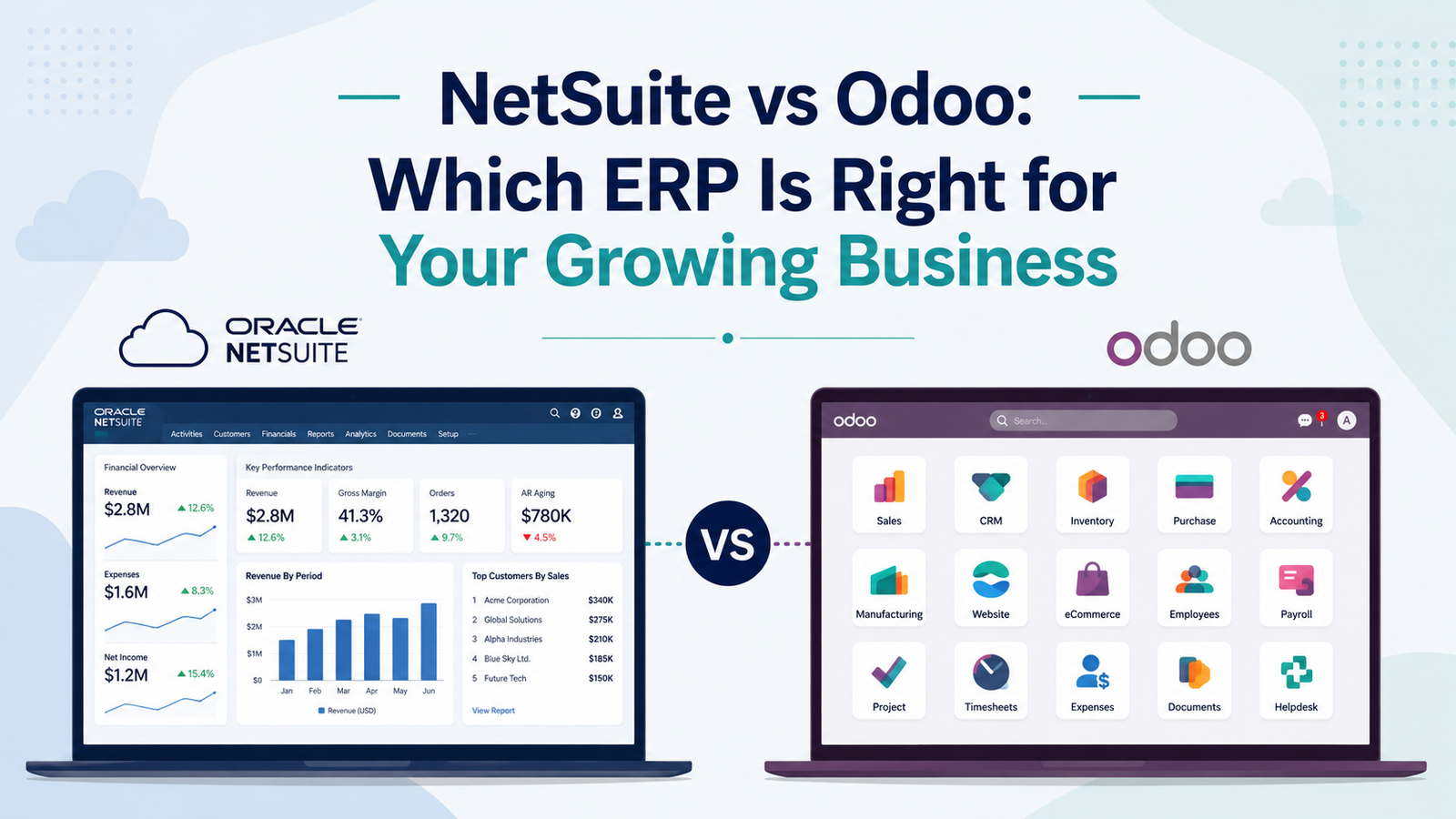
TL;DR: NetSuite fits growing businesses that want a fully managed, all-in-one cloud ERP, while Odoo fits those that want a modular, lower-cost system with more control over customization and hosting.
NetSuite and Odoo are two of the most common ERP platforms for growing businesses. Both promise to unify finance, inventory, and operations in one system, but they solve that problem in very different ways.
NetSuite is a cloud native platform built and owned by Oracle. Odoo is open source at its core, with a paid enterprise tier layered on top. That difference in structure shapes cost, flexibility, and how much control you keep over your own system.
What NetSuite Offers
NetSuite runs entirely in the cloud, with financials, inventory, CRM, and e-commerce built into one platform. Oracle manages the infrastructure, so your team never touches servers or patches.
The platform suits companies that want a mature, all-in-one system without juggling multiple vendors. Manufacturing, retail, and multi-location businesses use it often, since the built-in modules cover most standard workflows out of the box.
Pricing is licence-based and scales with users and modules. Costs rise quickly once you add multiple subsidiaries or advanced modules like revenue management.
What Odoo Offers
Odoo takes a modular approach. You install only the apps you need, from accounting to inventory to HR, and add more as the business grows.
The open source community edition covers basic functionality for free. Most growing businesses run Odoo Enterprise instead, which adds support, hosting options, and more advanced apps for a per-user fee.
Odoo suits companies that want to start small and expand deliberately, or that need heavy custom software work without licensing every change through a single vendor.
Cost, Customization, and Control
NetSuite costs more upfront but bundles support, hosting, and updates into one contract. Odoo costs less to start, though custom development work adds up if you need big changes to standard modules.
Odoo gives you more control over source code and hosting, since you can run it on your own cloud infrastructure or through a partner. NetSuite keeps everything inside Oracle’s cloud, which means less flexibility but also less maintenance burden on your team.
Neither platform is universally cheaper. A retail business with five staff and simple inventory usually spends less on Odoo. A multi-entity company with complex financial consolidation often spends less overall on NetSuite, once you factor in the custom development Odoo would otherwise need.
Choosing Between NetSuite and Odoo
The right choice depends on how much you value control against how much you value a fully managed system.
Pick NetSuite if you want a single vendor, predictable support, and modules that already fit standard finance and inventory workflows. Pick Odoo if you want to start lean, customize freely, and keep more control over your source code and hosting.
Either way, the implementation partner matters as much as the platform. Innosaber’s enterprise software solutions team has configured both systems for growing businesses across finance, inventory, and reporting. Talk to us before you commit to either platform.
FAQ
Is Odoo cheaper than NetSuite?
Usually, for smaller businesses with simpler workflows. Once heavy customization or multi-entity accounting enters the picture, the cost gap narrows or reverses.
Can Odoo handle multi-entity accounting like NetSuite?
Yes, with the right configuration and add-on apps, though NetSuite handles multi-entity consolidation natively with less setup work.
Which ERP is better for a small business?
Odoo tends to fit smaller teams that want to start with a few apps and expand gradually. NetSuite fits businesses ready for a full platform from day one.
Can you switch from Odoo to NetSuite later?
Yes, though migrating data and rebuilding custom workflows takes real planning. It’s easier to choose carefully upfront than to switch later.
The Right ERP Depends on Your Business, Not the Hype
NetSuite and Odoo both work well. They just work well for different kinds of businesses.
Choosing based on brand recognition or what a competitor uses leads to paying for modules you don’t need, or missing flexibility you actually do need.
If you want a clear read on which platform fits your operations, talk to Innosaber before you sign anything.