Most businesses approaching a mobile app project for the first time have a rough idea of what they want to build, but very little visibility into how a professional development engagement actually runs. What happens in the first week? When do you see something working? How long before the app is in users’ hands? Who is responsible for what, and at which stage?
These are reasonable questions, and the fact that many agencies avoid answering them clearly is part of why mobile projects so often run into scope confusion, budget overruns, and delayed launches. At Innosaber, our mobile app development process is structured to give clients full visibility at every stage, from the initial discovery session through to post-launch support. Here is what that actually looks like.
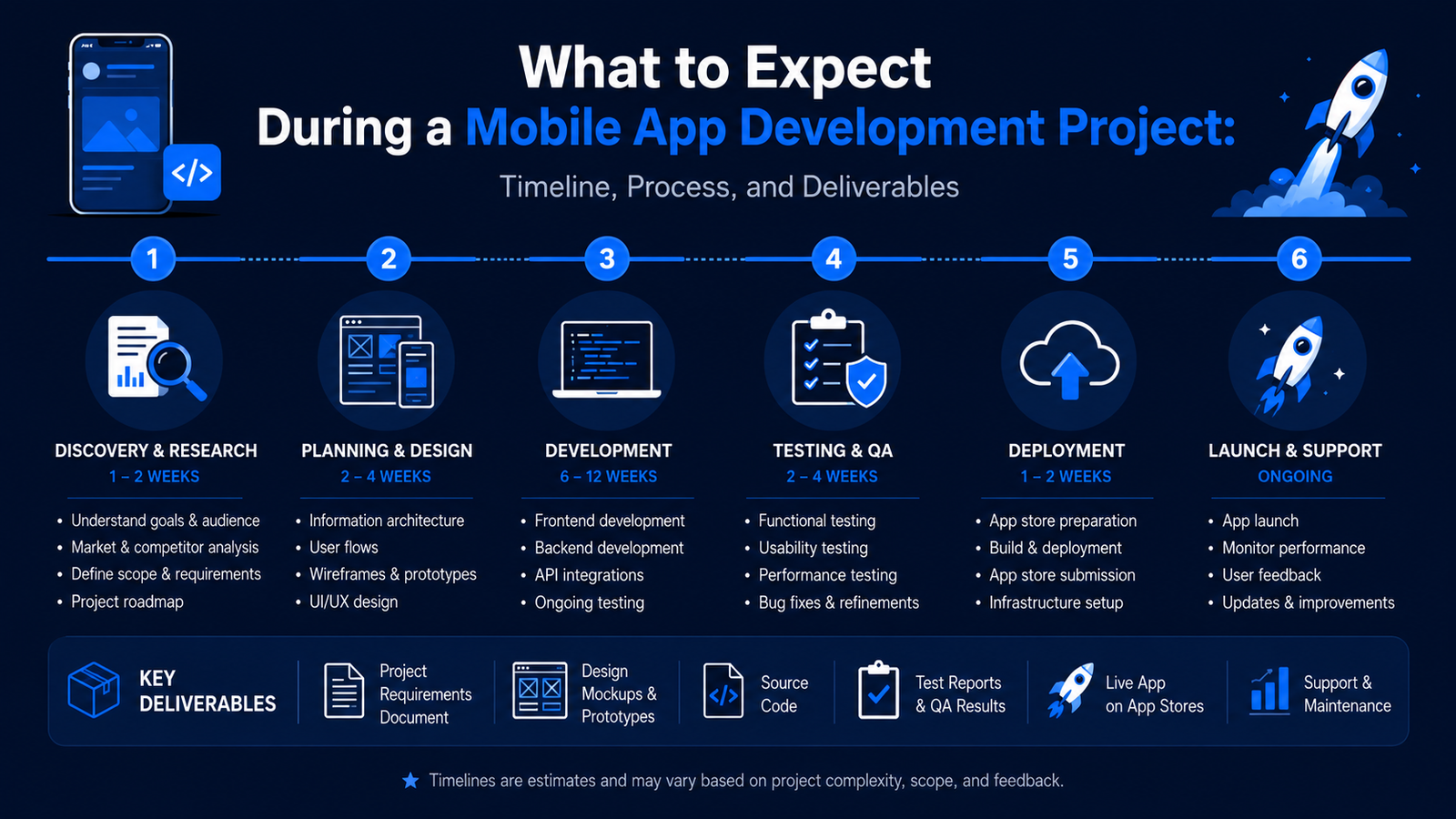
Phase 1: Discovery and Requirements (Weeks 1 to 2)
Everything starts with discovery. Before any design or development work begins, we spend time understanding the business problem the app is solving, who the users are, how they currently handle the problem, and what success looks like from the client’s perspective.
This phase produces a set of documented requirements: a feature list prioritised by business value, user personas, key user journeys, platform decisions (iOS, Android, or both), and a preliminary technical approach. It also surfaces the questions that need to be answered before scoping can be accurate.
Discovery is where the choice between native and cross-platform development gets made, where integration requirements with existing systems are mapped, and where the project’s realistic timeline and budget take shape. Skipping or rushing this phase is one of the most reliable ways to create problems later in the engagement.
Phase 2: UX Design and Prototyping (Weeks 2 to 4)
With requirements agreed, the UX/UI design work begins. This starts with wireframes: low-fidelity layouts that map out the structure of each screen, the navigation between them, and the flow a user takes through each key task. Wireframes are deliberately stripped of visual design so that feedback can focus on structure and logic rather than aesthetics.
Once the structure is approved, the design team moves into high-fidelity mockups. These show the app as it will actually look: colour, typography, iconography, spacing, and component states, including empty states, error states, and loading states. This is also when the design is reviewed against platform conventions for iOS and Android to ensure it feels appropriate on each.
A clickable prototype is typically produced at this stage. It is not a working app, but it allows stakeholders and test users to move through the key flows and give feedback before a single line of production code is written. Issues caught at the prototype stage cost a fraction of what they cost to fix after development.
Phase 3: Development in Sprints (Weeks 4 to 14, Depending on Scope)
Development runs in two-week sprints using an Agile methodology. Each sprint has a defined set of features to be built, tested, and reviewed. At the end of every sprint, there is a working build that the client can access on a test device, not just a status update but something tangible to review.
Sprint planning happens at the start of each cycle. The development team and the client agree on what will be built, clarify any outstanding questions, and flag any dependencies that need to be resolved. This keeps everyone aligned and prevents the kind of gradual scope drift that quietly extends timelines.
Backend development, which covers the API layer, database, authentication, and any third-party integrations, typically runs in parallel with the frontend. Where the app connects to cloud infrastructure, our cloud services team ensures the backend is architected for reliability and scalability from the outset rather than retrofitted after launch.
Phase 4: QA and Testing (Ongoing, with a Dedicated Final Phase)
Quality assurance is not a single phase at the end of development. It runs continuously. Each sprint includes testing of the features built in that cycle, covering functional testing, edge cases, and regression testing to ensure new work does not break existing functionality.
Before the app is submitted for store review, a dedicated testing phase covers the full product. This includes testing across a range of devices and OS versions, performance testing under different network conditions, security review, and user acceptance testing with real users where possible.
App store submission itself involves its own timeline. Apple’s App Store review process typically takes one to three days for a new submission, longer if there are issues requiring resubmission. Google Play is generally faster but also has a review process. These timelines need to be factored into the launch plan rather than treated as instant.
Phase 5: Launch and Post-Launch Support
Going live is not the end of the engagement. The first weeks after launch are often the most data-rich period in the app’s life, as real users interact with the product in ways that testing cannot fully replicate.
Post-launch support covers monitoring for crashes and performance issues, responding to user feedback from store reviews, and addressing bugs that surface in production. It also covers the first iteration cycle, where analytics data from real usage informs which features to improve, which flows to simplify, and what to build next.
At Innosaber, we structure post-launch support as a genuine part of the engagement, not an upsell. Our mobile app development team remains available for monitoring, hotfixes, and planned iterations after the app goes live. For clients who want ongoing development capacity without building an internal team, our resource augmentation model provides dedicated engineers on a flexible basis.
What You Should Receive as Deliverables
A professional mobile app development engagement should produce more than just a finished app. The deliverables from an Innosaber project include documented requirements and user stories, final UX/UI design files, a working app deployed to both stores (or one, depending on scope), backend infrastructure set up and documented, source code in a client-owned repository, test reports, and handover documentation covering architecture, APIs, and deployment processes.
You should own everything. The code, the design assets, the documentation, the app store accounts. An agency that retains ownership of your source code or limits your access to your own infrastructure is not a partner. Transparency about ownership is part of how we structure every mobile app development engagement at Innosaber.
FAQ
How long does a mobile app project take?
A straightforward app with a defined feature set typically takes 12 to 20 weeks from the start of discovery to app store submission. More complex products with extensive backend requirements,
third-party integrations, or a large feature scope can take longer. The discovery phase is where timeline estimates become reliable, so any quote given before requirements are defined should be treated as very preliminary.
How involved does the client need to be during development?
Meaningfully involved, but not full-time. The biggest requirement on the client side is availability for sprint reviews every two weeks and reasonably prompt responses to questions that arise during
development. Delays in client feedback are one of the most consistent causes of project timeline extensions.
What happens if requirements change during development?
Requirements do change. How that is handled depends on the engagement model. Fixed-scope projects manage changes through a formal change request process. Time-and-materials engagements are more flexible but require clear communication about what is being added and how it affects the timeline. The important thing is that changes are documented and their impact is agreed before work proceeds.
What is included in post-launch support?
Post-launch support covers crash monitoring, bug fixes, OS update compatibility checks as new iOS and Android versions are released, and planned feature iterations. The scope of support is agreed as part of the initial engagement rather than left ambiguous.
Can Innosaber take over an existing project?
Yes. We have experience picking up partially built projects. It typically requires a codebase review period to understand what has been built, what quality standards were applied, and what work remains. The discovery and review phase for a takeover project is usually longer than for a new build, but it is manageable with good documentation from the previous team.
Knowing what to expect makes the whole project run better.
Mobile app development projects fail or run over budget more often because of unclear expectations than because of technical problems. When both sides understand what happens at each phase, who is responsible for what, and what the deliverables look like, the work moves faster and with far less friction. That is not an accident. It is the result of a process designed around transparency.
At Innosaber, we have run enough mobile projects to know where the common pressure points are and how to address them before they become issues. Discovery that is thorough enough to catch ambiguity early. Sprint reviews that keep clients genuinely informed. Handover documentation that means you are
not dependent on us to understand your own product.
If you are planning a mobile app and want to work with a team that will be straight with you about timelines, scope, and what to expect at every stage, reach out to us at innosaber.com/contact.