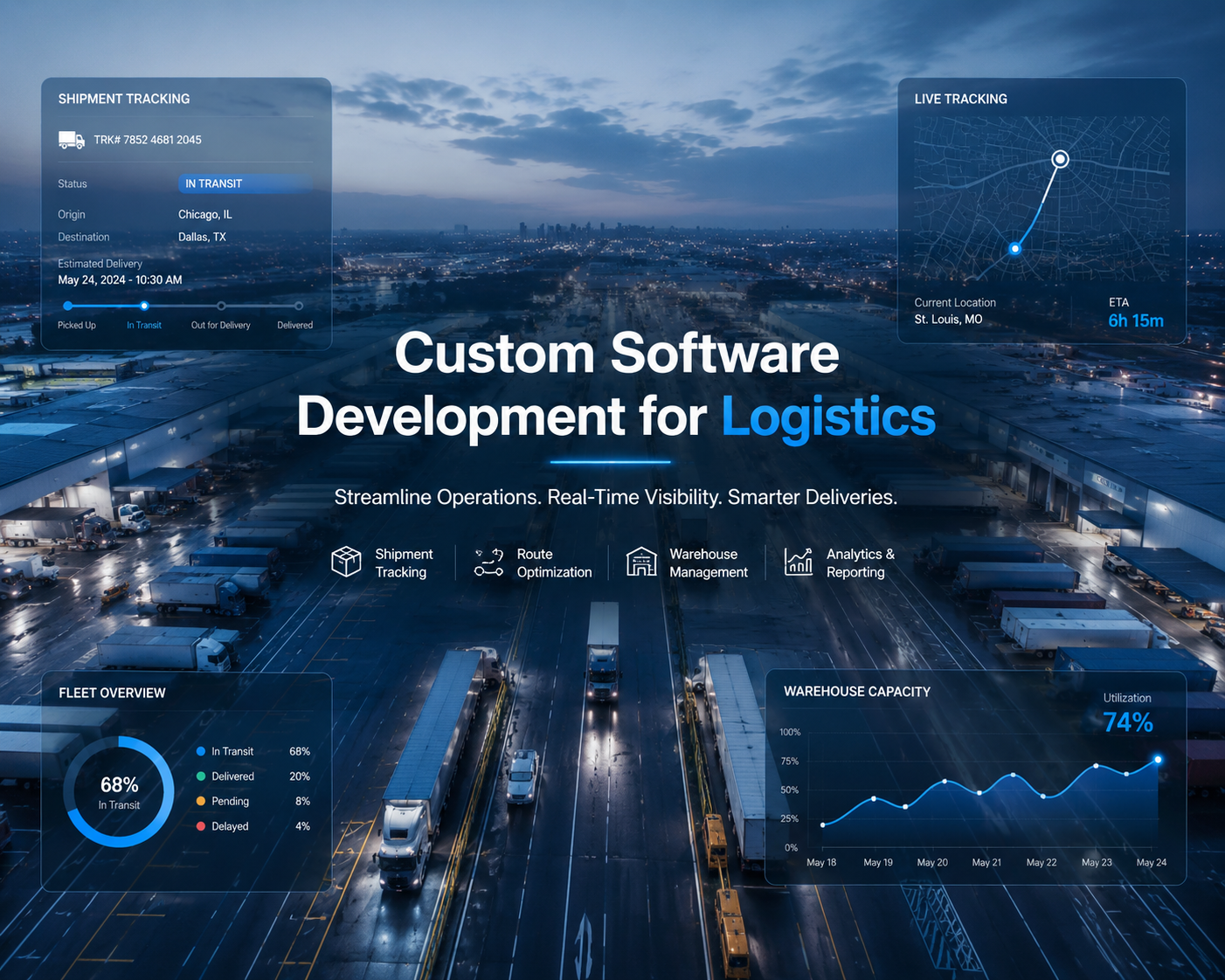
Generic logistics platforms were not built specifically for your operation. Custom software development lets logistics businesses build the tracking, integration, and workflow tools that fit how their freight actually moves.
Why Logistics Keeps Outgrowing Standard Software
Logistics operations are not standard. Two companies in the same freight sector can have completely different workflows depending on the type of cargo they handle, the geography they cover, and the partners they work with. Off-the-shelf logistics platforms are built around the most common configurations, which means anything outside that middle ground requires workarounds.
Those workarounds accumulate. A manual step here, a spreadsheet there, a custom export to bridge two systems that do not talk to each other. Over time, the operational overhead of managing those patches becomes a real cost, in staff time, in error rate, and in the speed at which the business can respond to change.
Custom software development for logistics addresses this directly. Instead of adapting your operation to fit a platform, you build the platform to fit your operation. For logistics businesses with complex or non-standard workflows, the difference in operational efficiency is significant.
What Logistics Companies Actually Build with Custom Software
The most common starting point is visibility. Logistics operations span multiple parties, locations, and systems, and the default state is fragmented information. Custom software can pull data from carriers, warehouses, customs, and customers into a single operational view, giving teams the information they need without hunting across five platforms.
Fleet and route management is another area where custom development pays off. Standard tools make assumptions about vehicle types, routing constraints, and scheduling that often do not match the reality of a specific operation. A custom route optimisation system built around your actual fleet, constraints, and customer commitments delivers results that generic tools cannot.
Warehouse management, last-mile delivery tracking, customs and compliance workflows, carrier performance reporting, and customer-facing shipment tracking portals are all examples of systems we have built for logistics clients. The common thread is that each one was designed around the specific way that business operates, not a generalised version of how logistics businesses might operate.
Integration as the Core Challenge
Logistics operations run on data from multiple sources: carrier APIs, GPS tracking, ERP systems, customs databases, warehouse management systems, and customer platforms. Getting that data to flow cleanly between systems is often the hardest part of any logistics technology project.
Custom software built for logistics has to be designed with integration at its centre, not added as an afterthought. That means robust API connections to the external systems you rely on, data normalisation when those systems use different formats, and fallback handling for when an upstream data source fails or delays.
The businesses that have solved their integration problem have a significant operational advantage. They have real-time visibility, accurate data, and the ability to respond to disruptions faster than competitors still managing information manually or across disconnected tools.
Real-Time Tracking and Customer Experience
Customer expectations in logistics have shifted. The standard in consumer shipping, real-time tracking with proactive notifications, has started to influence what B2B customers expect from freight and logistics providers. Generic carrier tracking pages do not cut it when your customer wants shipment visibility integrated into their own systems.
Custom software allows logistics businesses to build the kind of tracking and notification experience their customers actually want, branded, configurable, and connected to real-time operational data rather than a generic carrier feed. That kind of customer-facing capability is a commercial differentiator, not just a nice feature.
Beyond tracking, custom customer portals can give clients the ability to place orders, view documentation, access invoices, and raise queries without involving your operations team in routine tasks. That is the time your team gets back for work that actually requires human judgment.
Compliance, Documentation, and Risk
Logistics is a regulated industry, and the documentation requirements are significant. Customs declarations, certificates of origin, bills of lading, dangerous goods documentation, and regulatory filings all have specific format requirements and strict timelines. Manual handling of these documents is slow and creates compliance risk.
Custom software can automate document generation, pull the right data from your operational systems, and flag discrepancies before they become regulatory problems. For businesses operating across multiple jurisdictions, this kind of automation is not a convenience, it is a risk management tool.
We build compliance workflows into logistics systems from the design stage rather than retrofitting them. The regulations do not change often, but when they do, a custom system can be updated to match. You are not waiting for a software vendor to ship an update that may or may not reflect the specific requirements of your market.
Scalability Without Proportional Cost Growth
One of the recurring arguments for custom logistics software is the scalability story. SaaS logistics platforms typically price by shipment volume, user count, or feature tier. As your operation grows, so does the licence cost. At a certain scale, the maths starts to shift in favour of ownership.
Beyond licensing, custom software scales without the feature limitations that grow with your operation. You are not hitting the ceiling of a standard plan or waiting for a feature to become available on the enterprise tier. The system grows because you build it to grow, not because you upgrade your subscription.
This is particularly relevant for logistics businesses going through a growth phase. The software should be an enabler of growth rather than a bottleneck that requires renegotiating contracts and retraining staff on a new platform every time the operation changes shape.
What to Expect from a Custom Logistics Software Project
A well-run custom software project for a logistics business starts with a detailed understanding of the current operation. How does freight move through your system today? Where does information get lost or delayed? Which manual steps are creating risk? That discovery phase shapes everything that comes after.
From there, the build happens in stages, typically starting with the highest-impact workflows and expanding from there. Early delivery means real users are giving feedback before the full system is complete, which is how you avoid building the wrong thing at full cost.
Timeline and cost depend heavily on scope. A focused shipment tracking and customer portal system is a very different project from a full operational platform replacing multiple legacy systems. Innosaber works through scoping with logistics clients before committing to timelines, because precision matters more than a fast answer that turns out to be wrong.
Innosaber’s Approach to Logistics Software
We work with logistics and supply chain businesses on custom software that is designed around the specific demands of their operation. That means starting with how freight actually moves through your business, not a generic logistics workflow template.
Our team builds the integrations, the visibility tools, the compliance workflows, and the customer-facing portals that make logistics operations run with less friction. We also design for change, because logistics businesses evolve, and the software needs to evolve with them.
If you are dealing with operational inefficiencies that your current tools cannot solve, or if you are scaling and the existing platforms are not keeping up, talk to the Innosaber team. We will help you work out whether custom software is the right move and what that project actually looks like.
FAQ
Can custom logistics software integrate with carrier systems?
Yes. Most carrier and freight platforms expose APIs, and connecting to them is a standard part of logistics software development. For carriers without API access, we build integration layers that work with their data formats.
How long does it take to build custom logistics software?
A focused system targeting one or two core workflows can be delivered in a few months. A full operational platform replacing multiple legacy systems is a longer project. The scope drives the timeline, which is why discovery comes before commitment.
Is custom software worth it for a mid-sized logistics business?
It depends on how far your current tools are from fitting your actual operation. If you are spending significant time on manual workarounds or if standard platforms are limiting your ability to serve customers the way you want to, the business case is usually there.
What about data security in logistics software?
Logistics data includes commercially sensitive shipment information, client data, and, in some cases, regulated goods records. Security is built into the architecture from the start, covering data encryption, access controls, and audit logging.
Final Thoughts
Logistics is an industry where operational precision translates directly into commercial advantage. The businesses that have the clearest view of their freight, the cleanest compliance processes, and the fastest response to disruption consistently outperform those managing operations on legacy tools and manual workarounds.
Custom software development is how logistics businesses build that operational edge. Not as a technology project for its own sake, but as a direct investment in the efficiency and reliability of
the operation.
Innosaber builds logistics software that works the way your operation actually works. If you want to talk through what that looks like for your business, get in touch with the team.