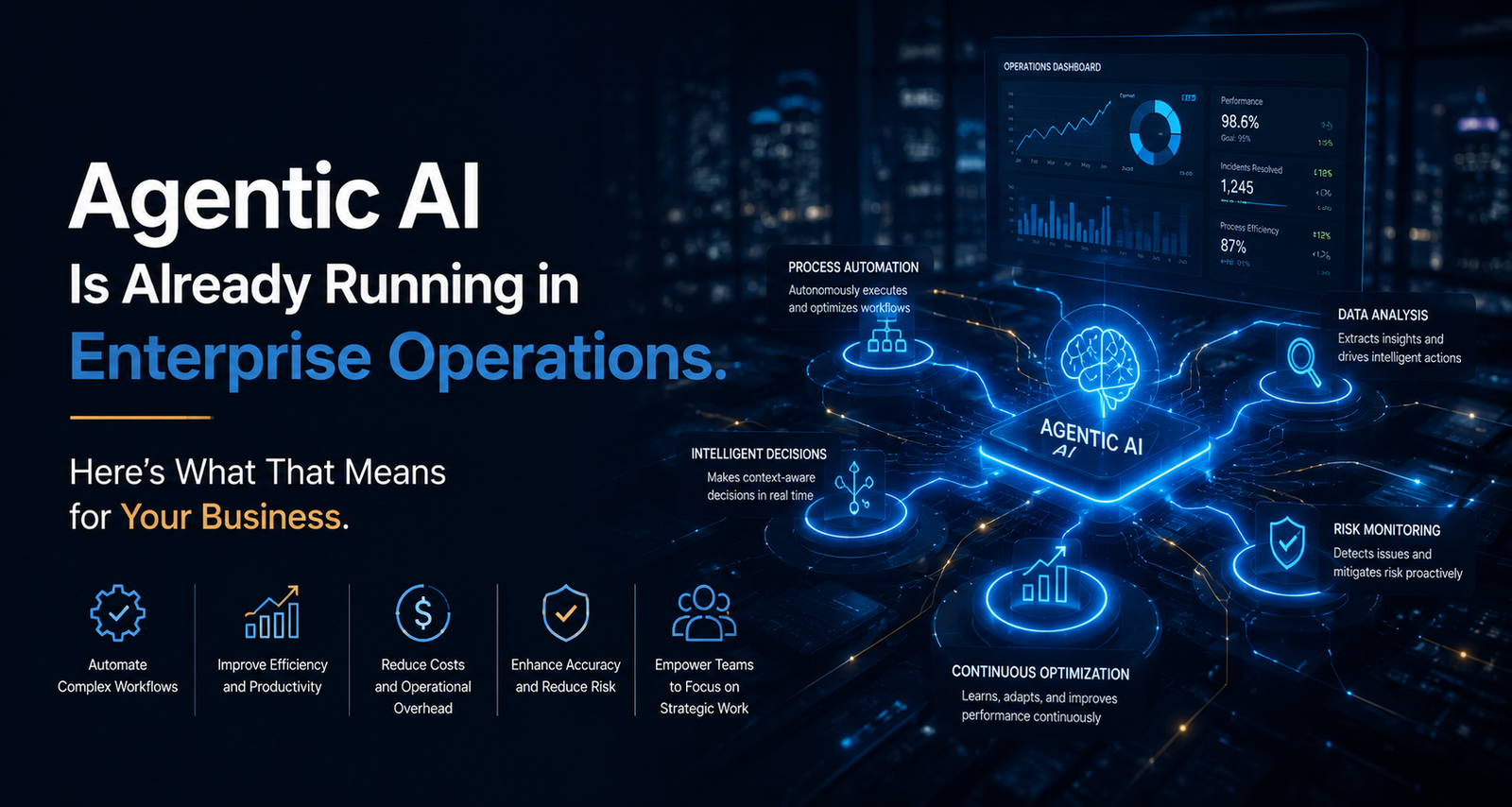
Most businesses are still thinking about AI as a tool you prompt. You type a question, it gives you an answer, and someone on your team decides what to do next. That model is already becoming outdated.
What’s replacing it is agentic AI: systems that don’t wait for instructions. They perceive a situation, reason through it, act across multiple platforms, and update their approach based on what happens. The difference sounds subtle until you see it in practice. One is a calculator. The other is a capable colleague working a parallel shift.
We work with enterprises and growing businesses across industries where operational efficiency isn’t optional. What we’re seeing in 2026 is that the companies pulling ahead aren’t necessarily the ones with the biggest AI budgets. They’re the ones that figured out which workflows to automate first and gave those systems the right boundaries to operate within. Learn more about how Innosaber approaches this through our AI/ML solutions.
What Makes an AI Agent Different
Standard generative AI responds to prompts. Agentic AI pursues goals. That single distinction changes everything about how you deploy it and what you can reasonably expect from it.
An agent doesn’t just draft a report when you ask. It monitors a data stream, notices an anomaly, cross-references three internal systems, flags the relevant finance team, drafts the incident summary, and logs the decision trail, without anyone needing to initiate the sequence. The human role shifts from doing to reviewing.
Gartner’s latest numbers put this in context: less than 5% of enterprise applications embedded task-specific AI agents in 2025. By the end of 2026, that figure is forecast to reach 40%. That’s not gradual adoption. That’s a structural shift happening inside a single calendar year.
The technology stack making this possible combines large language models as the reasoning layer with APIs that let agents take action across real business systems. CRM updates, ERP triggers, cloud storage, customer-facing messaging, internal ticketing — agents can move across all of it if the architecture is set up correctly.
Where Businesses Are Seeing Real Returns
The deployments generating the clearest ROI right now share a common trait: they’re narrow. Not AI doing everything, but AI doing one specific thing extremely well.
Customer service is the most mature use case. Enterprises running conversational agents for first-line support are seeing resolution rates that would require significantly larger human teams to match. One bank in Latin America saw a 17% increase in freed employee capacity and cut lead times by 22% after deploying agents across its customer service and fraud detection workflows.
In healthcare administration, a clinical AI assistant tested across 50 providers cut documentation time by 42%, saving roughly 66 minutes per provider per day. That time went back into patient care.
For businesses running complex supply chains, agents are handling demand signal monitoring, inventory reorder triggers, and exception escalation without waiting for weekly reports. The decision loop shrinks from days to minutes. These aren’t pilot projects anymore. They’re production systems.
The Deployment Gap Nobody Talks About
Here’s the number that actually tells the story of where most businesses stand right now: 79% of enterprises report adopting AI agents in some form. Only 11% are running them in production.
That 68-point gap is the real challenge. And Gartner estimates that more than 40% of agentic AI projects started in 2025 and 2026 will be cancelled before reaching any meaningful scale, not because the technology failed, but because the business case was unclear before the build started.
The pattern behind failed implementations isn’t usually a technical one. It’s the absence of a well-scoped use case, insufficient data infrastructure, or governance that nobody thought through until something went wrong. IDC assesses that only 21% of enterprises currently meet the readiness criteria needed for agentic AI to deliver expected value.
This is exactly where we see the most avoidable waste. Organisations spin up pilots on broad, ambitious goals and measure nothing. The companies that succeed do the opposite: they identify one expensive, repeatable workflow, build around it, measure the result, and then expand.
What Governance Actually Means in Practice
Enterprise AI conversations spend a lot of time on governance as a compliance concept. In practice, governance for agentic systems is simpler to think about: what can the agent decide on its own, what does it need to escalate, and how do you know when it got something wrong?
Human-in-the-loop controls are not a constraint on what AI can do. They’re what makes it safe to deploy at scale. The most successful enterprise implementations aren’t the most autonomous ones. They’re the ones where the agent’s decision boundaries are clear, and the audit trail is clean.
For regulated industries, this matters even more. Finance and technology sectors lead adoption right now, largely because they have the governance infrastructure already in place. We build enterprise software and AI systems for businesses that can’t afford to get this wrong. An agent running on well-governed cloud infrastructure with proper logging and access controls is a very different risk profile from one bolted onto a legacy system with no audit capability.
Where to Begin
The question we get most often isn’t ‘what can agentic AI do?’ at this point. It’s ‘where do we start without wasting time on another proof of concept that goes nowhere?’
The answer is almost always the same: start with a workflow that’s expensive, repetitive, and currently dependent on human attention it doesn’t actually need.
Look for processes that run on structured data, follow consistent rules, and generate outcomes you can measure. Document processing, invoice handling, customer query routing, lead qualification, internal IT ticketing — these are the entry points where agentic AI consistently delivers fast, provable ROI without requiring a business to bet everything on a broad transformation project.
Our teams work across AI/ML implementation, cloud infrastructure, enterprise software, and managed services. If your operations are still relying on manual handoffs for tasks an agent could own today, start the conversation with Innosaber.
FAQ
What is agentic AI?
Agentic AI refers to autonomous systems that pursue goals independently rather than simply responding to individual prompts. They perceive inputs, reason through a plan, take action across connected systems, and update their behaviour based on outcomes.
How is agentic AI different from standard generative AI?
Standard generative AI responds when asked. Agentic AI acts on its own based on defined objectives. It can monitor systems, trigger workflows, coordinate across platforms, and escalate to humans only when needed.
What business functions benefit most from AI agents?
Customer service, fraud detection, supply chain monitoring, document processing, IT support ticketing, and lead qualification are among the highest-ROI entry points. Any function that is repetitive, rule-based, and measurable is a strong candidate.
Why do so many AI agent projects fail?
The most common cause is an unclear business case before the build starts. Overly broad scope, poor data infrastructure, and absent governance frameworks account for the majority of failed implementations. Starting narrow and measuring everything is what separates successful deployments from cancelled pilots.
How does Innosaber implement agentic AI?
We start with use case scoping: identifying workflows where the ROI case is clear and the scope is tight. From there, we architect the right solution using our AI/ML, cloud, and enterprise software capabilities, with proper governance and audit infrastructure built in from the start.
Agentic AI that delivers more than a proof of concept
Most businesses that have tried agentic AI and walked away frustrated didn’t fail because the technology didn’t work. They failed because the use case wasn’t defined tightly enough before the build started, and nobody was measuring the right things afterward.
The businesses seeing real returns in 2026 are the ones that picked one expensive, repetitive workflow, built around it properly, governed it well, and then expanded from a position of proven ROI. That discipline is harder than it sounds when the technology feels exciting and the scope keeps growing.
At Innosaber, our AI/ML and enterprise software teams work with businesses to identify the right entry point, build the right architecture, and put the governance in place that makes scaling actually possible. If you’re ready to move past the pilot stage and build something that shows up in your numbers, book a consultation and we’ll start with where you actually are.