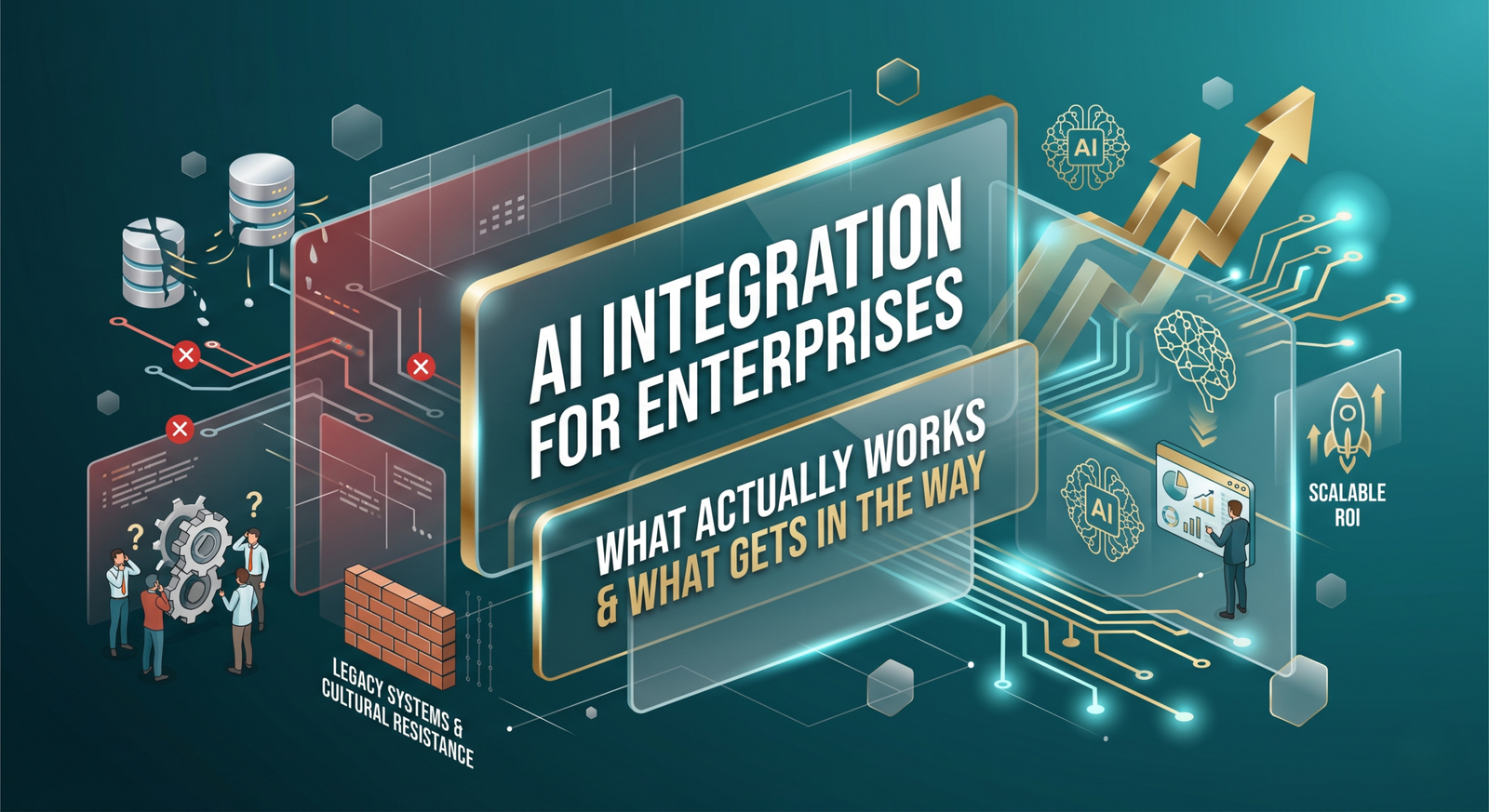
Most enterprise AI projects start with a lot of enthusiasm and end with a pilot that never made it to production.
The technology is rarely the problem. The problem is how organisations approach AI integration. What they expect from it, how they set it up, and whether the foundations are in place to make it work at scale.
This is what we’ve learned working with enterprise clients on AI integration across industries. Not the theory, but the practical side of what it takes to move from “we should be doing something with AI” to systems that are running in production and delivering measurable results.
Why Enterprise AI Integration Is Different
Consumer AI tools are one thing. You sign up, you use the product, it either helps or it doesn’t.
Enterprise AI integration is a different problem entirely. You’re dealing with existing systems, existing data, compliance requirements, internal politics, and teams who have workflows that the new system has to fit into. Or visibly improve. Otherwise, it doesn’t get adopted.
The companies that get this right are not necessarily the ones with the biggest AI budgets. They’re the ones who are clear about what problem they’re solving, honest about the state of their data, and disciplined about scope.
The companies that struggle are usually trying to do everything at once. A broad AI initiative without a specific use case, without clean data to work from, and without a plan for how the output gets used in practice.
The Business Problem: Why Startups Overbuild
There’s a pattern we see often. A founding team has an idea. They spend weeks mapping out features. By the time they sit down with a development partner, they have a 40-item backlog, three user roles, and an admin dashboard nobody will use for at least a year.
It happens because building feels productive. Every feature added feels like progress. But most of those features are assumptions, guesses about what users will need, and the only way to validate them is to ship something and watch what happens.
Overbuilding is expensive in two ways. The obvious one is cost. The less obvious one is time. Every extra feature delays your launch date, and every week you’re not in the market is a week you’re not learning.
The Foundation: Your Data Has to Be Ready
AI integration at the enterprise level lives or dies on data quality. That is not a disclaimer. It is the most important practical point in this article.
Most organisations have data. Fewer organisations have data that is clean, structured, and accessible in a way that makes AI actually useful. Years of legacy systems, inconsistent data entry, siloed databases, and undocumented schemas create a situation where the AI has nothing reliable to work with.
Before a serious AI integration project begins, the data engineering work must be done. That means understanding what data exists, where it lives, what condition it is in, and how it needs to be structured for the AI systems you are planning to build on top of it.
At Innosaber, we treat data engineering and AI integration as one continuous process. The pipeline that collects, cleans, and prepares data is part of the solution. Not a prerequisite that someone else handles before we start.
Where Enterprise AI Integration Delivers Real Value
The use cases that consistently produce results share a few characteristics. They are specific. They have clear inputs and outputs. They sit inside a workflow where the AI’s output directly influences a decision or action.
Some areas where we see consistent ROI:
Workflow automation. Repetitive processes that currently require human review are good targets. Document processing, data entry, approval routing, and exception handling. The AI does not need to be perfect. It needs to be right often enough and fast enough that the economics work. When it is uncertain, it flags for human review. That combination of automation and human oversight tends to work better than removing humans from the process entirely.
Internal knowledge and search. Large organisations accumulate enormous amounts of documentation, contracts, policies, and institutional knowledge that is effectively inaccessible because it is buried in file systems that nobody searches well. AI-powered search and retrieval can surface the right information faster, and in many cases, that alone changes how quickly people can do their jobs.
Predictive analytics. Using historical data to forecast demand, identify risk, predict maintenance needs, or surface anomalies before they become problems. This is where the combination of good data engineering and well-trained models produces the clearest business case.
Customer-facing applications. AI-driven support, personalisation, and recommendation systems. These require more careful implementation because they are visible to customers, so errors are visible too. But when done well, the impact on customer experience and operational efficiency is significant.
The Integration Challenge: Getting AI to Work with What You Already Have
One of the things that slows enterprise AI projects down is the gap between the AI system and the existing infrastructure.
Most enterprises are not starting from scratch. They have ERPs, CRMs, custom internal tools, and legacy systems that are not going anywhere. The AI integration has to connect with these.
Do not replace them.
This is where architecture decisions matter. The integration layer between AI systems and existing enterprise infrastructure has to be designed carefully. Poorly designed integrations create brittle dependencies, data sync problems, and systems that work in demos but fall apart under real-world conditions.
Our enterprise software and cloud services teams handle this integration work as part of the same engagement. We are not building an AI model in isolation and handing it over. We are building the whole system, including how it connects to what is already there.
Security and Compliance: Not an Afterthought
Enterprise AI integration involves data. Often sensitive data. Customer records, financial information, proprietary business logic.
Security and compliance have to be built into the architecture from the start. Retrofitting security onto a system that was not designed for it is expensive and unreliable. The same goes for compliance requirements, whether that is GDPR, industry-specific regulations, or internal data governance policies.
Our cybersecurity services run alongside our AI and software work. The teams building the integration and the teams responsible for security are working from the same plan, not reviewing each other’s work after the fact.
What Makes an AI Integration Project Succeed
Across the projects we have worked on, a few things consistently separate the ones that make it to production from the ones that stall.
A specific problem with a measurable outcome. “Use AI to improve operations” is not a project. “Reduce the time to process customer claims by 40% using AI-assisted document review” is a project. The specificity of the goal determines whether you can actually measure success.
Executive sponsorship with operational buy-in. AI projects driven from the top without operational support from the teams who will use the system rarely get adopted. Projects driven from within teams without leadership backing rarely get resourced properly. You need both.
A realistic timeline. Enterprise AI integration is not a six-week project. From data assessment through to production deployment, a meaningful integration typically runs three to six months, sometimes longer, depending on the complexity of existing systems. Organisations that try to compress this timeline tend to skip the data engineering and testing work that determines whether the system actually works.
An honest assessment of current data. This is the one that catches organisations off guard most often. The assumption that existing data is ready to train on or query against rarely holds up on inspection. The data work is often underestimated in scope and budget.
FAQ
Do we need to replace our existing systems to integrate AI?
No. The goal of AI integration is usually to work alongside existing systems, not replace them. The integration layer connects AI capabilities to what is already in place. That said, legacy systems with poor data quality or limited APIs can make integration more complex and may require some remediation work.
How do we know which AI use case to start with?
Start with the problem that costs the most, is most repetitive, and has the clearest inputs and outputs. The first integration should be something where success is measurable, and the business case is obvious. That builds organisational confidence and creates a template for subsequent projects.
What does the data engineering work actually involve?
Auditing existing data sources, assessing quality and completeness, designing the data pipeline that feeds the AI system, and building the infrastructure to keep that data current. The scope depends on the state of your existing data infrastructure.
How do we measure ROI on AI integration?
Measure the specific outcome that the integration was designed to affect. Processing time, error rate, cost per transaction, and customer response time. Establish a baseline before the integration goes live, then measure the same metrics after. Broad claims about AI productivity are hard to use. Specific before-and-after comparisons on a defined metric are actionable.
What is the difference between an AI pilot and a production integration?
A pilot is a controlled test, usually with a small dataset or limited user group, to validate that the approach works. A production integration runs at scale, connects to live systems, and is maintained ongoing. Many organisations run a successful pilot and then underestimate the work required to go from pilot to production. The architecture, security, monitoring, and change management requirements are substantially larger.
AI Integration That Actually Ships
Enterprise AI integration is not just a technology project. It is a systems problem that involves data, infrastructure, security, and the humans who have to use the output every day. At Innosaber, we approach AI integration as a full-stack engagement, from data engineering through to deployment and ongoing support. We work with enterprise teams to identify the right use cases, build the right foundations, and deliver integrations that run in production, not just in demos. If your organisation is planning an AI initiative and wants a development partner with real enterprise delivery experience, book a consultation, and let’s start with the problem you are actually trying to solve.