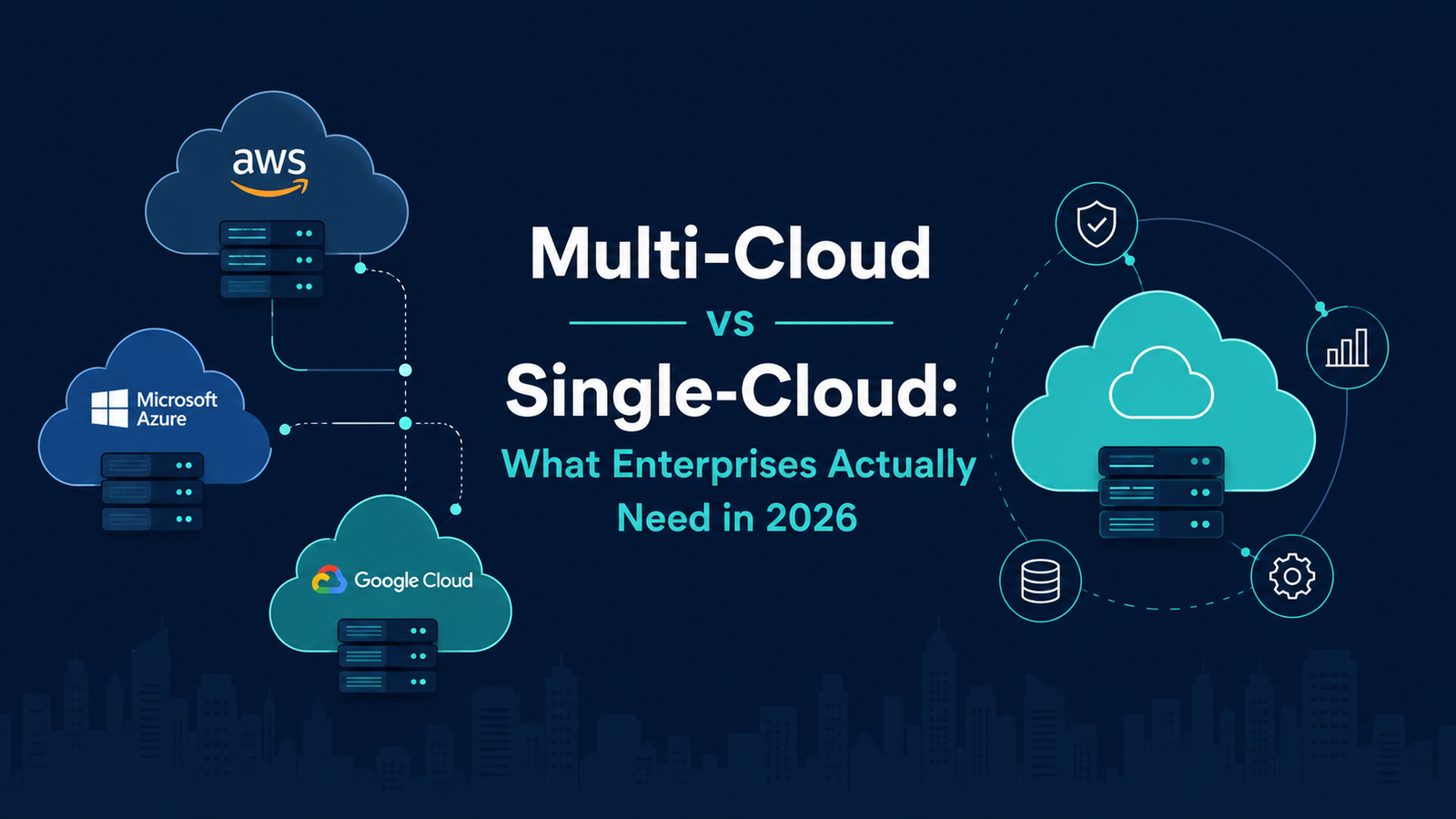
TL;DR: Multi-cloud vs single-cloud is not a one-size-fits-all decision. Most enterprises in 2026 get better results from a deliberately scoped single-cloud or dual-cloud setup than from spreading workloads across three or more providers without a clear reason for each one.
Multi-cloud strategy has been marketed for years as the safe, forward-looking default for enterprise cloud services, promising better resilience, no vendor lock-in, and leverage in pricing negotiations. In practice, many organizations that adopted multi-cloud without a specific reason ended up with higher operating costs, duplicated tooling, and a smaller pool of engineers who understand the whole environment.
That does not mean single-cloud is automatically the right answer either. The real question for 2026 is not which strategy sounds more sophisticated; it is which one matches the organization’s actual resilience requirements, regulatory footprint, and engineering capacity. Getting that match wrong is an expensive mistake in either direction.
The Real Cost of Multi-Cloud Without a Clear Reason
Running workloads across AWS, Azure, and Google Cloud simultaneously means maintaining separate expertise, separate security tooling, and separate cost management practices for each platform. Teams that adopt multi-cloud for its own sake often find that the complexity tax outweighs any theoretical benefit, especially at mid-market scale where engineering headcount is limited.
The organizations that get genuine value from multi-cloud usually have a specific driver: regulatory requirements that mandate data residency across regions no single provider covers well, a merger that inherited two cloud estates, or a genuine need to avoid dependence on one vendor for a mission-critical, revenue-generating service.
When Single-Cloud Is Actually the Stronger Choice
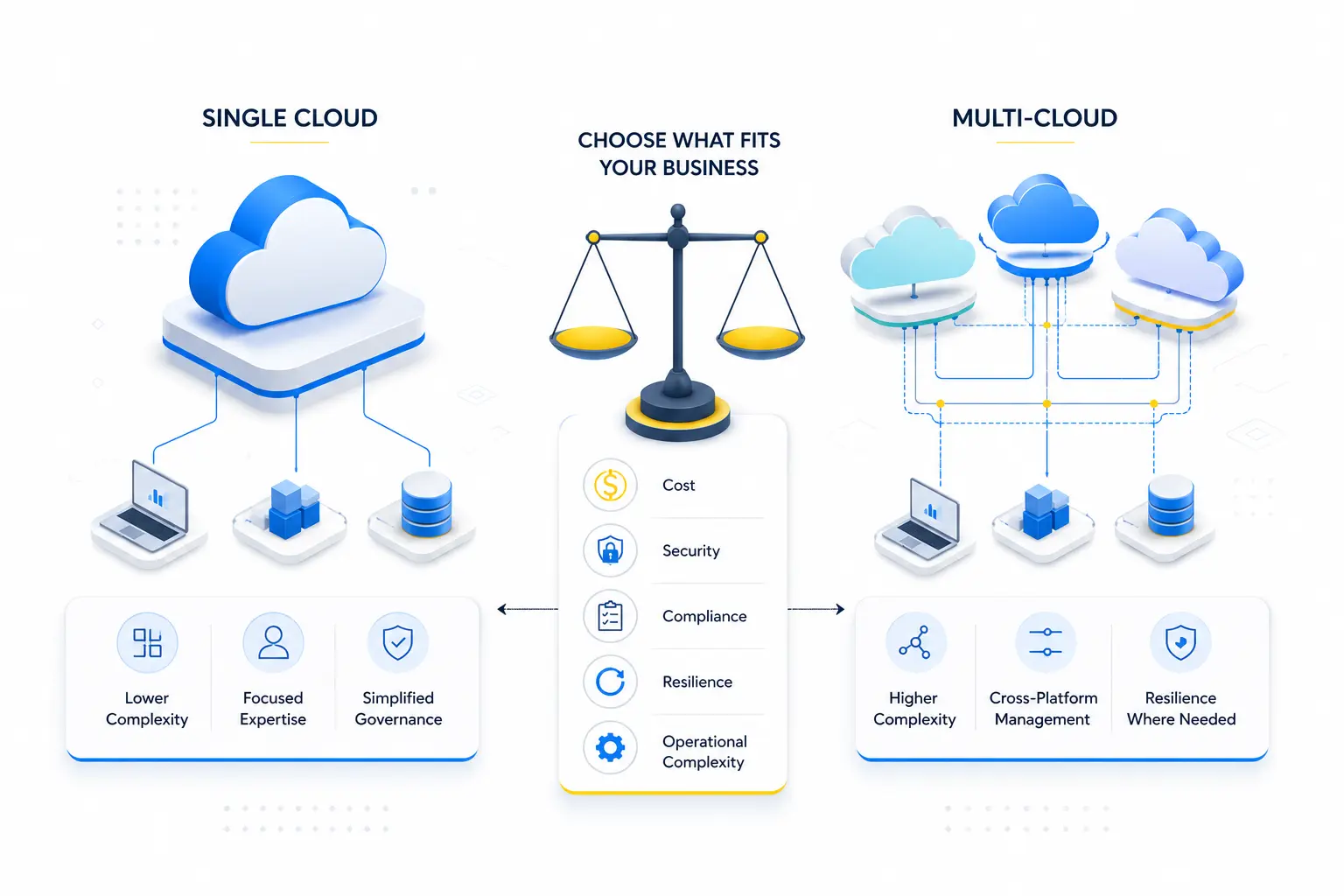
For most mid-size enterprises, a well-architected single-cloud environment delivers better reliability in practice than a poorly managed multi-cloud one, simply because the team can build deep expertise in one provider’s tools, security model, and failure modes instead of spreading that knowledge thin across three.
Single-cloud also simplifies compliance audits, cost optimization, and incident response, since there is one control plane and one set of logs to reason about instead of stitching together visibility across providers during an outage.
Where Multi-Cloud Earns Its Complexity
Multi-cloud makes sense when the business case is specific and measurable: running disaster recovery in a second provider for a system where downtime carries regulatory or financial penalties, meeting data sovereignty rules that require infrastructure in a region only one provider serves well, or isolating a specific high-risk workload from the blast radius of the primary environment.
In these cases, the complexity is a deliberate trade for resilience or compliance, not a default. Enterprises considering this path benefit from an experienced cloud services partner who can scope exactly which workloads need the second provider, rather than migrating everything out of caution.
Security and Governance Look Different at Each Scale
Whichever path an enterprise takes, its cybersecurity posture has to be designed for the actual environment rather than assumed. Single-cloud setups need strong identity governance and network segmentation within one provider. Multi-cloud setups need consistent policy enforcement across providers with genuinely different security models, which is where inconsistent implementation quietly creates the gaps attackers look for.
This is also where a lot of well-intentioned multi-cloud strategies fail in practice: teams replicate policies conceptually across providers without verifying that the actual controls behave the same way, and the difference only surfaces during an incident.
How Innosaber Helps Enterprises Choose the Right Cloud Strategy
Innosaber’s cloud services team starts every engagement by mapping actual resilience, compliance, and cost requirements before recommending a cloud strategy, rather than defaulting to whatever is currently fashionable. That approach has included work like supporting cloud infrastructure modernization for a major European stock exchange, where reliability, security, and compliance requirements shaped every architecture decision.
We also help teams that need extra resource augmentation during a cloud transition, so the migration does not stall because of limited internal capacity. If your organization is weighing multi-cloud against single-cloud for 2026, talk to Innosaber before committing to either path.
FAQ
Is multi-cloud always more resilient than single-cloud?
Not automatically. Resilience depends on how well each environment is architected and monitored. A poorly managed multi-cloud setup can be less reliable than a well-run single-cloud one, since complexity itself introduces new failure points.
What is the biggest hidden cost of multi-cloud adoption?
Duplicated tooling, duplicated security processes, and the engineering time needed to maintain deep expertise across multiple providers instead of one. These costs rarely show up in the initial business case.
How do we know if our business actually needs multi-cloud?
Look for a specific driver such as regulatory data residency requirements, a genuine need to isolate a mission-critical workload, or an inherited multi-cloud estate from a merger. Without one of these, single-cloud usually serves better.
Can we move from single-cloud to multi-cloud later?
Yes, and this is often the more practical path. Starting with a well-architected single-cloud environment and adding a second provider only when a specific need arises tends to be more cost-effective than starting multi-cloud and rationalizing down. Innosaber can help scope that transition either direction.
Match the Cloud Strategy to the Business, Not the Trend
Multi-cloud and single-cloud are both valid strategies, but only one of them is likely to be right for your specific resilience needs, compliance footprint, and engineering capacity. Choosing based on which sounds more advanced, rather than which fits, is how enterprises end up paying for complexity they never needed.
The organizations getting real value from either approach in 2026 are the ones that scoped the decision against actual requirements first, then built the architecture and governance to match.
Innosaber helps enterprises make that call with a clear-eyed view of cost, risk, and operational reality. Contact Innosaber to scope the right cloud strategy for where your business is headed.