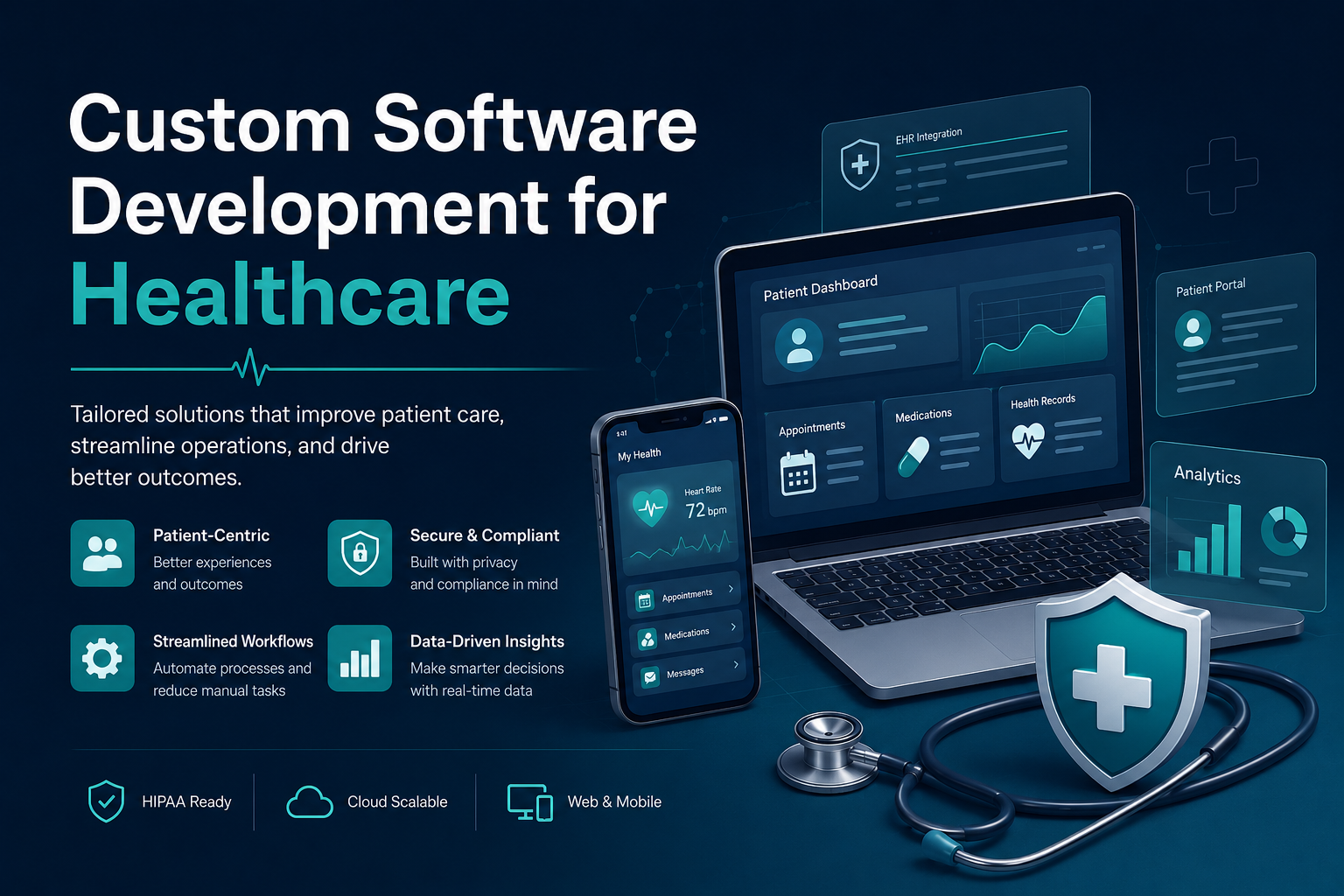
TL;DR: Custom software development for healthcare succeeds when it is built around compliance, interoperability, and clinical workflow from the first design sprint, not bolted on afterward. Off-the-shelf platforms rarely fit patient care processes cleanly, which is why purpose-built systems remain the safer long-term investment for hospitals, clinics, and health-tech companies.
Healthcare technology carries a weight that most other industries do not have to think about: a bug in a patient management system is not just an inconvenience; it can delay treatment or expose sensitive medical records. That is why custom software development for healthcare looks different from that in other industries. Every decision, from database schema to UI layout, has to account for compliance, clinical accuracy, and system uptime at once.
Off-the-shelf electronic health record and practice management platforms cover the basics, but they rarely fit a provider’s actual workflow without expensive customization, and even then they often remain locked into a single vendor’s roadmap. For hospitals, clinics, diagnostic labs, and health-tech startups building a differentiated product, purpose-built software is usually the more sustainable path.
Why Generic Platforms Fall Short in Clinical Settings
Generic EHR and practice management tools are designed to serve thousands of different practices at once, which means they optimize for the average workflow rather than any specific one. Clinics with unusual patient intake processes, specialty diagnostics, or multi-location coordination needs end up working around the software instead of the software working for them.
Custom builds remove that friction by starting from the actual clinical and administrative workflow, then designing the system around it. The result is fewer manual workarounds, fewer data entry errors, and staff who spend more time with patients and less time fighting the interface.
Compliance and Data Security Are Non-Negotiable Foundations
Regulations like HIPAA in the US, GDPR in Europe, and local data protection laws elsewhere set a high bar for how patient data is stored, transmitted, and audited. This cannot be a feature added near launch. It has to shape the architecture from day one, which is why cybersecurity planning belongs in the same sprint as the first database design decisions, not after a security review flags problems.
That means encrypted storage and transmission by default, granular role-based access control, full audit logging of who accessed what and when, and a breach response plan that has actually been tested rather than just documented.
Interoperability: Making Systems That Actually Talk to Each Other
A healthcare system rarely operates alone. It needs to exchange data with lab systems, imaging platforms, insurance clearinghouses, and other providers, typically through standards like HL7 and FHIR. Custom software built without interoperability in mind becomes an isolated island that staff have to bridge manually with spreadsheets and phone calls.
Designing for interoperability from the start, with clean API contracts and standards-based data exchange, is what allows a new system to plug into a hospital’s existing ecosystem instead of requiring that ecosystem to change around it.
Designing for the People Who Use It Under Pressure
Clinical staff use software while managing patients, often under time pressure, and interface mistakes in that context have real consequences. UX/UI design for healthcare software has to prioritize clarity and error prevention over visual novelty: clear confirmation steps for medication orders, unambiguous patient identification, and layouts that reduce the chance of selecting the wrong record.
Good healthcare UX is judged less by how impressive it looks in a pitch deck and more by how few mistakes a tired nurse makes at 2 a.m. using it for the hundredth time that week.
Building for Uptime, Scale, and Long-Term Maintenance
Patient-facing systems cannot go down during business hours, which puts real weight on cloud infrastructure choices, redundancy planning, and monitoring. A healthcare platform also needs to keep working as patient volume grows and as new regulations or integrations get added over the years, which is why the initial enterprise software development architecture matters as much as the first release.
Innosaber has applied this approach in practice, including building an end-to-end diabetes patient management platform that helped a healthcare provider track and follow up with patients more reliably than their previous manual process allowed. Projects like this reinforce a simple lesson: healthcare software has to be engineered for the long run, not just the launch date.
If your organization needs a healthcare platform built around compliance, interoperability, and real clinical workflow, talk to Innosaber about a custom build.
FAQ
Why choose custom healthcare software over an EHR?
Customizing a generic EHR can work for standard practices, but it often hits a ceiling once workflow needs, integrations, or patient volume grow beyond what the platform was designed for. Custom software removes that ceiling by design.
How long does custom healthcare software development take?
Timelines vary with scope and integration complexity, but a well-scoped clinical system usually moves through discovery, compliance architecture, and phased development rather than a single big-bang launch, which allows earlier modules to go live while later ones are still being built.
Is custom healthcare software more expensive?
Upfront cost is often higher, but total cost of ownership frequently favors custom builds once licensing fees, workaround labor, and forced upgrades on someone else’s roadmap are factored in over several years.
How is patient data kept secure in a custom-built system?
Through encryption in transit and at rest, role-based access control, full audit logging, and compliance-driven architecture from the first design decision, which is core to how Innosaber approaches every healthcare engagement.
Healthcare Software Built Around Patients, Not Around a Template
Healthcare software carries higher stakes than most other categories of enterprise technology, and it shows in every layer of a well-built system: compliance baked into the architecture, interoperability designed in from the start, and interfaces built for people working under real pressure.
Generic platforms will always serve the average case. Custom software is what lets a hospital, clinic, or health-tech company build around its actual patients and actual workflow instead of working around someone else’s assumptions.
Innosaber has built healthcare systems that hold up under real clinical use. Contact Innosaber to talk through what a custom build could look like for your organization.